

The Berlin Wall was not built to keep people out. It was built on the night of 12 to 13 August 1961 by the East German government to stop its own population from leaving, after an estimated 3.5 million people had crossed to the West between 1949 and 1961. The official name the GDR gave it was the Anti-Fascist Protection Rampart. The framing did not convince anyone, but the structure worked: in the twenty-eight years it stood, the number of successful escapes dropped dramatically compared to the years before its construction.
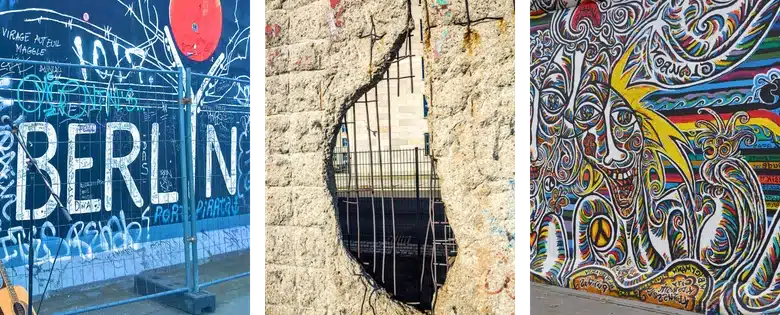
What most people picture when they think of the Wall is a single barrier, but the actual system was more complex. The inner-city sections that are most visited today were part of a broader border installation that included a second parallel wall, a no-man’s-land known as the death strip, watchtowers, searchlights, tripwires, and vehicle traps. The total length of the border around West Berlin ran to around 155 kilometres. The short stretches that survive today, including the East Side Gallery and the documentation centre on Bernauer Strasse, represent a fraction of what once divided the city.
The Wall fell on 9 November 1989, not as a result of a planned decision but because of a miscommunication at a press conference. Günter Schabowski, a GDR spokesman, announced new travel regulations and, when asked when they would take effect, replied “immediately, without delay.” He had not been fully briefed. Within hours, crowds gathered at checkpoints across the city and the guards, without clear orders, eventually stepped aside. Most of the physical structure was demolished within months, which is why so little of it remains and why the city has had to mark its former path with a double row of cobblestones running through streets, pavements, and intersections across central Berlin.
Tips For Visiting Berlin Wall
1. Choose The Right Berlin Wall Site
What many visitors call “the Berlin Wall” is actually spread across several places in the city. The longest preserved section with murals is the East Side Gallery, while the most historically detailed memorial area is the Berlin Wall Memorial on Bernauer Strasse. If you want context rather than just photos, Bernauer Strasse usually gives a clearer understanding of how the border system worked.
2. Learn The Difference Between The Wall And The Border
The barrier was never just a single concrete slab. In many places it formed a layered border system with outer walls, watchtowers, floodlights, patrol roads, and the so-called death strip in between. Knowing this before you visit helps the surviving fragments make more sense, especially at memorial sections where the open space can otherwise look deceptively simple.
3. Use Bernauer Strasse For Historical Context
Bernauer Strasse is one of the most important stretches because the border cut directly through the street and separated buildings from the pavement outside them. Residents famously escaped from windows before those openings were bricked up, and a preserved section now shows the scale of the fortifications. It is one of the best places to understand the human consequences of division rather than only its symbolism.
4. At East Side Gallery, Look Beyond The Murals
The painted wall panels are famous, but this site also tells a story about what happened after 1989. The remaining wall here is part of the inner wall that stood along the River Spree, and its transformation into an open-air gallery reflects Berlin’s effort to reclaim a space once built for control. It is worth pausing to notice where restored paintings sit alongside weathered concrete and newer interventions.
5. Treat Checkpoint Charlie As A Symbolic Stop
Checkpoint Charlie is one of the best-known Cold War sites, but the reconstructed guardhouse can give a simplified impression of the original crossing. It matters because it was the main checkpoint for foreigners, diplomats, and Allied personnel, and because of the 1961 tank standoff nearby. Visit it as part of a wider route rather than as the only Berlin Wall location on your list.
6. Look For Ground Markers Across The City
Even where the wall itself is gone, a double line of cobblestones often marks its former path through Berlin. Following these traces helps you understand how the border once cut through ordinary neighborhoods, parks, and streets that now feel seamlessly connected. It is one of the clearest ways to see how recent reunification really is in urban terms.
7. Give The Site The Right Pace
This is one of those places where rushing between photo points can flatten the experience. Memorial texts, preserved segments, and empty border spaces work together, and the quieter details often explain more than the headline landmarks. If you want stronger orientation before or after your visit, a free tour of Berlin can help place the wall within the wider history of the city.
History And Cultural Significance Of The Berlin Wall
The Berlin Wall was erected on 13 August 1961 by the East German government to stop movement from East Berlin to West Berlin, at a time when large numbers of people had been leaving the German Democratic Republic through the city. Over time, it developed into a heavily fortified border system extending for roughly 155 kilometers around West Berlin, not just a single wall through the center. Watchtowers, anti-vehicle trenches, patrol roads, and controlled crossing points turned the urban border into one of the most visible front lines of the Cold War. After border crossings opened on 9 November 1989, the wall quickly became both a physical ruin and a global symbol of the end of divided Europe. For more background on the city’s past, it also helps to read related articles such as the best things to do in Berlin.
