

Hong Kong is a city built on steep slopes, reclaimed shoreline, and political layers that still show in the street names, ferry piers, and old public housing blocks. A guided tour of Hong Kong with dim sum lunch covers that layering in 3 hours: a local guide walks you from the Mid-Levels Escalator through Lascar Row’s antique stalls, local markets and a spice factory, with an egg tart tasting along the way and a dim sum lunch to close. It starts at the Hang Seng Bank headquarters and works as a first-morning orientation before you spend the rest of the day exploring on your own.
Under the glass towers, you are never far from traces of the port city that grew between Victoria Harbour, granite hills, Cantonese traditions, and the long shadow of British rule. These 10 plans show different sides of Hong Kong, from working-class history to harbour views, hillside walks, local rituals and public spaces.
1. Walk the Tsim Sha Tsui Promenade
This waterfront walk gives you the clearest read on how Hong Kong faces itself across Victoria Harbour. The promenade runs along the Kowloon side, where shipping, rail, and colonial trade once converged, and today it still works as a public front row to the city’s skyline. One detail many visitors miss is that this stretch stands on land shaped by repeated reclamation, so the shoreline you see is not the original edge of Kowloon.
Go in the late afternoon if you want softer light and a better chance of watching the harbour change from workday traffic to evening glow. Spend time looking past the skyline itself: ferries, tugboats, and barges still tell the real story here. Bring water and expect crowds near sunset, especially around the Avenue of Stars end.
2. Ride the Star Ferry Across Victoria Harbour
The Star Ferry has been crossing the harbour since the late 19th century, and it remains one of the few daily experiences in Hong Kong that still feels tied to the city’s marine past rather than its finance-brand image. A single ride costs just a few Hong Kong dollars. The company’s founder, Dorabjee Naorojee Mithaiwala, was a Parsi businessman, which says a lot about how international colonial Hong Kong was long before the airport hub era.
Take the upper deck if you want a slightly better angle over the railings and more room to sit. Evening is the most photogenic time, but an early morning crossing shows the harbour as commuters use it. Have an Octopus card ready if you want the quickest boarding process.
3. Climb Victoria Peak via Lugard Road
What makes Lugard Road stand out is not just the harbour view but the fact that it follows one of the old residential promenades laid out when the Peak was reserved for the colony’s wealthier European residents under racial zoning practices that shaped Hong Kong for decades. That social history is still built into the district’s road pattern, old retaining walls, and former mansion plots.
Head there early in the morning for cooler weather and fewer people blocking the viewpoints. Follow the circular walk and stop at the western outlooks, where the city gives way to container terminals and outlying islands rather than the standard skyline angle. Wild boars are more plausible than monkeys in Hong Kong’s greener edges, but either way, keep food packed away and do not feed animals.
4. Explore Tai Kwun
This former Central Police Station compound combines a magistracy, prison blocks, and parade ground in one site, which makes it one of the clearest windows into how colonial law and order worked in Hong Kong. A less obvious detail is that many prisoners here were not violent offenders but people caught in the web of migration control, gambling laws, and petty street regulation that defined everyday urban governance. Entry is free, though some special exhibitions may charge separately.
Arrive in the late morning so you can move between the courtyards, cell blocks, and heritage displays before the after-work crowd arrives. Read the bilingual panels in the prison yard and look at the narrow sightlines between buildings, which were designed for surveillance as much as circulation. Check the day’s schedule online, since talks and performances are sometimes held in the open spaces.
5. Browse the Hong Kong Museum of History
The museum is worth your time because it explains Hong Kong as more than a skyline, moving from prehistoric settlement to fishing villages, wartime occupation, industrial growth, and the handover era. One of its strongest points is how seriously it treats the Japanese occupation from 1941 to 1945, a period that still sits uneasily in family memory but often gets skimmed over by short-term visitors. Check current admission policy before you go, since some permanent displays may be free on selected arrangements.
Set aside at least two hours, especially if the social history galleries are open in full. Start with the sections on boat people, village life, and postwar manufacturing, since they give context for neighbourhoods you will see elsewhere in the city.
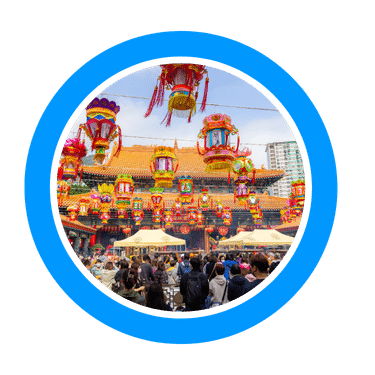
6. Watch the Ritual at Wong Tai Sin Temple
Wong Tai Sin is not a decorative stop to tick off between shopping malls. It is one of the clearest places in Hong Kong to see how religion still operates in public life, with Taoist worship, incense offering, and fortune seeking happening in plain view. The temple rose to prominence after the Sik Sik Yuen organization opened it to the public in 1934, and its reputation for granting requests made it especially important for working families during uncertain decades of migration and resettlement.
Visit in the morning when regular worshippers are active and the courtyard feels purposeful rather than performative. The best-known custom here is kau cim, where worshippers shake a bamboo cylinder until one numbered stick falls out for interpretation, but it is worth watching the quieter routines too: offerings placed carefully, incense counted, names murmured under the breath. Dress modestly and avoid stepping into someone else’s prayer space for a photo.
7. Cross the Streets of Mong Kok
If you want polished Hong Kong, go elsewhere. Mong Kok is the city in its less flattering and more truthful form: compressed, noisy, commercial, improvised. The district sits on land that was once more peripheral than its current fame suggests, and its later build-up followed the logic of tenement housing, small workshops, and relentless subdivision. That is why the area still feels like a machine for turning every square metre into rent, trade, or storage.
Come in the early evening and walk with a bit of discipline. Start around Sai Yeung Choi Street South, cut across to Fa Yuen Street, then continue toward the older market grid near Nelson Street and Dundas Street. Look up as often as you look ahead. You will catch scraps of old tong lau facades above signboards, metal window cages, and narrow balconies that survived redevelopment by accident more than by policy. This is the place to study how Hong Kong actually uses buildings, not how it advertises them.
8. Hike Dragon’s Back
Dragon’s Back is one of the easiest ways to understand how quickly Hong Kong flips from dense city to open ridge. The trail runs along the back of Shek O Peak and passes through country park land, part of a conservation system created in the 1970s after years of concern over quarrying, squatting, and uncontrolled hillside development. That protected landscape is one reason Hong Kong feels so physically constrained. The city did not simply run out of space. It also chose, unevenly but decisively, to keep large areas undeveloped.
Start in the morning, especially outside winter, because there is little shade on exposed sections. Walk at a steady pace and stop at the ridge viewpoints where you can see Shek O, Big Wave Bay, and the broken curve of the southeastern coast. Wear proper shoes, since loose dirt and humidity make the descent more slippery than it first appears.
9. Step Into Man Mo Temple
Man Mo Temple is one of the oldest and most historically loaded religious sites on Hong Kong Island. Built in the mid-19th century and dedicated to the gods of literature and war, it served not only for worship but also as a place where local disputes could be mediated before formal colonial legal structures became dominant. The giant hanging incense coils are what people photograph, but the temple’s deeper story is tied to the early Chinese elite of Sheung Wan and their role in negotiating power under British rule.
Drop in during a quieter weekday hour if you want to avoid crowding at the entrance. Stand back for a minute so your eyes adjust to the dim interior, then look at the carved wood, ceramic figures, and old plaques rather than rushing through. Smoke can be heavy, so this is not the best stop for anyone sensitive to incense.
10. Walk from Central to Sheung Wan
This may be the best way to understand Hong Kong without joining a formal tour. Start around Statue Square or the Court of Final Appeal, then move past HSBC, St John’s Cathedral, Queen’s Road Central, the Mid-Levels Escalator, Graham Street Market, Hollywood Road and Man Mo Temple. In less than two hours, the route takes you through colonial law, global banking, land pressure, street markets, Taoist worship and the older Chinese commercial streets that still shape this part of Hong Kong Island.
The key is to walk slowly and read the transitions. Central shows the city’s legal and financial face, with court buildings, banks and public squares packed into a few blocks. Sheung Wan feels more layered, with dried seafood shops, incense, temples, stair streets and older shopfronts surviving beside galleries and cafés. Hong Kong becomes much clearer when you see how a temple, a market, a bank tower and a colonial court can all sit within the same short walk.
Notice Hong Kong in the Ferry Piers and Old Slopes
What stays with you in Hong Kong is often not the skyline but the evidence of negotiation: a temple spared by redevelopment, a promenade built on reclaimed land, a ferry route still surviving under pressure from tunnels and rail lines, a hillside road laid out for one class and inherited by everyone else. That is the city’s real texture. The granite never quite disappears, and neither does the harbour, even where concrete tries to overrule both.
If the city catches your attention, it will probably be for the same reason it did at the start: street names, piers, retaining walls, and housing blocks keep giving away older versions of Hong Kong. Follow those clues and the place stops looking like a clean financial surface. It starts reading like what it is: a port city that has spent generations arguing with its own terrain.