


Santorini tomatoes are so small mainly because the island’s local tomato ecotype developed under deliberate water stress in a harsh dry-farming environment with very little rain, strong winds, alkaline volcanic ground, and almost no irrigation water. That combination does not favor big, watery fruit. It favors tomatoes with concentrated sugars and soluble solids, and that is why the island’s famous Tomataki Santorinis stays notably small. The clearest place to see how this small tomato shaped the island is the Santorini tomato museum in Vlychada, a former paste factory where the visit ends with a tasting of the paste still made there.
The museum occupies the former D. Nomikos factory on the Vlychada seafront and is reached by bus or taxi from Fira, the island’s main town, which you can get to know first on a free walking tour of Fira. Visits include an audio tour, a film screening, and a tasting of tomato paste.
The explanation is more precise than the simple idea that “volcanic soil makes everything tiny.” Volcanic soil matters, but not on its own. Santorini’s tomato size comes from the interaction of local genetics, poor alkaline soil with sodium, lack of fertilizer, scarce water, and a cultivation system built around aridity. The pumice-rich ground also plays a specific role: it absorbs atmospheric moisture at night and releases it gradually during the day, giving the plant just enough support to survive while still keeping it under stress.
That balance shaped a crop unlike standard mainland tomatoes. The fruit averages about 30 grams, the production season on the island lasts only 20 to 25 days, and yields are extremely low compared with inland Greece. In practical terms, this is why Santorini’s tomato became prized less for size than for intensity, especially in paste and preserved forms that suit the island’s food culture.
A single ingredient like this can be reason enough to visit. GetYourGuide calls the trend Biteseeing, and its research found that 57% of travelers would travel for a single ingredient.
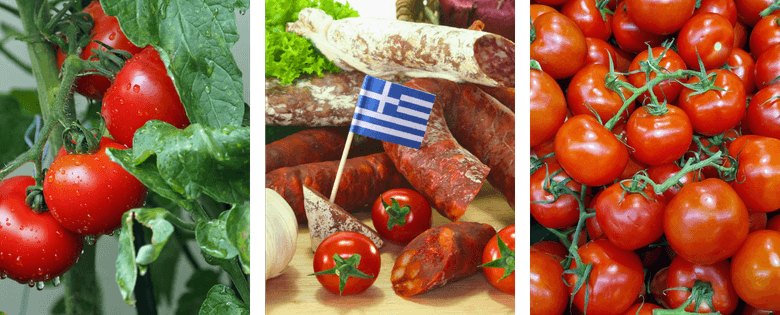
How The Tomato Became A Santorini Crop
The earliest reliable evidence for tomato cultivation on Santorini dates to the 1870s, and the first official documentary record appears in 1899 in a flora and agricultural report. This places the crop firmly in the late nineteenth century, not in an earlier legendary period that sometimes appears in tourism retellings.
At first, tomatoes were not the island’s main agricultural priority. The turning point came after the October Revolution disrupted Santorini’s wine sales to Russia. Growers then moved more systematically into tomato cultivation, and local newspaper reports from 1919 and 1920 described the crop spreading across the island.
By 1922, income from tomato-growing was five times higher than income from wine-growing. By 1928, tomato purée production had reached about 1,300 tonnes, and by 1933 processing had become one of Santorini’s two main agricultural income sources. Over roughly fifty years, the local stock adapted further to island conditions, while traditional seed selection and cultivation methods became established.
Why Small Size Is Part Of The Advantage
The small size is not a defect of poor growing conditions. It is part of the product’s defining character. The plants grow with very little available water, in poor alkaline volcanic soil made of pumice and lava, and under strong northerly winds. In those conditions, energy goes into concentrated flesh rather than expansion into large, watery fruit.
The island’s pumice-rich soil is especially important because it traps night-time atmospheric moisture and releases it gradually by day. That does not create lush growth. Instead, it moderates extreme dryness just enough for the plant to function while remaining under stress. The result is a tomato that stays small but develops high sugars and soluble solids.
The scale of this difference shows up clearly in production. Santorini yields are around 500 kilos per stremma, compared with about 10 tonnes per stremma for outdoor inland tomatoes. This is also why the fruit became closely tied to products such as paste and local preserves, themes you also meet in Santorini’s traditional food.
Myths And Half-Truths
A common claim says a Capuchin friar first sowed tomato seed on Santorini at the beginning of the nineteenth century. That story belongs to local lore, but the firmer documented timeline begins with cultivation confirmed from the 1870s and a documentary record in 1899. The friar tale is best treated as unconfirmed rather than established history.
Another shortcut is to say the tomatoes are small simply because they are cherry tomatoes. That misses the crucial point. Authenticity does not rest on generic size alone. It rests on a distinct local ecotype, together with Santorini’s environment and traditional cultivation methods.
It is also too simple to say that sea mist or volcanic ash alone explains everything. The accepted explanation is a bundle of factors working together: local genetics, arid farming, scarce water, poor alkaline soil, sodium, little fertilizer, and pumice that captures atmospheric moisture. Researchers have also found both a clear genetic difference between authentic Tomataki Santorinis and other domestic tomato varieties and a strong environmental effect, since the same plant material developed its full characteristics only in Santorini’s own conditions.
Where You Can See The Story Today
The clearest place-specific stop is the Tomato Industrial Museum “D. Nomikos” in Vlychada on the south coast. The museum occupies the old D. Nomikos factory, a site transformed into a museum in 2014. The factory itself operated from 1945 to 1981, linking the present-day visit directly to the period when processing shaped the island economy.
Inside, you can see processing machinery dating from 1890, factory manuscripts, tools, and labels, along with interpretation of traditional cultivation and processing. The museum stands on Vlychada beach among dramatic volcanic rock formations, so the surrounding landscape is part of the explanation. You are not just looking at old equipment. You are also looking at the terrain that made this kind of agriculture necessary.
Beyond the museum, the tomato still appears across Santorini’s local gastronomy, especially in paste and spoon-sweet form.
Frequently Asked Questions
Are Santorini Tomatoes Naturally Small Or Made Small By Farming?
Both factors matter. A distinct local ecotype is part of the answer, but its defining characteristics depend on Santorini’s dry-farming conditions and traditional cultivation.
How Small Are Santorini Tomatoes?
The fruit averages about 30 grams, making it far smaller than standard large slicing tomatoes.
Did Volcanic Soil Alone Make The Tomatoes Small?
No. Volcanic soil is only one part of the explanation, alongside water scarcity, wind, poor alkaline ground, little fertilizer, and a locally adapted tomato stock.
When Did Tomatoes Become Important On Santorini?
They became economically central in the early twentieth century, especially after disruption to wine exports pushed growers toward tomato cultivation.
Why Are Santorini Tomato Yields So Low?
The plants are grown under extreme dry conditions with almost no irrigation, so output is far lower than inland Greek tomato production.
Where Is The Best Place To Learn About Them On The Island?
The Tomato Industrial Museum “D. Nomikos” in Vlychada is the most concrete place to see the machinery, documents, and processing history tied to Santorini’s small-fruited tomato.
