

Guided tour
Santorini Guided Tour
8.7 Fabulous · 1,073 reviews (as of Nov 2026) Free cancellation
Choose your date
Civitatis displays availability and confirms bookings on its own site.
Santorini’s wine exists because of hardship: strong Aegean winds and volcanic soil forced growers to train vines into low basket shapes called kouloura, a method still used on the island. That same volcanic landscape also explains why viewpoints here feel so abrupt, with villages and vineyards set above a flooded caldera. In one late-afternoon route, you move between an inland settlement, a monastery outlook, a winery and the island’s best-known sunset stop.
The guided tour lasts 5 hours and includes pickup and drop-off at your hotel or a nearby point in Santorini. You travel by minibus through Megalochori, the viewpoint of Profitis Ilias Monastery, viewpoints over Pyrgos, Santo Wines winery and Oia, ending with sunset in the Oia area before returning to your pickup point. The activity also includes a tasting of 3 local wines.
An English-speaking guide accompanies the tour throughout. If you want to keep exploring afterwards on foot, Santorini also has a free tour in English that works well as a separate way to understand the island’s town streets at a slower pace.
What You Will See on the Santorini Guided Tour
Megalochori Neighborhood
Megalochori is one of Santorini’s long-established inland villages, with cave houses, neoclassical mansions and narrow lanes shaped by both wealth from trade and the need for shade. Its bell towers and enclosed courtyards reflect a settlement pattern that grew before mass tourism, when village life centred on wine production and local churches.
Profitis Ilias Monastery Viewpoint
The Monastery of Profitis Ilias stands on the island’s highest mountain, at about 567 metres above sea level. Founded in the early 18th century, it became an important religious and cultural centre, and the viewpoint near it gives wide views across Santorini’s caldera side, vineyards and inland villages.
Views of Pyrgos
Pyrgos was once the island’s capital and is still arranged around the remains of a Venetian-period kasteli, or fortified settlement. From the road and viewpoints nearby, you can clearly see how the village rises in layers up the hill, a defensive layout typical of medieval Aegean communities exposed to pirate raids.
Santo Wines Winery
Santo Wines is one of the island’s best-known wine stops, set on the caldera side with a direct view over the volcanic basin. Here you taste 3 local wines, a practical introduction to how Assyrtiko and other island varieties respond to Santorini’s dry climate, porous soil and basket-trained vines.
Oia
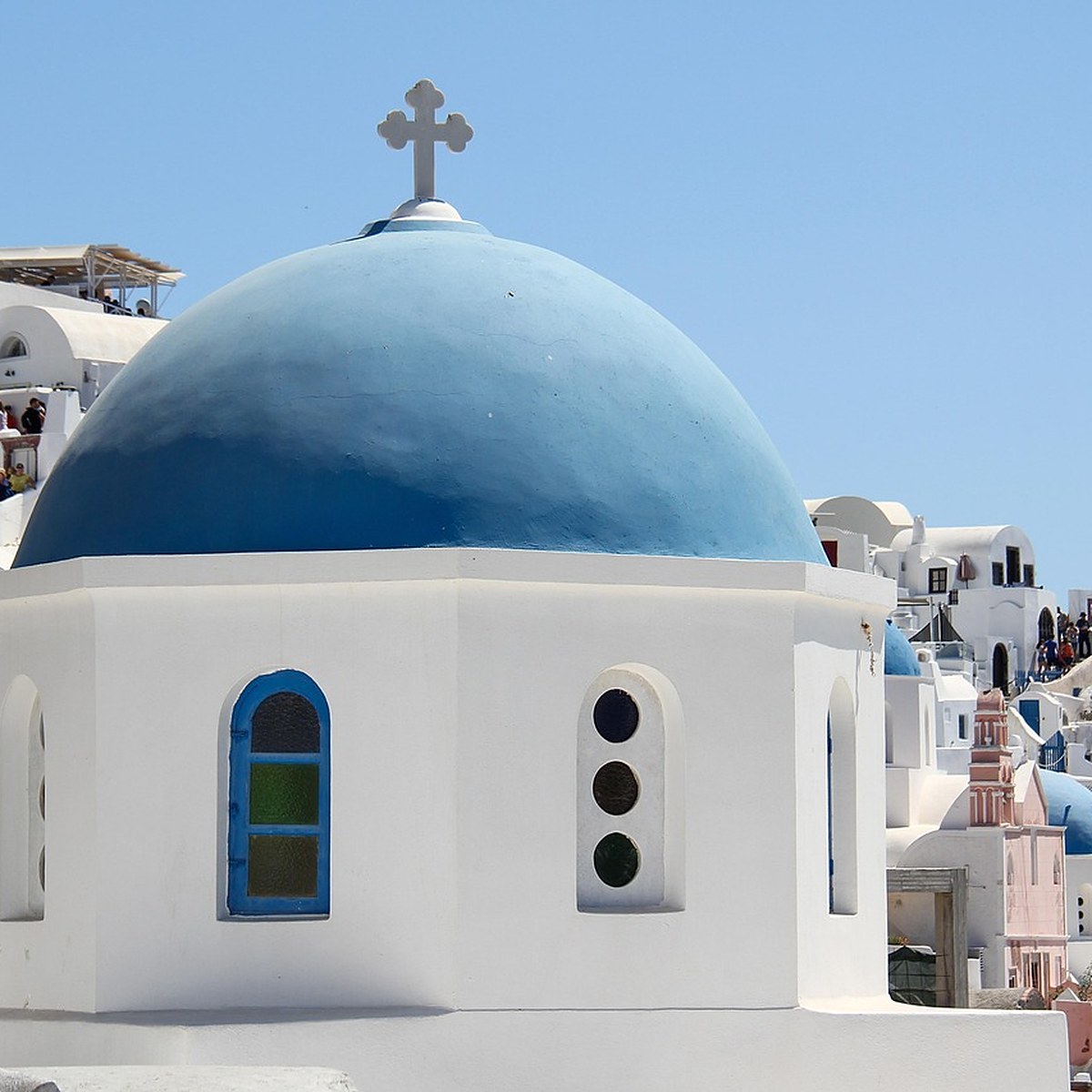
Oia sits on the northern tip of Santorini and developed as a maritime settlement, with captains’ houses and cave dwellings cut into the cliff. Its whitewashed lanes and blue-domed churches are the result of Cycladic building traditions adapted to the island’s steep volcanic edge.
Sunset in the Oia Area
The final stop is timed for sunset, when the light drops across the western side of Oia and the sea below. From this part of the island, you see the sun sink toward the open Aegean rather than into the caldera, which is one reason Oia became Santorini’s classic evening viewpoint.
Tips to Enjoy the Santorini Guided Tour
✔️ Keep the period before your pickup free if possible. Traffic often slows on the road north toward Oia in the hour before sunset, and this 5-hour route is planned around reaching the final stop at the right light.
✔️ At Santo Wines, try the 3 wines in the order poured instead of starting with the sweetest glass first. Assyrtiko usually shows high acidity and a dry finish, so tasting in sequence makes the contrast between Santorini’s dry and sweeter styles much clearer.
✔️ If you want cleaner photos, save your widest shots for the Profitis Ilias viewpoint and the final stop in Oia rather than using most of your time in the lanes of Megalochori. The monastery area gives the broadest island panorama, while Oia is the strongest stop for evening light.
✔️ Bring a light layer specifically for the monastery viewpoint and the sunset section. Profitis Ilias sits at about 567 metres above sea level, and Oia can feel noticeably cooler after sunset than inland stops such as Megalochori.
✔️ Families should note one firm rule before booking: children under 2 are not permitted on this activity. For older children, a 5-hour minibus route is usually easier to manage than a full-day island circuit with longer gaps between stops.
✔️ If you are staying in a cave hotel or on a pedestrian lane in Fira, Oia or Imerovigli, ask your accommodation earlier in the day where vehicles usually stop for pickups. In Santorini, many hotels are reached by steps or narrow lanes, so the minibus may use a nearby road pickup point rather than the hotel entrance.
What Else to See in Santorini
Akrotiri Archaeological Site
Akrotiri is the island’s major Bronze Age site, buried by the volcanic eruption in the late 17th century BC. Multi-storey buildings, drainage systems and wall paintings make it one of the clearest ways to understand Santorini before the caldera took its present form. It is on the southern side of the island near modern Akrotiri village.
Ancient Thera
Ancient Thera sits on Mesa Vouno, the ridge between Kamari and Perissa, and preserves remains from the Hellenistic, Roman and Byzantine periods. Its temples, theatre and street grid show a very different chapter of the island’s history from the villages seen on this route. The hilltop setting also gives a very different perspective from caldera viewpoints such as Oia or Santo Wines.
Museum of Prehistoric Thera
In Fira, this museum displays finds from Akrotiri, including pottery, furniture and the well-known wall paintings of saffron gatherers and blue monkeys. It gives useful context for the volcanic history that shaped the landscapes seen from Profitis Ilias and Oia, and it works particularly well before or after a village-and-viewpoint tour.
The Best of Santorini
What stands out most on this route is how tightly Santorini’s villages, vineyards and viewpoints are linked to the volcano. The same eruption that transformed the island into a caldera also left the dry, mineral-rich ground that still defines local wine and farming.
The food that fits this tour best is the food shaped by the same landscape. Look for fava, Santorini’s smooth yellow split-pea purée, often served in tavernas around Pyrgos and Megalochori, and tomatokeftedes made with the island’s small, concentrated tomatoes grown in dry conditions. Both make sense after a winery stop because they are tied to the same agricultural conditions explained during the route.
If the tasting at Santo Wines leaves you curious, the strongest takeaway from this excursion is that Santorini is not only about caldera views at sunset. It is also an island where monasteries, inland villages and vine-growing methods all reflect the same constraints of wind, drought and volcanic ground.
Frequently Asked Questions
How long does the Santorini Guided Tour last?
The activity lasts 5 hours. That time covers hotel pickup or a nearby meeting point, transport by minibus, the sightseeing route, the wine tasting and the return to your hotel or pickup point.
Where does the Santorini Guided Tour start?
The tour starts with pickup at your hotel or at a nearby meeting point in Santorini. If you are staying in a pedestrian-only area or a hotel reached by steps, the pickup is usually arranged on the nearest road accessible to the minibus.
What language is the Santorini Guided Tour conducted in?
The tour is conducted in English. An English-speaking guide accompanies the activity from pickup through the sightseeing stops and wine tasting.
Is admission included in the Santorini Guided Tour?
The activity includes minibus transport, the guided sightseeing route, hotel pickup and drop-off, and a tasting of 3 local wines at Santo Wines. The description does not mention separate admission tickets for the listed stops.
Do I need to book in advance?
Booking ahead is advisable, especially because this is a timed 5-hour route that ends around sunset in Oia, one of the island’s busiest periods. If your travel dates are fixed, reserving early also makes hotel pickup arrangements easier.
Is the Santorini Guided Tour accessible for people with reduced mobility?
No, this activity is not wheelchair accessible. Several stops involve village streets, viewpoint areas and boarding a minibus, which can be difficult for travellers with reduced mobility.
Can children participate in the Santorini Guided Tour?
Yes, children can participate if they are at least 2 years old. The activity is not permitted for anyone under 2.
Is photography allowed during the Santorini Guided Tour?
Yes, photography is suitable throughout the route, especially at the Profitis Ilias viewpoint, Santo Wines and the sunset stop in the Oia area. The last section of the tour is usually the most photo-focused.
Popular Activities in Santorini
Santorini Caldera Catamaran Trip in English
Santorini Sunset Boat Cruise with Barbecue

Free Tour of Fira

Tomato Museum
