

Free walking tour
Free Tour of Bergen
Choose your date
Civitatis displays availability and confirms bookings on its own site.
One of the stranger facts about central Bergen is that Bryggen functioned as one of the Hanseatic League’s four major overseas offices even though Bergen itself was not a Hanseatic town. That tells you a lot about the city’s past: Bergen grew rich through trade, but it was never shaped by trade alone. Founded around 1070 and strengthened when the bishop’s seat moved here in 1163, it became a place where royal power, church influence and the stockfish trade all met along the same harbour.
This free walk takes in the compact heart of that story. You will see the Seafarer’s Monument on Torgallmenningen, the city-centre green space of Byparken, the old Fish Market, Bryggen and Bergenhus Fortress, with KODE and the Old Town Hall adding art and civic history along the way. These are not scattered sights across a large capital but neighbouring landmarks that show why Bergen is often easier to grasp on foot than many bigger Nordic cities.
The tour lasts 2 hours and is led in English by an English-speaking guide. It starts at the Seafarer’s Monument and finishes at Bergenhus Fortress. The English-speaking guide is included. Tipping the guide at the end is up to you.
What You’ll See on the Free Tour of Bergen
Seafarer’s Monument and Torgallmenningen
You will begin in Bergen’s main square, Torgallmenningen, the broad axis linking Torget with Ole Bulls plass. The Seafarer’s Monument stands here as a reminder that this city was built by shipping, fishing and trade across the North Atlantic. It is a fitting starting point because Bergen’s story has always been tied to the sea, from medieval merchants to the later harbour economy that shaped the centre around you.
Byparken and the Music Pavilion
Byparken is the city-centre park beside Lille Lungegårdsvann, and its Music Pavilion is such a recognisable landmark that it is used as a visual symbol of central Bergen on the city’s official weather page. In summer, the pavilion is framed by one of Bergen’s most photographed flower displays. The park also contains the Rhododendrariet, a rhododendron collection established in 1989, which adds a more botanical side to an otherwise urban route.
KODE
KODE represents a long museum tradition rather than a single building with a single story. Bergen’s museum history began in 1825, when Wilhelm F. K. Christie initiated Bergens Museum, laying the foundation for the collections associated with KODE today. Another key date is 1896, when Bergen Visual Arts Museum and the West Norway Museum of Decorative Art moved into the Permanent Exhibition Building, also called Permanenten, showing how early the city invested in art, design and public culture.
The Old Town Hall
The Old Town Hall is one of the few Renaissance buildings in Bergen, which already makes it stand out in a city often associated with timber architecture and rebuilt streets. It was built in 1558 as the private residence of the feudal lord Christoffer Valkendorf, then served as Bergen’s first town hall from 1561. Around it lies Rådstuplassen, likely paved in the same year, a square that later became a stage for public protest and once even had a pillory.
The Fish Market
Bergen’s Fish Market has existed since the 1200s and was never just a place to buy seafood. It was a meeting point for merchants, fishermen, farmers and townspeople, tying the coast and the city together for centuries. Fish were also historically sold directly from boats along the quay, so when you look across the water today, you are seeing a trading landscape that once worked on both land and sea.
Bryggen and Bergenhus Fortress
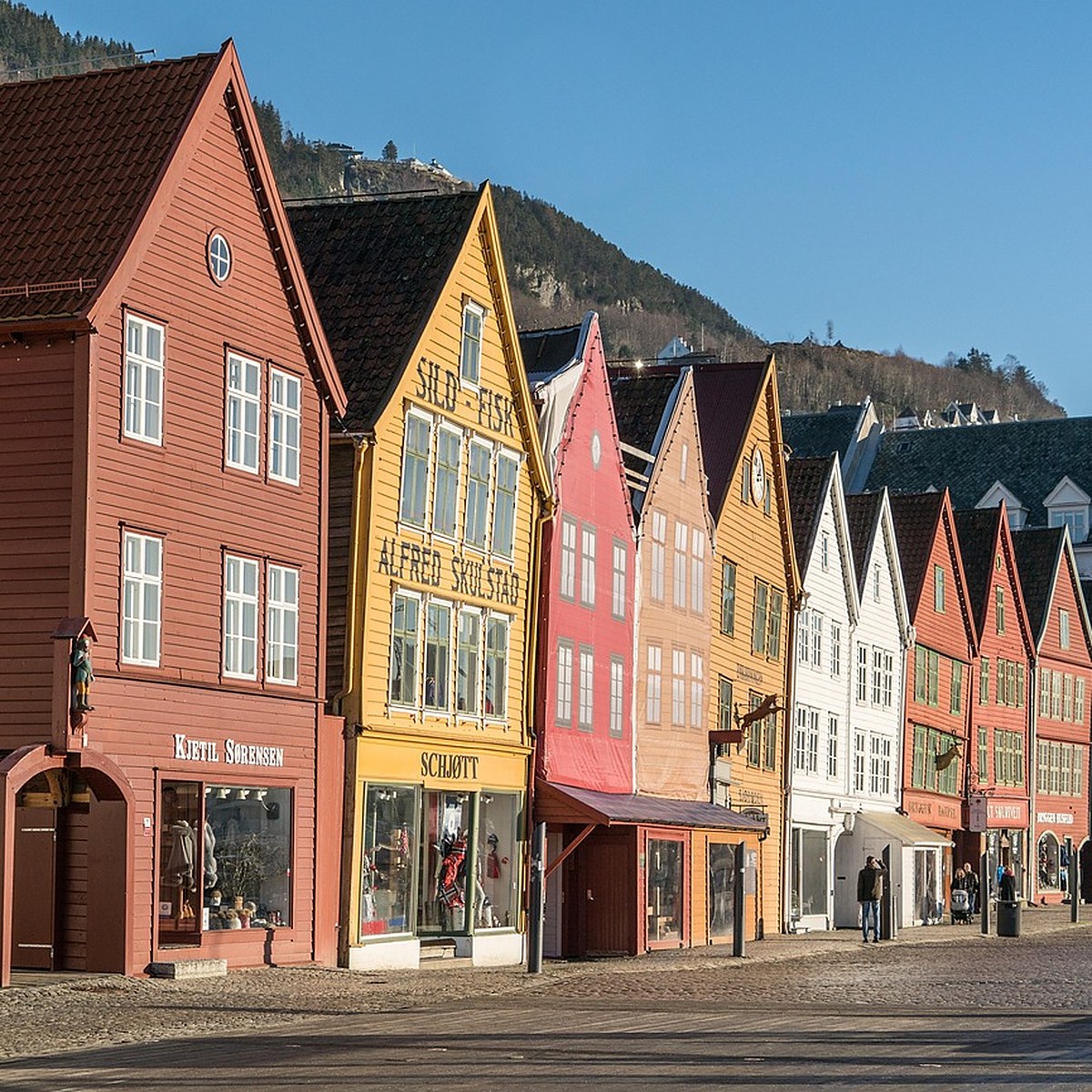
Bryggen is the best-known image of Bergen because it was central to the stockfish trade controlled by the Hanseatic League from the 1350s onward. A short distance away, Bergenhus Fortress shifts the story from merchants to kings and soldiers. Within that complex stands Håkon’s Hall, in use by 1261 for the wedding of Magnus Lagabøte, and still notable as the largest secular building from the Middle Ages still standing in Norway.
History and Curiosities of Bergen
From Royal Town to Church Centre
Bergen was founded around 1070, and later sources credit King Olav Kyrre with laying out the town. Its importance grew quickly in 1163 when the bishop’s seat moved from Selja to Bergen, strengthening both religious and political power here. If you want to understand why Bergen mattered so much in medieval Norway, that combination of monarchy, church and harbour trade is the starting point.
Fire, Law and the Shape of the Centre
A major fire in 1248 destroyed eleven churches on the east side of Vågen, a reminder of how vulnerable a timber-built port could be. In 1276, Magnus Lagabøte introduced a city law that ordered fire precautions and the laying out of allmenninger, the broad firebreak streets that still shape the centre. Torgallmenningen is part of that long story, not just a modern square but a response to the practical problem of urban fire.
The Hanseatic Office at Bryggen
In the 1350s, the Hanseatic League established an office in Bergen and gradually took control of Bryggen’s stockfish trade. The unusual thing is that Bergen itself was not a Hanseatic town, yet Bryggen operated as one of the league’s four major overseas offices. That odd status helps explain why Bryggen feels both deeply Bergen and partly separate from it, a merchant enclave tied into a trading network stretching far beyond Norway.
Old Town Hall Oddities and Håkon’s Hall Afterlife
The Old Town Hall area carries a few details many visitors miss. Rådstuplassen once had a pillory, and the square later became a site of protests, including the Strile War in 1765. Håkon’s Hall had a second life too: after its medieval role, it was used as a warehouse from about 1520 until around 1860, a practical reuse that says a lot about how old power buildings can slip into everyday urban service.
Local Life, Traditions and Food in Bergen
Festivals, Light and a City That Takes Culture Seriously
Bergen’s cultural life is not an added extra to the history. The Bergen International Festival, established in 1953, remains the city’s flagship festival for music and theatre, while KODE’s scale shows how strongly art, craft, design and music are built into local identity. In winter, Lysfesten around Lille Lungegårdsvann draws thousands for the Festival of Lights, and the Christmas season also brings Pepperkakebyen, described as the world’s largest Gingerbread City, built from citizens’ own contributions.
Everyday Bergen Around the Centre
The centre is easy to read because daily life still happens around the historic landmarks. The Fish Market remains linked to the old exchange between coast and town, while nearby Vågsbunnen mixes narrow alleyways and old wooden buildings with a present-day social life. Skostredet, in particular, is known as a pedestrian-friendly place where locals meet in cafés, bars and restaurants, and Bergenhus Fortress is used not only as a historic site but also as a cultural park and concert area. If you are looking for free things to do in Bergen after the walk, simply spending time around these central areas gives a good sense of the city without needing a packed schedule.
Traditional Food of Bergen
If the tour leaves you hungry, there are a few dishes worth knowing by name. Persetorsk is a Bergen cod dish pressed for a long time in a sugar-and-salt solution and traditionally served with egg butter, and many Bergen families have eaten it around Christmas. Skillingsbolle, made with butter, cinnamon and sugar and topped with more sugar before baking, takes its name from the old price of one Norwegian skilling and has been a local favourite for over 500 years. Bergen fish soup, fish cakes and røkerumpe also belong to the traditional food of Bergen, all tied in different ways to the city’s long seafood trade.
Tips for the Free Walking Tour of Bergen
- Bring a waterproof jacket and shoes, or carry an umbrella, because Bergen’s weather is often wet and can change quickly in any season.
- Most visitors come between May and September when conditions are milder, but the historic centre works year-round if you dress for the forecast rather than the month.
- The route is compact, so it helps to arrive a little early and use the time to get your bearings around Torgallmenningen before meeting the guide.
- Give yourself extra time after the walk for Bryggen, the Fish Market or nearby Vågsbunnen, since these neighbouring areas are easy to continue exploring on foot.
- The tour is in English, lasts 2 hours, starts at the Seafarer’s Monument and ends at Bergenhus Fortress. It is not wheelchair accessible. Pets are allowed. Groups of more than six people are not admitted, even if they book separately. If you cannot attend, cancel your reservation so the guide is not left waiting.
- If you plan to eat after the tour, this is a good part of town to look for Bergen specialities such as skillingsbolle, Bergen fish soup or fish cakes.
Frequently Asked Questions
Where does the free tour of Bergen start?
The walk starts at the Seafarer’s Monument. Check your booking confirmation before you go, as the exact meeting point can change for seasons, events or roadworks.
What does the free tour of Bergen cover?
The route includes the Seafarer’s Monument in Torgallmenningen Square, City Park, the Music Pavilion, KODE, the Old Town Hall, the Fish Market, Bryggen and Bergenhus Fortress.
How long is the free tour of Bergen?
The tour lasts 2 hours.
What language is the free tour of Bergen in?
The tour is conducted in English by an English-speaking guide.
Where does the free tour of Bergen end?
The walk finishes at Bergenhus Fortress.
What is Bergen known for?
Bergen is known for Bryggen, the former Hanseatic wharf on UNESCO’s World Heritage List, and for its historic role in the stockfish trade.
Is Bergen worth visiting?
Yes. Bergen has a compact historic centre where Bryggen, the Fish Market, KODE, Byparken and Bergenhus Fortress lie within walking distance, combining medieval, maritime and cultural history.
How many days should I stay in Bergen?
A short stay works for the historic centre because major sights such as Bryggen, the Fish Market and Bergenhus Fortress are close together, but extra time helps if you also want museums, food and mountain walks.
Popular Activities in Norway
Free Tour of Oslo
