

Free walking tour
Free Tour of Sarajevo
9.4 Exceptional · 58 reviews (as of Nov 2026) Free cancellation
Choose your date
Civitatis displays availability and confirms bookings on its own site.
One of Sarajevo’s least expected facts is how early it became an urban centre. By the mid 15th century it already had a water-supply system, earlier than many European cities, and its first cafes appeared about a century before those in Paris. In the old commercial centre, a mosque, a Catholic church, an Orthodox church and a synagogue stood within roughly 200 metres of one another. That close religious geography is not a modern slogan but part of the city’s historical fabric.
This free walking tour follows the heart of that story through Baščaršija and beyond. You will see craft streets such as Kazandziluk, where copper-working still defines the old bazaar, and key landmarks including Gazi Husrev-beg Mosque, the Clock Tower, the old Orthodox church, the Sacred Heart Cathedral, Hotel Europe and the Latin Bridge. The walk also helps you read Sarajevo’s Ottoman and Austro-Hungarian layers side by side, often within only a few minutes on foot.
The tour lasts 2 hours and is led in English by an English-speaking guide. It starts at Gazi Husrev-begova 75 and finishes back at the starting point. The tour is not wheelchair accessible. Pets are allowed. If your plans change, cancel your booking so the guide is not left waiting.
What You’ll See on the Free Tour of Sarajevo
Baščaršija Old Bazaar
You will see the historic commercial core of Sarajevo, where old street names still record the trades that once defined each lane. Kazandžiluk marks the coppersmiths, Kujundžiluk the jewellers, Kovači the blacksmiths and Mudželiti the bookbinders. Baščaršija also preserves the Ottoman division between the čaršija, the business district, and the surrounding mahalas, the residential quarters on the hillsides. More than 1,000 shops still operate here, so this is not just a preserved monument zone but a working part of the city.
Kazandziluk Street
Kazandžiluk takes its name from the coppersmiths, and you will still notice copper coffee pots, cups and engraved metalwork in the shopfronts. The street is one of the clearest signs that craft traditions remain active in Sarajevo rather than existing only in museums. Some craftsmen even decorate objects made from deactivated mines and bullets with traditional motifs, turning war debris into everyday souvenirs. It is one of the most direct places to understand how Sarajevo’s past industries still shape what you see and buy today.
Gazi Husrev-beg Mosque and the Clock Tower
You will come to one of the key sites in the making of Sarajevo’s old centre. Gazi Husrev-beg Mosque was built in 1530 and is regarded as the most monumental Ottoman-Islamic structure in the old town. Gazi Husrev-bey’s endowment also funded a bazaar, two inns, water supply, a fountain in the mosque courtyard, a public toilet and the Clock Tower, which explains why this part of Baščaršija became the city’s commercial and religious core. The tower itself belonged to the same endowment, although its exact construction date is uncertain.
Sarajevo City Hall
You will see one of the clearest statements of the Austro-Hungarian period on the riverfront. Sarajevo City Hall was built from 1892 and officially opened on 20 April 1896 as the headquarters of the city administration. Architect Alexandar Wittek designed it in Neo-Moorish style after studying buildings in Cairo, and Ćiril M. Iveković completed the project. Its scale and style show how the new administration reshaped Sarajevo after 1878 with monumental public architecture.
The Old Orthodox Church, Synagogue and Sacred Heart Cathedral
Among the strongest impressions in central Sarajevo is how closely different religious landmarks sit to one another. The Old Orthodox Church is considered one of the oldest religious monuments in the city, although its exact construction date is unclear, and its museum holds about 700 objects, including an icon collection regarded as exceptionally valuable. Nearby, the synagogue and the Sacred Heart Cathedral help show why Sarajevo is so often described through coexistence as much as architecture. Within a short walk, you can read several layers of the city’s religious and civic history at once.
The Austro-Hungarian Centre, Hotel Europe and Latin Bridge
You will also step into the part of the centre where Sarajevo’s late 19th-century rebuilding becomes most visible. Much of the town burned in 1878, and the following building phase introduced a Bosnian style that mixed central European and Islamic elements, followed later by Viennese Secession architecture. Around the cathedral, Hotel Europe and the streets leading towards Latin Bridge, you can read that change directly in the façades, proportions and urban layout. At Latin Bridge, the city’s compact scale meets world history, as the assassination of Archduke Franz Ferdinand and Sophie on 28 June 1914 triggered the diplomatic crisis that led to the First World War.
History and Curiosities of Sarajevo
From Sarai Ovasi to a Town of Many Faiths
Sarajevo’s urban history is commonly dated from 1462, when Isa-beg Ishaković began building his residence and a mosque on the site of the modern city. Under Ottoman rule in the mid 15th century, Sarai Ovasi became an administrative centre and developed into a town in the 1460s. Mosques and churches existed side by side from an early stage, which helps explain why the old centre later held a mosque, synagogue, Catholic church and Orthodox church within a very short walk. That compact religious map is still one of the city’s defining features.
The Fire of 1697 and the Rebuilding of 1878
Sarajevo was not shaped by one uninterrupted past but by destruction and rebuilding. Prince Eugene of Savoy’s soldiers disrupted the city in 1697, and the great fire that year destroyed Sarajevo’s many sebils, or public fountains. A second major turning point came in 1878, when Bosnia and Herzegovina passed under Austro-Hungarian control and parts of the city were destroyed again. The rebuilding that followed produced the hybrid townscape you can still read today, where Ottoman streets lead into central European façades within minutes.
City Hall and the New Riverfront
City Hall matters not just as an eye-catching building but as evidence of a new political era. It was planned after the Austro-Hungarian occupation and opened in 1896, signalling how the administration wanted to reshape the riverfront through grand public architecture. Its Neo-Moorish design borrowed from forms studied in Cairo while serving a modern civic function as the city administration’s headquarters. Only hours before the 1914 assassination, Franz Ferdinand and Sophie attended a reception in its Ceremonial Hall, which ties the building directly to one of the most discussed days in European history.
The Fountain Legend and Sarajevo Coffee
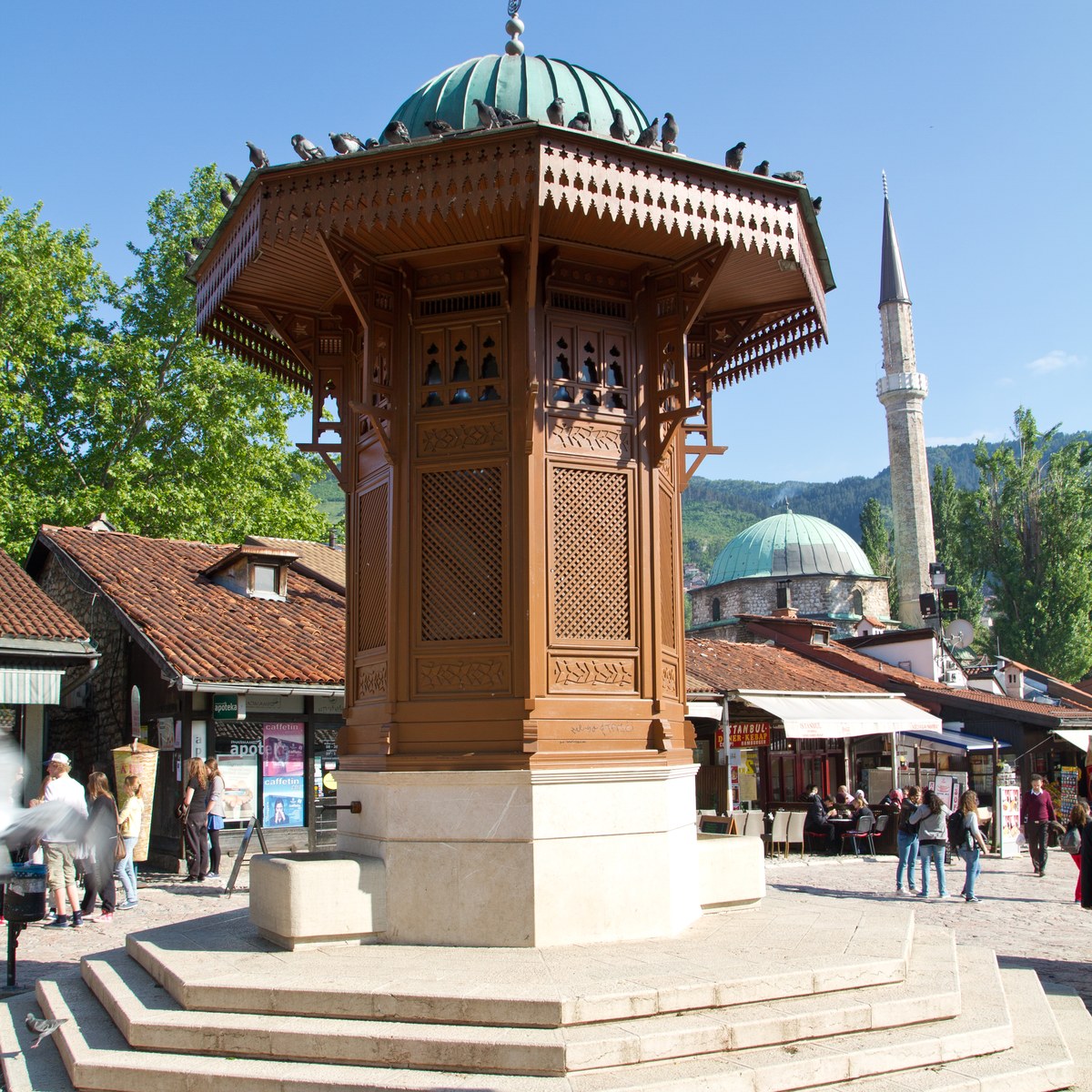
One Sarajevo legend says that anyone who drinks from the city’s public fountains will return. It is a legend rather than a provable fact, but it survives because public water and public space have long mattered here. Sarajevo had a water-supply system by the mid 15th century, unusually early by European standards, and coffeehouses became part of daily life very early too. Bosnian coffee remains central to social life, so the legend and the coffee culture fit neatly together.
Local Life, Traditions and Food in Sarajevo
The Čaršija, the Mahalas and Everyday Sarajevo
For centuries, people traditionally lived in the hillside mahalas and came down to work or trade in the čaršija. That pattern still helps you make sense of the city’s layout, with the old bazaar as the practical centre of daily movement. Baščaršija remains active rather than decorative, and its more than 1,000 shops show that it is still a working district. This is also why a short walk in central Sarajevo can reveal daily life as clearly as major monuments.
Coffee, Craft and Festival Culture
Bosnian coffee is often described as the backbone of Sarajevo’s social life, usually served with small sugar cubes and rahat lokum. In Kazandžiluk, the copper džezva and matching cups show how craft and coffee still belong together in a way that feels lived-in rather than staged. The city’s cultural calendar also matters, especially in summer when the Sarajevo Film Festival brings an international focus to South-East European cinema. It is a modern layer added to a city already used to balancing different traditions in a small centre.
Traditional Food of Sarajevo
If the walk leaves you hungry, the traditional food of Sarajevo is easy to continue exploring nearby. Sarajevo ćevapi are grilled minced meat served in somun, a soft flat roll associated with the city, while burek and other pies remain standard Baščaršija meals. Other dishes to look for include japrak, stuffed vine leaves, bosanski lonac, a Bosnian pot stew, klepe, minced-meat dumplings, and sogan dolma, stuffed onions. Bravadžiluk is one of the central streets where residents and visitors commonly go for ćevapi, pies and ašćinica dishes.
Tips for the Free Walking Tour of Sarajevo
- Wear comfortable shoes with good grip because the old centre includes stone paving and you will spend 2 hours on foot.
- Summer is a strong time to visit if you want outdoor city life and major cultural events such as the Sarajevo Film Festival, but central Sarajevo also works well for walking in a one or two day stay at other times of year.
- After the tour, stay in Baščaršija for Bosnian coffee served with sugar cubes and rahat lokum, or continue to Bravadžiluk for ćevapi, pies and other classic local dishes.
- If you want souvenirs that feel connected to the city rather than generic, Kazandziluk is the place to compare copper coffee sets, engraved cups and other metalwork tied to Sarajevo’s craft tradition.
- The tour is in English and includes an English-speaking guide. It is not wheelchair accessible, pets are allowed, and you can book up to 30 minutes in advance if there are any seats left. If you are not able to attend, cancel your reservation, otherwise the guide will be waiting for you.
Frequently Asked Questions
Where does the free tour of Sarajevo start?
The meeting point is Gazi Husrev-begova 75. Check your booking confirmation before you go, as the exact meeting point can change for seasons, events or roadworks.
Which places does the free tour of Sarajevo visit?
The tour visits or covers Gazi Husrev-begova, Kazandziluk street, Baščaršija old bazaar, Ottoman and Austro-Hungarian architecture, City Council, the old Orthodox church, Gazi Husrev-beg mosque, the Clock Tower, the synagogue, the Sacred Heart Cathedral, Hotel Europe and the Latin Bridge. It finishes back at the starting point.
How long is the free tour of Sarajevo?
The tour lasts 2 hours.
Is the free tour of Sarajevo in English?
Yes. The tour is conducted in English by an English-speaking guide.
Where does the free tour of Sarajevo finish?
The tour ends back at the starting point.
What is Sarajevo known for?
Sarajevo is known for Baščaršija, its close mix of mosque, synagogue, Catholic and Orthodox landmarks, the 1914 assassination near Latin Bridge, and the blend of Ottoman and Austro-Hungarian urban layers. Few European cities show those contrasts in such a compact centre.
Is Sarajevo worth visiting?
Yes if you want a compact old town where craft streets, religious landmarks, Austro-Hungarian public buildings and 20th-century history can be explored on foot.
How many days should I spend in Sarajevo?
One or two days works well for most visitors. A single day covers the old-town route through Baščaršija to City Hall and Latin Bridge, while a second day gives you time for museums and a slower look at the city beyond the bazaar and riverfront.
