

Guided tour
Segway Tour of Seville
9.4 Exceptional · 170 reviews (as of Nov 2026) Free cancellation
Choose your date
Civitatis displays availability and confirms bookings on its own site.
Plaza de España and much of Parque María Luisa were created for the 1929 Ibero-American Exposition, so one of Seville’s most recognisable settings is actually a 20th-century showcase rather than a medieval survival. Seeing these spaces in sequence from the old centre to the Guadalquivir helps make sense of how Seville expanded, staged its image, and tied its monuments to the river.
The route crosses parts of the historic centre and then moves out towards major landmarks including Plaza de España, Parque María Luisa, Seville University, Plaza de América, San Telmo Palace, the Golden Tower and the Guadalquivir riverfront. You can choose a 30-minute, 60-minute or 90-minute ride, and the activity includes an English-speaking guide, the Segway, a helmet and the necessary equipment.
The meeting point is Calle Álvarez Quintero 44, a central address a short walk from the Cathedral area. If you want a useful follow-up afterwards, continue on foot through the old centre, where the contrast between narrow medieval streets and the broad avenues seen on the ride becomes much clearer.
What You Will See on the Segway Tour of Seville
Ancient City Centre
The route begins through Seville’s historic core, where the street pattern still reflects the long Islamic period that shaped the city before the Castilian conquest of 1248. In this area, narrow lanes open suddenly into larger civic spaces, showing how medieval urban planning and later Christian rebuilding overlap in the centre.
Plaza de España
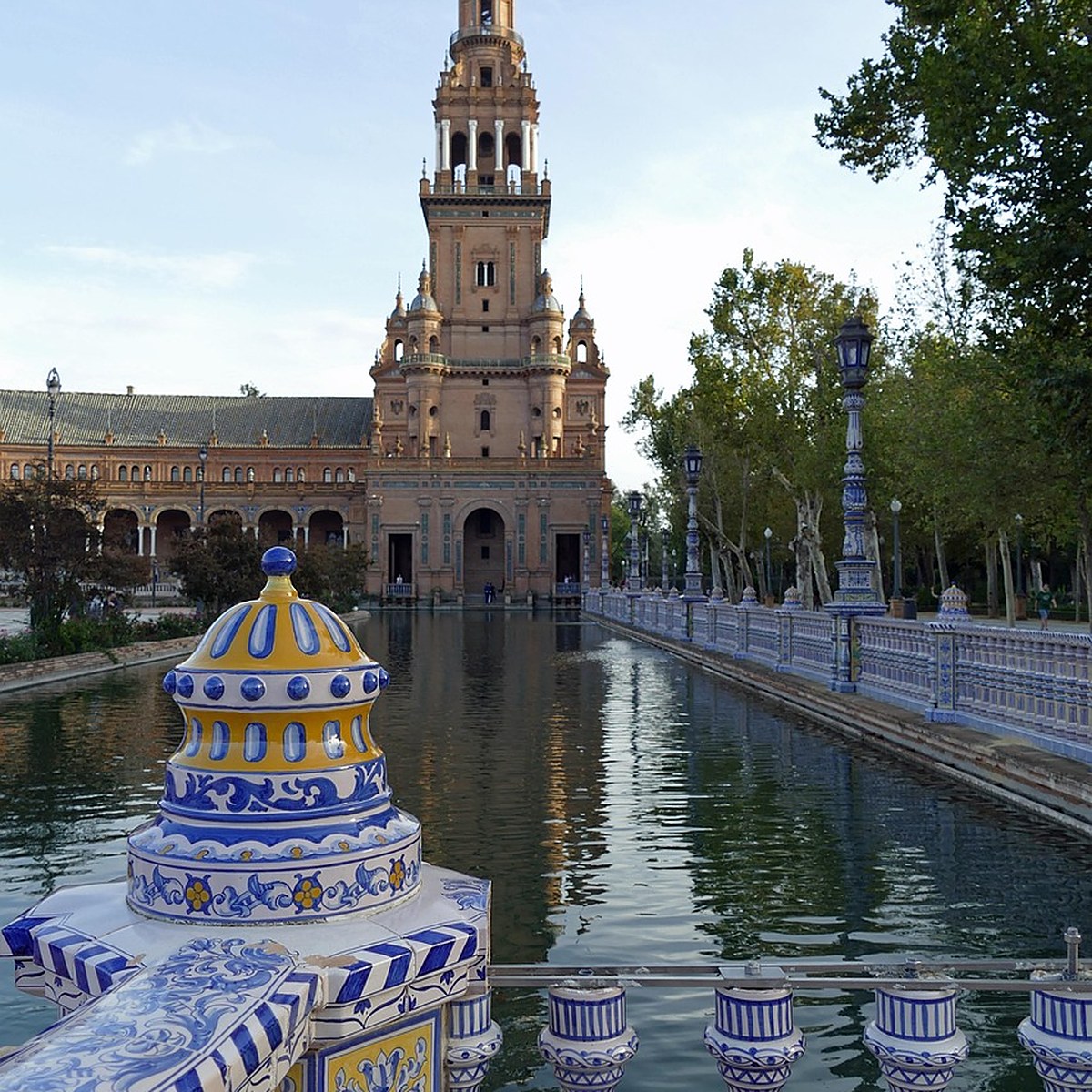
Plaza de España was designed by architect Aníbal González for the 1929 Ibero-American Exposition and completed in a monumental semi-circular form. Its brick façades, ceramic tilework and canal with four bridges were intended to symbolise the provinces of Spain and the links between the old kingdom and its former territories.
Parque María Luisa
Parque María Luisa occupies the former gardens of the Palace of San Telmo, donated to the city in the late 19th century. Its broad avenues, tiled benches, fountains and shaded paths were formalised for the 1929 exposition, turning what had been aristocratic grounds into Seville’s main public park.
Seville University and San Telmo Palace
Seville University occupies the old Royal Tobacco Factory, an 18th-century industrial complex that was one of the largest buildings of its kind in Europe. Nearby stands San Telmo Palace, begun in 1682 as a school for navigators, with a richly decorated Baroque façade that reflects Seville’s long connection to Atlantic trade and maritime training.
Plaza de América
Inside Parque María Luisa, Plaza de América groups together three major exposition buildings completed for 1929. The square is anchored by the Mudéjar Pavilion, the Fine Arts Pavilion and the Royal Pavilion, each designed with different historicist styles to showcase Spanish architecture through revival forms.
The Golden Tower and the Guadalquivir River
The Golden Tower, or Torre del Oro, dates from the 13th century and formed part of the Almohad defensive system that controlled access along the Guadalquivir. From the riverfront you can see why this stretch mattered so much: Seville’s wealth depended on navigation, customs control and the movement of goods between inland Andalusia and the Atlantic.
Tips to Enjoy the Segway Tour of Seville
✔️ Calle Álvarez Quintero 44 sits inside the old centre near the Cathedral area, where vehicle access is limited and pedestrian streets can slow you down. If you are walking in from Santa Cruz, Sierpes or El Arenal, allow time for the final approach through narrow central streets.
✔️ If your main goal is to reach Plaza de España, Plaza de América and the Guadalquivir riverfront in one ride, choose the 60-minute or 90-minute option. The 30-minute ride is better for a shorter introduction near the centre rather than a fuller sweep of the 1929 exposition area.
✔️ In summer, the most exposed parts of the route are Plaza de España, Plaza de América and the open stretches by the river, where the heat is stronger than in the shaded lanes of the old quarter. Morning or late-day departures are usually easier than the middle of the afternoon.
✔️ Children under 8 cannot take part, so families with younger children may find Parque María Luisa a practical alternative after the ride. Its wide paths, fountains and pavilions make it one of the easiest nearby areas to continue exploring on foot.
✔️ Pets are not allowed on the activity, so sort that out before heading to Calle Álvarez Quintero 44. This is especially worth planning if you are staying in nearby central areas such as Santa Cruz, El Arenal or around Calle Sierpes.
✔️ If you already know which ride length you want, book at least 9 hours in advance. Spring dates can fill faster because the route passes through some of Seville’s busiest outdoor areas, especially around Torre del Oro and María Luisa Park.
What Else to See in Seville
Real Alcázar of Seville
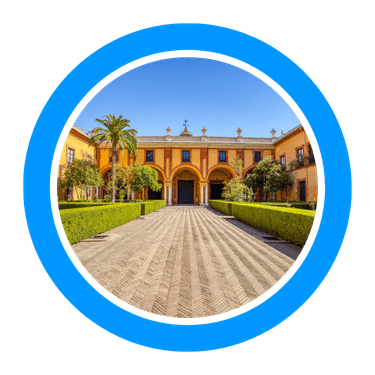
The Alcázar works especially well after this route because it deepens the Islamic and Christian history only glimpsed from the street on a Segway. The palace complex includes Mudéjar halls commissioned by Peter I in the 14th century, earlier courtyards linked to the Islamic period, and extensive gardens that show later Renaissance and Baroque changes.
Archivo General de Indias
Just beside the Cathedral, the Archivo General de Indias explains the river story introduced near the Guadalquivir and Torre del Oro. The building began in the late 16th century as the Casa Lonja de Mercaderes, a merchants’ exchange tied to Seville’s Atlantic trade, and today preserves documents linked to Spain’s administration of the Americas.
Triana
Across the Guadalquivir, Triana gives useful context for the ceramics and river identity seen on the ride. The district was long associated with pottery workshops and river trades, and its tile-making tradition helps explain the decorative language used later in places such as Plaza de España.
The Best of Seville
Seville makes the most sense when you read it as a city shaped by the river and by periods of deliberate reinvention. A Segway route brings that into focus quickly, linking the Almohad riverfront, the old centre, the former Tobacco Factory, San Telmo, and the grand exposition landscape of 1929 around María Luisa Park.
That same continuity appears in local food. After the ride, look for espinacas con garbanzos in traditional bars around the centre and Santa Cruz, a classic Sevillian dish with roots in Andalusi cooking. Another strong local choice is pringá served in a montadito, especially in older taverns in El Arenal and the streets leading towards the river, areas that connect neatly with the final part of the route near Torre del Oro.
If you still want more context afterwards, continue on foot through the historic centre to compare the tight medieval street pattern with the broad planned spaces you have just covered on the Segway.
Frequently Asked Questions
How long does the Segway Tour of Seville last?
You can choose between a 30-minute, 60-minute or 90-minute ride. Overall, the activity lasts from 30 minutes to 1 hour 30 minutes depending on the option you book.
Where does the Segway Tour of Seville start?
The meeting point is Calle Álvarez Quintero 44 in Seville. This address is in the historic centre, near the Cathedral area, so it is easy to combine with visits in Santa Cruz, El Arenal or the central shopping streets.
What language is the Segway Tour of Seville conducted in?
The tour is conducted in English. An English-speaking guide accompanies the route and the necessary equipment is included.
Is admission included in the Segway Tour of Seville?
The activity includes the guided Segway ride itself, the Segway, a helmet and all necessary equipment. It is a sightseeing route through public streets and open spaces, so it does not include entry into monuments such as the University buildings or San Telmo Palace.
Do I need to book in advance?
Yes, advance booking is recommended, especially if you want a specific 30-minute, 60-minute or 90-minute slot. You can book up to 9 hours in advance if there are still places available.
Is the Segway Tour of Seville accessible for people with reduced mobility?
No, this activity is not wheelchair accessible. Because it takes place on a Segway through city streets, squares and park routes, it may not suit travellers who need adapted, step-free sightseeing.
Can children participate in the Segway Tour of Seville?
Children under 8 are not permitted to join this activity. If you are travelling with older children, make sure everyone in your group meets the age requirement before booking.
Is photography allowed during the Segway Tour of Seville?
Yes, you can take photos during the route, and some of the clearest photo stops are Plaza de España, Plaza de América and the riverfront by Torre del Oro. It is best to take pictures during pauses rather than while the Segway is moving.
Popular Activities in Seville
Free Tour of Seville
Alcazar of Seville Tour

Seville Cathedral and Giralda Guided Tour
