

Free walking tour
Free Tour of Cork
9.3 Exceptional · 1,397 reviews (as of Nov 2026) Free cancellation
Choose your date
Civitatis displays availability and confirms bookings on its own site.
Much of central Cork exists because water was drained away. The modern street pattern sits on land reshaped in the 18th and 19th centuries, when channels around the medieval city were filled in and the old island settlement on the River Lee was enlarged. Beneath that busy centre, parts of the medieval city wall survive unusually well below ground because the city was built on estuarine marsh, even though most visible stretches were demolished as Cork expanded.
This free walking tour focuses on the historic core and several of the city’s defining religious and civic landmarks. You will take in the Cork historic centre, St. Anne’s Church, St. Mary and St. Anne’s Cathedral, Bishop Lucey Park, Saint Fin Barre’s Cathedral and Elizabeth Fort before finishing at the National Monument. It brings together medieval traces, the rebuilding that followed the 1690 siege, and the churches and public spaces that still shape daily life in the city centre.
You should set aside 2 hours for the walk. The tour meets at Cork Opera House and is led in English by an English-speaking guide. The guide is included, and tipping the guide is up to you.
What You’ll See on the Free Tour of Cork
Cork Historic Centre
You will see a city centre laid out on a central island between the north and south channels of the River Lee. That geography matters because Cork grew on estuarine islands and marshland, and much of today’s street pattern was created only after river channels around the medieval city were drained in the 18th and 19th centuries. As you walk, the compact scale becomes obvious, with bridges, narrow streets and larger commercial thoroughfares all packed into a small core. It is also a place where archaeology still matters, because the old city wall survives better below ground than above it.
St. Anne’s Church
St. Anne’s stands on the site of St. Mary’s Church, which was destroyed by fire during the Siege of Cork in 1690. The present building is regarded as one of the most important early 18th-century churches in Ireland, and it still keeps its original 18th-century bells. Visitors can ring those bells themselves, which is a rare survival of an old bell-tower tradition. When you see the church in Shandon, you are also seeing part of the district that grew through cattle and butter trading.
St. Mary and St. Anne’s Cathedral
This cathedral began in 1799 under Bishop Francis Moylan and was dedicated in 1808, placing it in the period when Cork was growing as a trading city. Fire badly damaged it in 1820, after which architect George Pain directed the refurbishment before it reopened in 1828. Those dates tell a story of resilience rather than smooth continuity. When you look at the cathedral, you are seeing a building shaped by both late 18th-century ambition and early 19th-century repair.
Bishop Lucey Park
Bishop Lucey Park offers one of the clearest reminders that medieval Cork was once walled. A portion of the old city wall survives here, giving you something solid to connect with beneath the streets. The park also sits beside the English Market and functions as a green space in the heart of the city centre rather than as a purely ceremonial site. That mix of old fortification and everyday urban use says a lot about how Cork handles its past.
Saint Fin Barre’s Cathedral
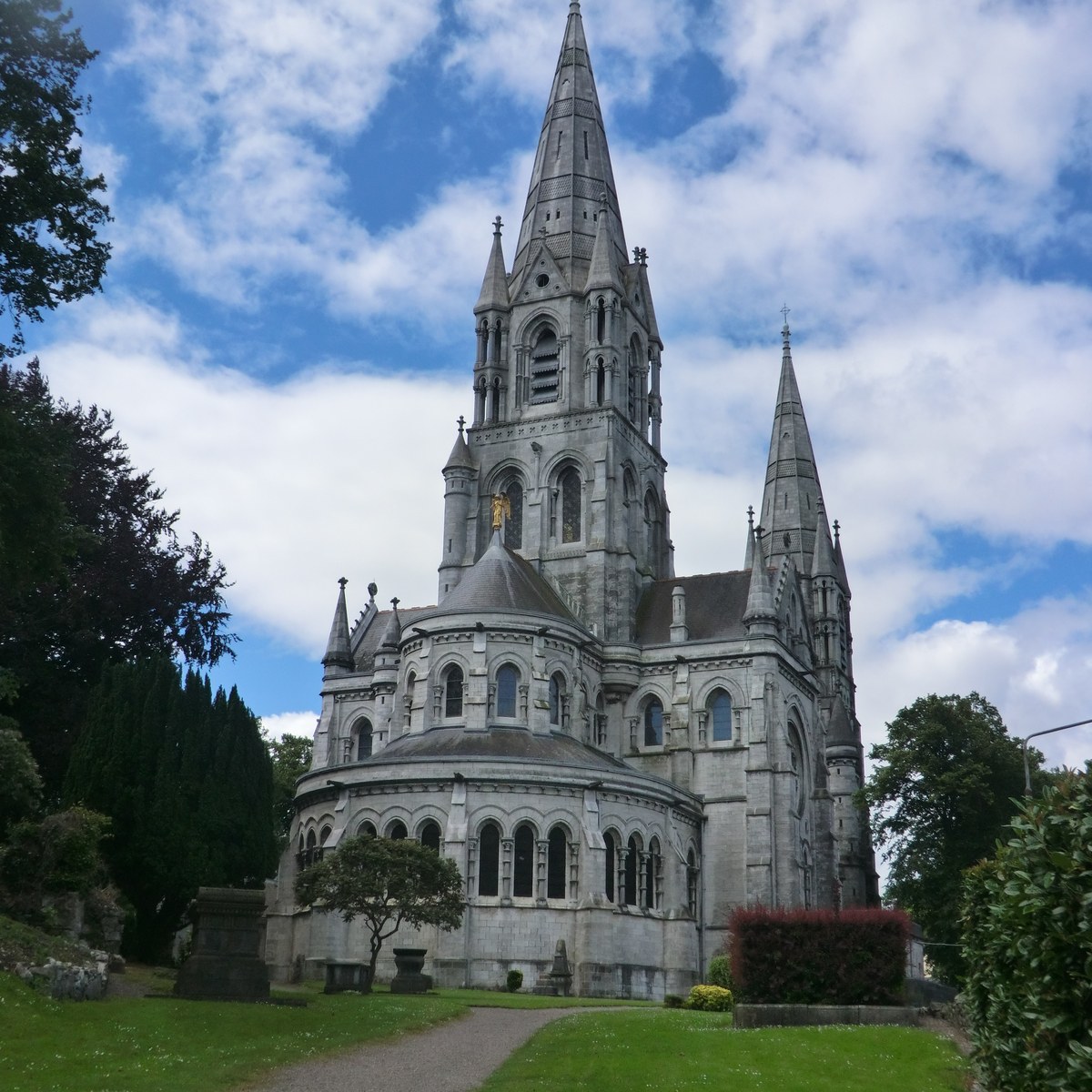
Saint Fin Barre’s Cathedral occupies a site associated with Cork’s patron saint, who founded his first church and school here. The present cathedral is the diocesan cathedral of the Church of Ireland, so it remains an active religious centre as well as a landmark. Its importance comes not only from architecture but from continuity of worship and education on the same ground. On this stop, you are looking at one of the places where Cork’s Christian story is anchored most firmly.
Elizabeth Fort
Elizabeth Fort has had more than 400 years of changing use, including military, prison, police and famine-relief roles on the same site. During the Siege of Cork in 1690, it was surrendered after about a week of bombardment, when the city wall had been breached. That episode ties the fort directly to one of the most destructive moments in Cork’s early modern history. What you notice today is not just a defensive structure but a place repeatedly adapted to the needs and pressures of different centuries.
National Monument
The walk ends at the National Monument on Grand Parade, one of the city centre’s key civic landmarks and a fitting place to finish, with the English Market and Bishop Lucey Park a few steps away.
History and Curiosities of Cork
The Marsh City Under Your Feet
Cork takes its name from a marsh landscape, which explains why the city developed differently from inland walled towns. The medieval core stood on islands in the River Lee valley, and later drainage and infill transformed those channels into buildable ground. In the 18th century, as the city expanded, the old walls fell into disrepair and were removed above ground. Yet the marsh conditions helped preserve buried remains, so one of Cork’s oddities is that its city wall is often easier to find underground than on the street.
The Siege of 1690
The Williamite war left visible marks on Cork. St. Mary’s Church, the predecessor of St. Anne’s, was destroyed by fire during the Siege of Cork in 1690, and Elizabeth Fort was surrendered when the city wall was breached after roughly a week of bombardment. That was not a local skirmish but a turning point that reshaped parts of the urban fabric. When you pass churches and fortifications on this route, you are seeing places that were directly altered by that conflict.
Trade, Warehouses and the Expanding City
In the 18th and 19th centuries, Cork became a major industrial and trading centre. The city’s growth left warehouses, malt-houses and other industrial remains that still influence the character of the modern centre, even where original uses have vanished. This is also the period that produced the stronger street network of central Cork after channels were drained and plots regularised. The result is a city where Georgian facades can sit close to narrower older lanes without that contrast feeling accidental.
The National Monument and Civic Memory
The National Monument has an interesting civic detail attached to it: it was unveiled on St Patrick’s Day rather than on a military anniversary. That choice linked the monument to a public ritual already embedded in the city calendar, not just to formal remembrance. It is a small clue to how monuments work in Cork, where history is often folded into everyday public life rather than kept separate from it. Finishing there places the tour in a civic setting as much as a historical one.
Local Life, Traditions and Food in Cork
Markets, Parks and the Compact Centre
Cork works well on foot because the city centre is compact and concentrated on the central island. Historic streets, bridges, pubs, bookshops and independent boutiques sit close together, and everyday life is visible rather than hidden away in distant districts. Bishop Lucey Park shows this well, especially with the English Market beside it, as residents use the benches and steps much as visitors do. The English Market itself is not just for visitors. It is a working market that has traded since 1788, and its Princes Street frontage dates from 1862.
Festivals and the City’s Public Culture
Cork’s calendar still makes strong use of the city itself as a backdrop. Cork Midsummer Festival is a multidisciplinary arts festival built around urban spaces, while the Cork Jazz Festival has run since 1978 and remains one of the city’s major annual events. Christmas in Cork is organised as a city-centre winter programme, which says something practical about local culture: public streets and squares are still treated as shared social space. Even outside festival dates, that civic habit shapes the atmosphere of the centre.
Butter, Spiced Beef and Local Drinks
If you want the traditional food of Cork, start with the products tied to its trading history. Butter is central to the city’s identity. The Butter Exchange was established in Shandon in 1769, and Cork butter was exported to Africa, Australia, America and England. Spiced beef, made by salting, curing and spicing beef, is another local classic linked to the old export trade, especially at Christmas. For a drink with local roots, Beamish stout goes back to a Cork brewery founded in 1792, while Tanora, the tangerine-flavoured soft drink, has been part of the city’s food culture since the 1930s.
Tips for the Free Walking Tour of Cork
- Wear comfortable shoes with good grip, because central Cork is easy to walk but includes older pavements, bridges and stretches where rain can make surfaces slick.
- Bring a light waterproof layer if the forecast looks uncertain. Cork’s compact centre is very walkable, but exposed streets and bridges can feel wetter and windier than expected.
- If you want to keep exploring after the tour, the English Market and the surrounding central streets make an easy next stop for food, people-watching and a better sense of everyday city life.
- There is no real need for a car for this walk if you are staying in or near the centre, because Cork’s core sights are close together and the city centre is compact.
- The tour lasts 2 hours, is in English, meets at Cork Opera House and ends at the National Monument. The guide is included, tips are not included, it is not wheelchair accessible, pets are not allowed, and you can book up to 12 hours in advance if there are seats left. If your plans change, cancel the booking so the guide is not left waiting.
Frequently Asked Questions
What Is the Meeting Point for the Free Tour of Cork?
The usual meeting point is Cork Opera House. Check the exact details in your booking confirmation, as the meeting point can occasionally change because of seasonal events, demonstrations, concerts or works.
What Route Does the Free Tour of Cork Follow?
The walk covers the Cork historic centre and includes St. Anne’s Church, St. Mary and St. Anne’s Cathedral, Bishop Lucey Park, Saint Fin Barre’s Cathedral, Elizabeth Fort and the National Monument. It is a route built around the city’s religious landmarks, defensive history and compact central streets.
How Much Time Should I Set Aside for the Free Tour of Cork?
Set aside 2 hours for the tour itself. It is also sensible to allow a little extra time before the start so you can reach the meeting point without rushing.
What Language Is the Free Tour of Cork in?
The tour is in English. It is led by an English-speaking guide.
What Do I Get on the Free Tour of Cork?
You get a 2-hour guided walk in English through central Cork with an English-speaking guide. The guide service is included, while tipping the guide at the end is up to you.
How Do You Get to Cork?
Cork can be reached by air through Cork Airport, by rail through Kent Station, and by coach and bus. Cork Airport is linked to the city centre and Kent Station by bus routes 225 and 226, which makes arriving without a car straightforward.
Is Cork Worth Visiting?
Yes, especially if you want a compact Irish city where you can cover major sights on foot. Cork combines medieval archaeology, 18th- and 19th-century trade history, two cathedrals, a working food market and a strong local identity without the scale of a capital city.
What Is Cork Known for?
Cork is known for its island city centre on the River Lee, the English Market, Shandon and its butter trade history. It is also known for a strong local food and drink culture and for the joking local claim that it is the real capital of Ireland.
Popular Activities in Ireland
Free Tour of Dublin
Free Tour of Galway
