

This 90-minute English-language tour meets outside the Reina Sofía Museum’s main entrance on Calle de Santa Isabel and includes museum admission, a guide and the option to remain inside after the guided visit.
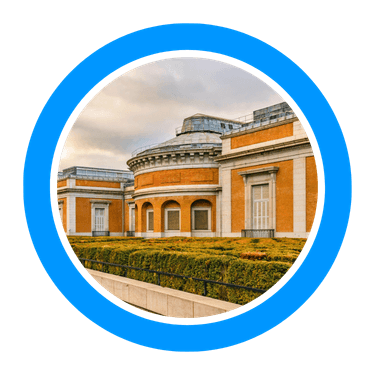
Before it became one of Spain’s principal museums of modern and contemporary art, the Reina Sofía’s Sabatini Building formed part of the Hospital de San Carlos. The institution had much earlier origins, but the surviving building was extended during the reign of Charles III by José de Hermosilla and Francesco Sabatini. Its long corridors, vaulted spaces and ordered courtyards now provide the setting for works created during periods of social conflict, political rupture and artistic experimentation.
The guided route concentrates on selected works rather than attempting to cover the entire collection. Picasso’s Guernica is its central reference, accompanied by paintings from artists including Salvador Dalí, Joan Miró, Juan Gris and Ángeles Santos. The guide uses these works to trace changes in Spanish art during the first half of the 20th century, connecting Cubism, Surrealism and other avant-garde movements with the political and cultural pressures of their time.
Admission covers the museum visit, while the guide may also discuss selected temporary pieces. The order of the paintings can change, and one advertised work may occasionally be replaced by another for organizational, conservation or exhibition reasons. This makes the tour a guided introduction to the collection rather than a guaranteed checklist of rooms.
After the 90-minute tour, you can leave or continue through the museum independently. That additional time is useful if you want to return to a painting, see other collection galleries or compare the historic Sabatini Building with the later Nouvel extension.
Works and Artists on the Guided Route
Guernica by Pablo Picasso
Picasso painted Guernica in 1937 for the Spanish Pavilion at the International Exposition in Paris. Its immediate catalyst was the bombing of the Basque town of Gernika during the Spanish Civil War, although the painting avoids a literal account of one moment. Fragmented bodies, distorted faces, a bull, a horse and a harsh field of black, white and grey turn the event into a broader image of civilian suffering.
Its dimensions are difficult to grasp through reproductions. Standing before the painting reveals how its figures compete for space across a canvas more than seven metres wide. Instead of trying to decode every symbol immediately, begin with the overall movement of the composition. Then follow the changes in light, gesture and expression from one side to the other.
The surrounding material matters as much as the familiar image. Related works and documents help explain the painting’s creation, public reception and eventual arrival in Spain. Guernica entered the Reina Sofía in 1992 after previously being displayed at the Casón del Buen Retiro.
A World by Ángeles Santos
Ángeles Santos painted A World in 1929 while still a teenager. The large canvas turns the Earth into a strange cubic structure surrounded by elongated figures, stars and ritual-like activity. Its imagined geography feels both carefully organized and detached from ordinary physical rules.
The painting offers a different route into Spanish modernism. Rather than treating the period as a story dominated entirely by Picasso, Dalí and Miró, it introduces an artist whose work combined contemporary experimentation with a highly personal visual system. Look at how the scene shifts between distant cosmic scale and small narrative details.
The Face of the Great Masturbator by Salvador Dalí
Dalí completed The Face of the Great Masturbator in 1929, during a decisive period in his relationship with Surrealism. A large, ambiguous facial form dominates the painting, while smaller figures and objects introduce desire, anxiety and bodily transformation.
The precise technique makes the irrational scene feel unusually concrete. That tension is central to the work: Dalí paints dreamlike associations with the clarity of observed objects. The guide can help separate its principal forms before discussing the personal and Surrealist ideas connected with them.
The Musician’s Table by Juan Gris
Juan Gris’s The Musician’s Table approaches Cubism through a structured arrangement of objects and intersecting planes. Musical references, fragments of familiar forms and shifts in perspective are assembled into a composition that asks the viewer to reconstruct the scene rather than receive it from a single viewpoint.
Comparing Gris with Picasso shows that Cubism was not one fixed visual formula. Gris often gives his compositions a measured clarity, with carefully balanced shapes and relationships. The painting provides an opportunity to examine how an ordinary still life could become a study of perception and representation.
The House with the Palm Tree by Joan Miró
The House with the Palm Tree belongs to an early stage of Miró’s career, before the highly reduced signs and floating forms associated with much of his later work. Its detailed treatment of the landscape and architecture still points toward an artist interested in reorganizing visible reality rather than copying it mechanically.
The painting helps place Miró’s development within the wider route. By comparing it with Cubist and Surrealist works nearby, you can see how Spanish artists moved between close observation, geometric reconstruction and symbolic invention during the early decades of the century.
Reading Guernica in Historical Context
Guernica was commissioned for the Spanish Pavilion in Paris while the Civil War continued. The bombing that inspired it took place on 26 April 1937, when German and Italian aircraft supporting the Nationalist forces attacked Gernika. Picasso completed the monumental painting within the following months.
The work later travelled internationally before being placed at the Museum of Modern Art in New York. Picasso had stipulated that it should return to Spain after the restoration of democratic freedoms. It arrived in Madrid in 1981 and was initially installed at the Casón del Buen Retiro before moving to the Reina Sofía.
That history changes the meaning of seeing the canvas here. The building itself had served as a hospital, and areas of the complex treated people injured during the aerial attacks on Madrid. A painting created in response to the destruction of another Spanish city now hangs in a place connected with the consequences of the same war.
The galleries around Guernica prevent it from becoming an isolated celebrity image. Documents, preparatory material and works by other artists place it within debates about propaganda, artistic responsibility and the representation of violence. The guide’s most useful role is to make those relationships visible without reducing the painting to one definitive interpretation.
Planning Your Reina Sofía Visit
The group meets outside the museum’s main entrance on Calle de Santa Isabel. This is important because the Reina Sofía has more than one public entrance. Follow the meeting instructions on your electronic voucher instead of entering independently through another part of the complex.
The tour includes admission and an English-speaking guide. Its advertised route combines the permanent collection with various temporary pieces, but the selection can change. Conservation work, loans and exhibition planning may affect which paintings are available or the order in which the group sees them.
Ninety minutes provides a focused introduction rather than a complete museum visit. Staying afterward lets you return to a work without the group, continue into later periods or spend more time studying the documents around Guernica. Keep your ticket accessible while moving through controlled areas of the museum.
The Reina Sofía and Prado represent different parts of Madrid’s national collections. A separate Prado Museum guided tour concentrates on earlier European painting, while the Reina Sofía begins with the emergence of modern art and extends into contemporary practice. Visiting both makes most sense when each museum receives its own time rather than being treated as another stop on a crowded checklist.
For a wider view of the capital, the free walking tour of Madrid covers the historic centre around Puerta del Sol, Plaza Mayor and the Royal Palace. That route provides an urban contrast to the political and artistic history presented inside the museum.
Tips for Your Reina Sofía Tour
✔️ Meet on Calle de Santa Isabel. The museum also has an entrance in the Nouvel Building, but this tour meets outside the main entrance specified by the provider. Save the location from your voucher before setting out.
✔️ Keep your electronic voucher ready. Admission is included, but the group still needs to assemble and enter together. Arrive with enough time to locate the guide without delaying the scheduled visit.
✔️ Request accessibility when booking. The activity is listed as accessible, but the requirement must be indicated in advance so that the appropriate arrangements can be made.
✔️ Allow time after the guided section. The tour lasts 90 minutes, and you may continue independently afterward. Another hour gives you room to revisit a painting or see galleries outside the guided selection.
✔️ Bring a light layer. The museum maintains its galleries at a controlled temperature for conservation. The interior may feel cool even when Madrid is warm outside.
✔️ Photograph selectively. Personal photography without flash, tripods or selfie sticks is generally permitted unless signage says otherwise. Put the camera away when restrictions apply and avoid blocking circulation around major works.
✔️ Use Estación del Arte or Atocha. Both place you within walking distance of the museum. Check the final approach to Calle de Santa Isabel rather than following signs toward another entrance.
Frequently Asked Questions
How Long Does the Reina Sofía Tour Last?
The guided visit lasts 1 hour and 30 minutes. You may remain inside the museum afterward and continue independently.
Where Does the Tour Meet?
The meeting point is outside the museum’s main entrance on Calle de Santa Isabel. Check the identification instructions on your electronic voucher.
Is Museum Admission Included?
Yes. Admission to the Reina Sofía Museum and the services of an English-speaking guide are included.
Which Works Are Included?
The advertised selection includes Guernica, A World, The Face of the Great Masturbator, The Musician’s Table and The House with the Palm Tree. The order may change, and certain works may be replaced.
Is the Tour Conducted in English?
Yes. The activity takes place with an English-speaking guide.
Is the Tour Accessible?
Yes, but you must indicate your accessibility requirements when making the reservation so that the necessary arrangements can be considered.
Can I Take Photographs?
Personal photographs are generally permitted without flash, tripods or selfie sticks unless a room or artwork has its own restriction. Follow the signs and staff instructions.
Are Pets Allowed?
No. Pets are not permitted on the activity. The museum makes exceptions for qualifying assistance and emotional support dogs under its visitor rules.
What Is the Cancellation Policy?
Cancellation is free until 24 hours before the activity begins. Later cancellations and no-shows are nonrefundable.
More Tours in Madrid
Prado Museum

Madrid Free Tour

Royal Palace of Madrid
