

This 90-minute English-language tour meets at the entrance to the Thyssen-Bornemisza National Museum, includes skip-the-line admission and follows a selected route through the permanent and Carmen Thyssen collections before finishing back at the meeting point. The group is limited to 15 participants, and you may remain inside afterward.
The Thyssen fills a gap that neither the Prado nor the Reina Sofía covers in quite the same way. Its galleries trace European painting from the 13th to the 20th century, allowing a medieval religious panel, a Renaissance portrait, an Impressionist dancer and a modern abstract painting to form part of one chronological account. Few museums make such broad changes in Western painting visible within a single visit.
Much of that range comes from a private collection assembled by two generations of the Thyssen-Bornemisza family. Heinrich Thyssen-Bornemisza concentrated largely on Old Masters, while his son Hans Heinrich expanded decisively into 19th and 20th-century art. Their different interests explain why the museum can connect traditions and periods that are usually divided among separate institutions.
The guide concentrates on representative works rather than attempting to cover nearly 1,000 paintings. Advertised highlights include Ghirlandaio’s portrait of Giovanna Tornabuoni, Degas’s green dancer and Holbein’s portrait of Henry VIII. Works by artists such as El Greco, Caravaggio, Rubens, Rembrandt, Van Gogh, Cézanne, Kandinsky, Picasso, Dalí and Rothko broaden the route, although the precise selection may depend on the galleries open during your visit.
Your ticket also provides access to the Carmen Thyssen Collection, which adds another perspective on landscapes, Impressionism and late 19th-century painting. After the guided section, you can return to the rooms that interested you most or continue through parts of the museum not covered by the group.
Masterpieces on the Thyssen Guided Tour
Portrait of Giovanna Tornabuoni by Ghirlandaio
Domenico Ghirlandaio’s Portrait of Giovanna Tornabuoni is one of the collection’s best-known Renaissance paintings. Giovanna appears in strict profile against an orderly architectural setting, following a format associated with Florentine portraiture and classical medals.
Her clothing, jewellery and personal objects communicate family standing as carefully as her facial features communicate identity. An inscription in the background introduces a moral and commemorative dimension. The portrait was produced after Giovanna’s death, making it both an image of an individual and an idealized record intended to preserve her place within a prominent Florentine family.
Look at how little physical space separates the sitter from the objects behind her. The shallow setting gives every detail visual importance. This controlled arrangement contrasts strongly with the looser surfaces and shifting viewpoints encountered later in the tour.
Swaying Dancer by Edgar Degas
Degas repeatedly studied dancers in rehearsal, performance and moments of physical strain. In Swaying Dancer (Dancer in Green), the performer’s movement is shaped by a composition that feels cropped rather than ceremonially arranged. Parts of other figures enter the scene without becoming complete portraits.
The unusual viewpoint reflects Degas’s interest in photography, Japanese prints and the fragmented perspectives of modern city life. Instead of presenting ballet as a distant formal spectacle, he places the viewer close to the stage and emphasizes motion, fabric and the unstable balance of the body.
Comparing this work with Renaissance portraiture reveals how dramatically the purpose of painting had changed. Ghirlandaio constructs permanence and social order. Degas catches an instant that seems capable of slipping out of view.
Portrait of Henry VIII by Hans Holbein
Hans Holbein the Younger worked at the English court and helped establish the visual image through which Henry VIII is still recognized. The Thyssen portrait shows the king in a three-quarter pose, richly dressed and presented with an attention to texture, jewellery and controlled expression.
The painting is smaller and less confrontational than the full-length image associated with the lost Whitehall mural, but it performs a related political function. Clothing, posture and physical presence create authority without requiring a crown or an elaborate narrative setting.
Portraits of this kind were not simply private records of appearance. They could circulate an official image of the ruler and communicate status across courtly and diplomatic networks. The guide can help distinguish Holbein’s close observation from the strategic construction of royal power.
From El Greco and Caravaggio to Rubens and Rembrandt
The Old Master galleries widen the tour beyond three individual highlights. El Greco introduces elongated figures and expressive colour, while Caravaggio’s dramatic lighting gives physical immediacy to a religious subject. Rubens and Rembrandt represent different approaches to Baroque painting, from movement and rich colour to concentrated observation of faces, light and material surfaces.
Seeing these artists within the same collection makes comparison easier. Pay attention to how each painter directs the eye. Light may isolate a figure, establish a sacred atmosphere, intensify movement or reveal the passage of time across a face.
From Van Gogh and Cézanne to Kandinsky and Rothko
The later galleries show painting moving away from the expectation that an image should reproduce the visible world faithfully. Van Gogh gives brushwork and colour an emotional role. Cézanne reorganizes landscape and objects through structure. Kandinsky moves toward abstraction, while Rothko uses large fields of colour to create a different kind of visual attention.
This progression is one of the museum’s main strengths. The route does not require every artist to fit into a simple line of improvement. Instead, it shows painters repeatedly redefining what an image could represent, how a surface could be organized and what viewers were expected to notice.
The Carmen Thyssen Collection
Admission to the Carmen Thyssen Collection is an important inclusion because it extends the visit beyond the core permanent collection. Its holdings are particularly useful for understanding landscape painting, 19th-century naturalism and the development of Impressionist and Post-Impressionist approaches.
These paintings show how landscape gradually became more than a backdrop for religious, mythological or historical events. Artists increasingly treated changing light, weather, rural labour and modern leisure as subjects in their own right. The visible handling of paint also became part of the meaning of the image.
The collection helps connect academic traditions with artists who worked outdoors or pursued more personal uses of colour. It also provides a useful counterpoint to the portraits and religious paintings seen earlier. Instead of organizing identity through clothing, inscriptions or courtly symbols, many of these works locate human experience within a changing natural or urban environment.
The guided portion may not cover every Carmen Thyssen room. Since access is included, you can continue independently and use the tour’s chronological framework to make sense of additional works. Returning to one early landscape and one later example is often more useful than crossing every gallery without comparison.
From a Private Collection to a National Museum
The Thyssen collection was assembled through private acquisition rather than inherited from Spain’s royal collections. Heinrich Thyssen-Bornemisza began building a major group of Old Master paintings during the first half of the 20th century. Hans Heinrich later reunited parts of the collection and expanded its chronology through Impressionism, Expressionism, American painting and other modern movements.
This history helps explain the museum’s distinct character. The Prado grew largely from royal collecting and is especially strong in artists valued by the Spanish monarchy. The Reina Sofía concentrates on modern and contemporary art. The Thyssen connects those periods through acquisitions shaped by the interests of individual collectors.
The museum opened to the public in Villahermosa Palace in 1992. The building had developed from an 18th-century aristocratic residence and was adapted for museum use by architect Rafael Moneo. Its restrained galleries allow the arrangement of paintings to change gradually with the chronology of the collection.
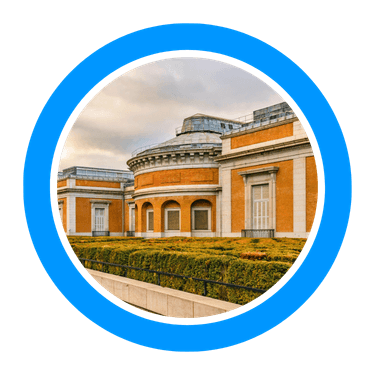
Location reinforces that connecting role. Villahermosa Palace stands on Paseo del Prado within walking distance of Madrid’s two other major national art museums. A separate Prado Museum guided tour provides deeper attention to royal patronage and Old Masters, while the Thyssen supplies many of the movements and geographical traditions that bridge earlier painting with modern art.
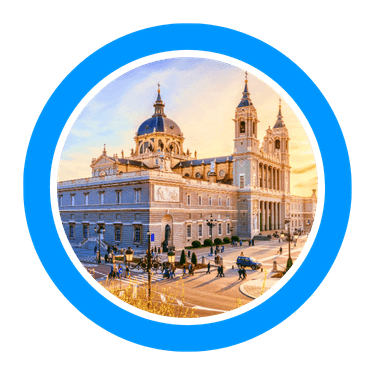
If you want to place the museum district within the wider capital, the free walking tour of Madrid covers the historic centre around Puerta del Sol, Plaza Mayor and the Royal Palace. It provides a different perspective from the institutional and cultural axis of Paseo del Prado.
Tips for Your Thyssen Museum Tour
✔️ Meet at the museum entrance. The address is Paseo del Prado 8. Keep the identification instructions from your electronic voucher ready so you can locate the guide before the group enters.
✔️ Arrive before the scheduled departure. Skip-the-line admission avoids the standard ticket queue, but the group must still assemble and complete the entrance procedure together.
✔️ Plan around a group of up to 15. The maximum is smaller than many standard museum groups, but staying close to the guide remains important when moving between galleries.
✔️ Keep time after the guided route. Your admission allows you to remain inside. Another 45 to 60 minutes is useful for the Carmen Thyssen Collection or a second look at the period that interested you most.
✔️ Travel with a small bag. Carrying less makes security and movement through the galleries easier. Avoid arriving with luggage or bulky items that could require additional storage.
✔️ Compare two works from different centuries. Selecting one early portrait and one modern painting gives the museum’s broad chronology a clear purpose. Look at what changed in space, colour, subject and the visible treatment of paint.
✔️ Leave a break before another museum. The Prado is nearby, but two guided art visits without time between them can become difficult to absorb. A short walk or meal in Barrio de las Letras creates a useful pause.
Frequently Asked Questions
How Long Does the Thyssen Museum Tour Last?
The guided visit lasts 1 hour and 30 minutes. You may remain in the museum afterward and continue independently.
Where Does the Tour Meet?
The group meets at the entrance to the Thyssen-Bornemisza National Museum at Paseo del Prado 8. Follow the guide identification details on your voucher.
Where Does the Guided Visit Finish?
The guided route concludes back at the meeting point. You may then leave or continue through the museum on your own.
What Does the Booking Include?
It includes an English-speaking guide, skip-the-line admission to the permanent collection, access to the Carmen Thyssen Collection and a group limited to 15 participants.
Will Every Artist Named in the Description Be Seen?
The tour follows a selected highlights route, not every gallery. Displays can change because of loans, conservation or museum operations, so treat the published artists as the scope of the collection rather than a guarantee that every named painter will receive a separate stop.
Is the Tour Accessible?
Yes. The activity is listed as accessible. Include any specific requirement when booking so the provider can prepare for your visit.
Are Pets Allowed?
No. Pets are not permitted on this activity.
Can I Stay in the Museum After the Tour?
Yes. Your ticket continues to provide access to the permanent and Carmen Thyssen collections after the guided portion ends.
What Is the Cancellation Policy?
Cancellation is free until 48 hours before the activity begins. Later cancellations and no-shows are nonrefundable.
More Tours in Madrid
Prado Museum

Madrid Free Tour
Royal Palace of Madrid
