

Free walking tour
Free Tour of Santa Clara
Choose a date to check availability on Civitatis. Dates shown here are not live availability.
Choose your date
Civitatis displays availability and confirms bookings on its own site.
Founded in 1689, this inland Cuban city exists partly because people were trying to get away from pirates. The community that led to Santa Clara grew after repeated corsair attacks on San Juan de los Remedios pushed residents to seek a safer site away from the coast. That practical beginning helps explain why Santa Clara feels different from Cuba’s older port and colonial towns. Its identity was built less by seafaring trade and more by civic ambition, republican architecture and, later, revolution.
This free tour highlights the places where that identity is easiest to read. You will see Parque Vidal, the social heart of the city, La Caridad Theatre, the Cathedral of Santa Clara de Asis and the park housing the Monument to the Seizure of the Armored Train. The route also includes the statues of Cuban independence leaders, Plaza Che Guevara with the Che Guevara Mausoleum, Café Museo Revolución and El Mejunje, one of the clearest windows onto Santa Clara’s contemporary cultural life. Together, these landmarks sketch a city tied to both Marta Abreu and Che Guevara, the two names most closely linked to Santa Clara’s public image.
The tour lasts 3 hours and begins at Parque Vidal, finishing near the starting point. The guide speaks English and Spanish. An English-speaking guide is included. Tipping the guide at the end is up to you.
What You’ll See on the Free Tour of Santa Clara
Parque Vidal
You will see the civic centre that still organises much of daily life in Santa Clara. Parque Vidal is more than a square. It is part of a network of parks, promenades and meeting places that shape how locals use the city. Around it, you can read Santa Clara’s mixed architectural character, with Spanish influence alongside neoclassical and later republican styles. It is the right place to begin understanding a city where public life happens in the open air.
La Caridad Theatre
You will stop at one of Santa Clara’s most important cultural buildings, inaugurated on 8 September 1885 thanks to the benefactor Marta Abreu de Estévez. Teatro La Caridad belongs to a surviving trio of 19th-century neoclassical theatres in Cuba and has been a National Monument since 1982. Its story says a great deal about Santa Clara’s civic culture, because the theatre’s revenues were intended to support charity and public education. Even from outside, it gives the city a more refined, republican air than many visitors expect in central Cuba.
Statues of Cuban Independence Leaders
These monuments place Santa Clara within the wider national story beyond the revolution of 1958. They reflect how Cuban cities use public sculpture to connect daily urban life with the memory of independence, civic duty and national identity. On a walk through the centre, they help explain why Santa Clara’s squares and parks are not just decorative spaces, but places where history is constantly on display.
Cathedral of Santa Clara de Asis
You will see one of the religious landmarks that reflects the city’s Iberian inheritance. The cathedral helps place Santa Clara within a broader Cuban pattern of Spanish-influenced urbanism, but the surrounding cityscape is noticeably less colonial than places such as Trinidad or Remedios. That contrast is part of Santa Clara’s appeal. The cathedral sits within a city better known for civic spaces, memorials and 19th- and 20th-century public buildings than for a preserved colonial core.
Monument to the Seizure of the Armored Train
You will visit the site tied to one of the decisive episodes of the Cuban Revolution. Santa Clara was captured by guerrilla forces in late 1958, and the action against the armoured train became one of the best-known moments of that campaign. This stop helps explain why Santa Clara matters so much in Cuban national memory. It is a key to understanding how local geography and revolutionary history became inseparable.
Plaza Che Guevara and the Che Guevara Mausoleum
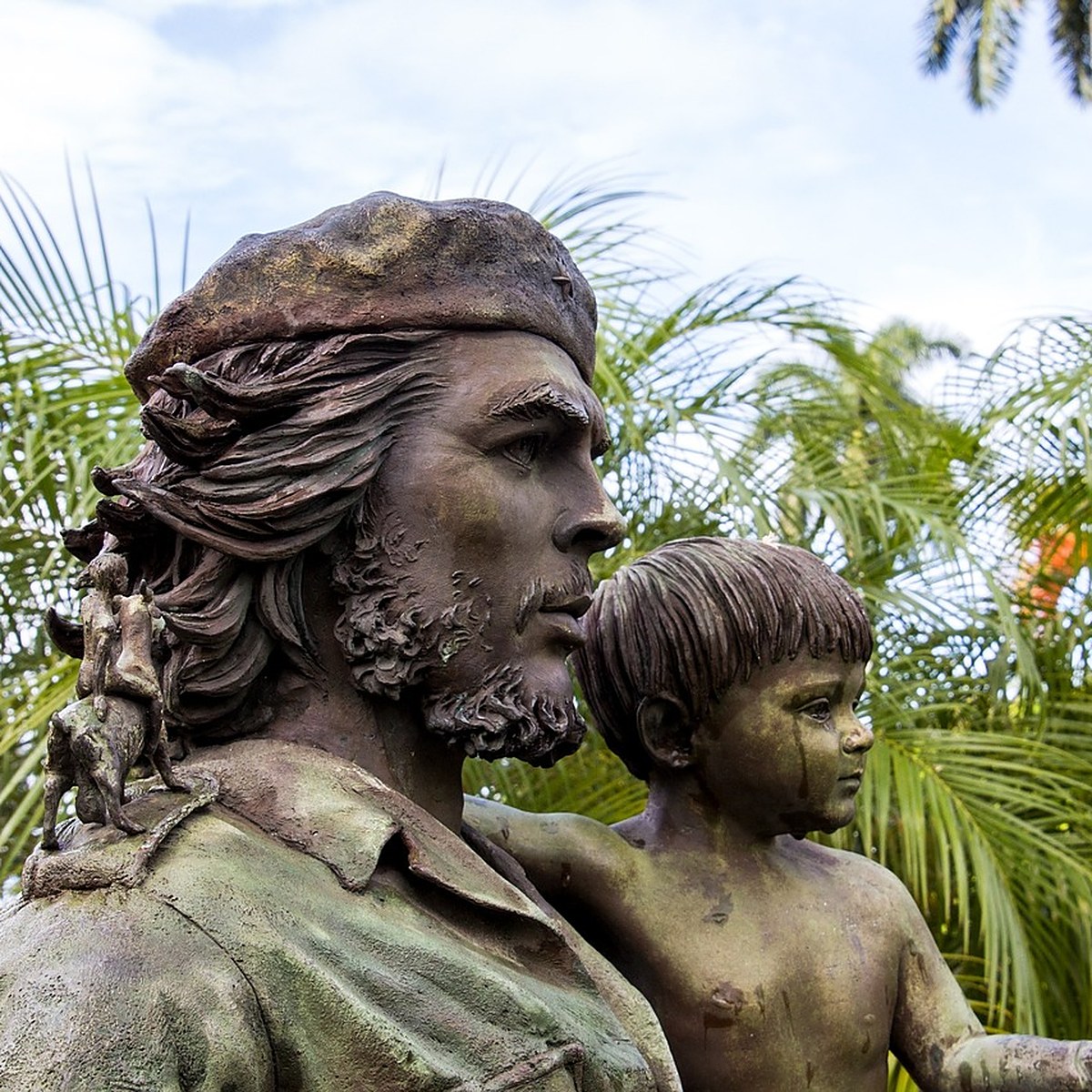
You will see the memorial complex that made Santa Clara the main city of remembrance associated with Ernesto Che Guevara. His remains and those of his companions are kept here, which is why Santa Clara is often described as a major memorial landscape for Che in Cuba. The setting is solemn and political at once, and it attracts travellers who want to grasp why this city carries such symbolic weight. If you are interested in modern Cuban history, this is one of the places that gives Santa Clara its national importance.
Café Museo Revolución
This stop extends the revolutionary thread of the route into a more everyday urban setting. In Santa Clara, political memory is not confined to large monuments. It also appears in smaller public spaces where visitors can see how the city continues to frame its modern identity through the story of the revolution.
El Mejunje
You will also encounter a very different side of the city at El Mejunje, one of Santa Clara’s best-known cultural spaces. It combines theatre, visual art, coffee and bar culture in a way that reflects the city’s active, informal creative life. This matters because Santa Clara is not only about monuments and revolutionary memory. El Mejunje shows the everyday cultural energy that keeps the city socially interesting after the history lesson ends.
History and Curiosities of Santa Clara
Why Santa Clara Was Founded Inland
Santa Clara was founded in 1689, but the reasons behind that date begin earlier. Repeated pirate and corsair attacks on San Juan de los Remedios pushed residents to support a move inland, and the relocation was approved to the surroundings of the Ciego de Santa Clara estate near the present city. By 1672, the inland settlement that preceded the formal foundation already had about 500 inhabitants living in 80 houses. That detail shows the move was not a sudden leap into empty land, but the consolidation of a community that had already started to take shape.
Marta Abreu and the Civic City
Santa Clara is often called the city of Marta and Che, a pairing that says a lot about how its identity is built. Marta Abreu de Estévez, one of the city’s great benefactors, helped shape Santa Clara through civic works including the railway station and Teatro La Caridad. Her influence is still visible in the city’s public face, especially in the institutions that link culture, education and philanthropy. In a country where many cities are introduced through colonial plazas, Santa Clara often feels instead like a city designed by civic generosity.
The Battle That Fixed Santa Clara in National Memory
Late 1958 changed Santa Clara’s place in Cuban history. The city was captured by guerrilla forces during the revolution, and the battle here became one of the most important episodes of the conflict. That is why modern Santa Clara carries such a strong memorial function, especially around the Armored Train monument and Plaza Che Guevara. You can still see how public space in the city has been used to turn political history into a lived urban landscape.
A Different Kind of Cuban Cityscape
One curiosity of Santa Clara is that its principal built heritage is largely republican rather than colonial. Its streets are described as narrow and curved, with a boulevard running parallel to Parque Leoncio Vidal and many secondary parks feeding daily urban life. This gives the city a different rhythm from Cuba’s older showpiece towns. Visitors expecting a museum-like colonial centre usually find something more revealing: a working provincial capital with layers from the 19th century, the republic and the revolution.
Local Life, Traditions and Food in Santa Clara
How the City Lives Day to Day
Santa Clara is one of the main urban centres of Villa Clara and has long been tied to industry, education and public culture. The province has roots in sugar, chemicals, leather and steel, later expanding into textiles, biotechnology, machinery, telecommunications and automotive activity. It is also considered an important scientific pole thanks to the Central University Marta Abreu de Las Villas, one of the country’s most prestigious universities. For a visitor, that means Santa Clara often feels less museum-like than other destinations and more connected to everyday Cuban working life, especially around the parks, boulevard and Casa de la Cultura.
Theatre, Festivals and Contemporary Culture
Cultural life here is not confined to formal monuments. Teatro La Caridad remains central to theatre life in Villa Clara, while El Mejunje represents a looser, more hybrid form of urban culture where stage performance, visual art and social life meet. The broad avenue by Estadio Sandino is used for much of Santa Clara’s carnival celebrations, which shows how civic and sporting spaces double as festival ground. If you stay beyond the walk, time around the central parks and cultural venues is one of the clearest ways to understand the city.
Traditional Food and Drinks to Try After the Tour
The food of Santa Clara follows the broader Cuban table rather than a separate local cuisine. You are likely to find ropa vieja, braised or shredded beef cooked with spices and vegetables, along with staples such as rice and black beans, plantains and viandas such as cassava or yucca. Congrí, the rice-and-beans combination found across Cuba, is another standard order in local restaurants and paladares. To drink, look for coffee, guarapo made from sugarcane, natural juices, champola, pru oriental, mojito, daiquirí, Cuba Libre or piña colada. The presence of sugarcane drinks such as guarapo also reflects the importance of sugar in the wider history of Villa Clara.
Tips for the Free Walking Tour of Santa Clara
- Wear light clothes and comfortable shoes, because 3 hours on Santa Clara’s streets and plazas can feel longer in the heat, especially on exposed sections around open civic spaces.
- Carry water and sun protection. Much of what makes Santa Clara interesting lies in parks, squares and memorial spaces rather than shaded interiors.
- If you are choosing between a day trip and an overnight stay, a day trip works well for the Che memorial and battle history, while an overnight stay gives you time for theatre, dance and the social life around Parque Vidal and the boulevard.
- After the tour, stay in the centre for food or coffee. Santa Clara’s public life is easiest to read when people are out strolling, meeting in the parks or heading to venues such as El Mejunje.
- Groups cannot be larger than 6 people, even if booked separately. You can book up to the tour start time, subject to availability. Pets are allowed only in outdoor areas. If you cannot attend, cancel your reservation so the guide is not left waiting. The tour is not wheelchair accessible, and auditory, intellectual and visual accessibility varies according to the attraction included. If you need any personal details not shown here, check your booking confirmation.
Frequently Asked Questions
What is the meeting point for the free tour of Santa Clara?
The meeting point is Parque Vidal.
What route does the free tour of Santa Clara follow?
The walk includes Vidal Park, La Caridad Theatre, statues of Cuban independence leaders, the Cathedral of Santa Clara de Asis, the park housing the Monument to the Seizure of the Armored Train, the Che Guevara Mausoleum in Plaza Che Guevara, Café Museo Revolución and El Mejunje cultural centre.
How long is the free tour of Santa Clara?
The tour lasts 3 hours.
What language is the free tour of Santa Clara in?
The tour is offered in English and Spanish.
Where does the free tour of Santa Clara finish?
It finishes near the starting point.
What is Santa Clara known for?
It is best known for the Battle of Santa Clara in late 1958 and for the Ernesto Che Guevara Memorial, where Che Guevara and companions are buried.
How do travellers get to Santa Clara?
Santa Clara is served by Abel Santamaría International Airport on the outskirts of the city.
Is Santa Clara worth visiting if I am interested in Cuban history?
Yes. Santa Clara is one of the most important cities in Cuba for understanding the revolution, and it also reveals an older story about inland settlement, civic philanthropy and republican architecture.
Popular Activities in Cuba

Free Tour of Havana
El Nicho Waterfalls Tour from Cienfuegos

Trinidad
Colonial Havana Free Tour
