

Guided tour
Seville Bike Tour
8.7 Fabulous · 267 reviews (as of Nov 2026) Free cancellation
Choose your date
Civitatis displays availability and confirms bookings on its own site.
Seville makes unusual sense from a bicycle saddle because much of the city grew along the Guadalquivir, the river that turned it into Spain’s gateway to the Atlantic after 1492. In 2 hours 30 minutes, this route connects the old port quarter, Cristo de la Expiración Bridge, La Cartuja’s former monastery land, Triana, Isabel II Bridge and the grand avenues created for the Ibero-American Exposition of 1929. It starts at Calle Rastro 12A and returns there, with an English-speaking guide and bike hire included for the rest of the day after the guided ride ends.
You pass through El Arenal, Triana, the Guadalquivir shore, Plaza de España, María Luisa Park, Santa Cruz and Alameda de Hércules. The ride is guided rather than a simple rental, and different bikes are available, including children’s bikes, with baby seats available on request when booking.
If you want to keep exploring afterwards, the included day-long bike hire makes it easy to continue on your own through the historic centre or back along the river.
What You Will See on the Seville Bike Tour
El Arenal
El Arenal was the riverside district tied to Seville’s trade with the Americas in the 16th and 17th centuries. This area stood close to the city’s old port activity and to institutions linked to commerce and navigation, making it central to Seville’s rise as an imperial trading city.
Cristo de la Expiración Bridge and La Cartuja Island
The Cristo de la Expiración Bridge, also called Puente del Cachorro, links the historic city with the Cartuja area across the Guadalquivir. La Cartuja is known for the Monastery of Santa María de las Cuevas, founded in the 15th century, and for its later transformation during Expo 92, when this part of Seville was extensively redeveloped.
Triana and Isabel II Bridge
Triana has long been associated with ceramics, shipbuilding and flamenco families, and its identity is closely tied to the west bank of the river. Isabel II Bridge, better known as Puente de Triana, opened in 1852 and was Seville’s first permanent bridge over the Guadalquivir, replacing an older floating bridge that had connected both sides for centuries.
Plaza de España and María Luisa Park
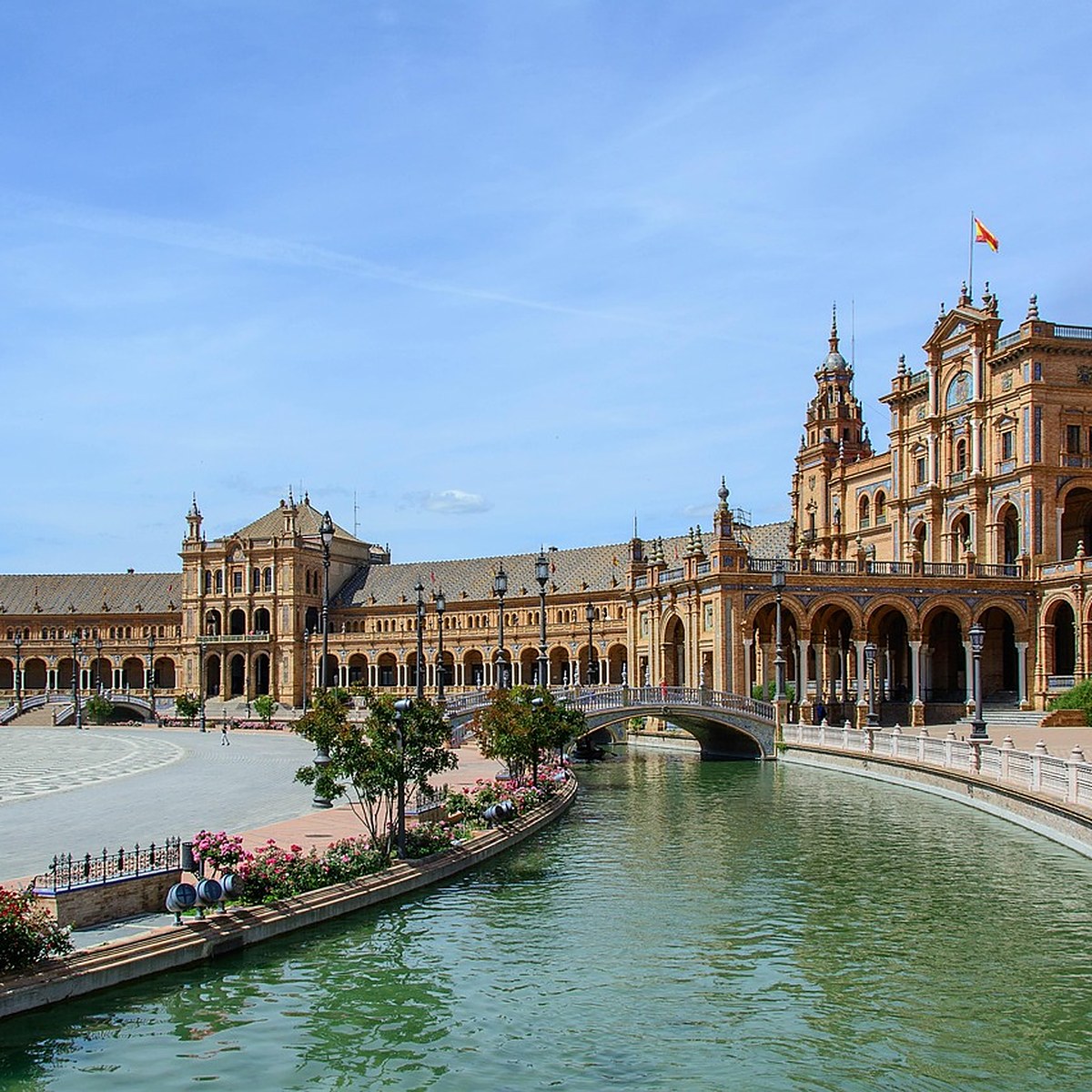
Plaza de España was built for the Ibero-American Exposition of 1929 and remains one of Seville’s clearest examples of regionalist architecture. Next to it, María Luisa Park occupies land donated to the city by the Infanta María Luisa in the late 19th century, with avenues, fountains and planted spaces arranged as a formal urban park.
Santa Cruz Neighbourhood
Santa Cruz occupies part of Seville’s old Jewish quarter, with narrow streets laid out within the medieval city. Its urban form reflects centuries of adaptation to heat, privacy and defensive planning, and it remains one of the clearest surviving pieces of pre-modern Seville.
Alameda de Hércules
The Alameda de Hércules was created in 1574 and is often described as one of Europe’s oldest public promenades. Its long rectangular plan, Roman-style columns and later tree planting gave Seville an early formal public space that still marks the northern side of the historic centre.
Tips to Enjoy the Seville Bike Tour
✔️ The meeting point at Calle Rastro 12A is near the edge of the historic centre, between the Puerta de Carmona area and the approach to Santa Cruz. If you are coming from the cathedral side, Avenida de Menéndez Pelayo is usually a simpler approach than trying to cut through the narrow lanes around Santa Cruz.
✔️ The guided ride lasts 2 hours 30 minutes, but the bike hire continues for the rest of the day. A practical plan is to use the afternoon for a separate riverside loop from Puente de Triana toward La Cartuja, which lets you revisit the Guadalquivir without trying to stop for long photos during the guided section.
✔️ If you are booking for a family, request a child’s bike or baby seat at the time of reservation, not when you arrive at Calle Rastro 12A. This can make the start of the activity smoother and help you set up the right bike from the beginning.
✔️ In warmer months, bring water, sun protection and light clothing for cycling around Seville. Earlier start times are often more comfortable if you prefer to avoid the strongest heat of the day.
✔️ Pets are not allowed on this activity, so arrange pet care before heading to the start point.
✔️ Free cancellation is available up to 24 hours before the start. If you are arriving in Seville by AVE train at Santa Justa or by flight on the same day, leave enough margin before your start time rather than booking the first slot after arrival.
What Else to See in Seville
Archivo de Indias
Beside the cathedral, the Archivo de Indias preserves documents related to Spain’s administration of the Americas. The building was completed in the late 16th century as the Casa Lonja de Mercaderes, so it connects directly with the mercantile history introduced in El Arenal during the ride.
Monastery of Santa María de las Cuevas
On La Cartuja, this former monastery helps explain one of the route’s biggest contrasts: medieval religious land later absorbed into the redevelopment linked to Expo 92. If the bike tour sparks your interest in that part of Seville, this is the landmark to follow up with.
Real Alcázar of Seville
The Alcázar brings together Islamic, Mudéjar, Gothic and Renaissance architecture within the same royal complex. It pairs naturally with the section through Santa Cruz, since both belong to the medieval core of the city and are only a short distance from the tour’s central route.
The Best of Seville
Seville is especially rewarding when you follow the city through its public spaces and river edges. The same ride can show you the trade corridor of the Guadalquivir, the historic link to Triana, the 16th-century urban idea of Alameda de Hércules and the monumental planning of 1929 around Plaza de España and María Luisa Park. A bike tour makes those layers easier to connect than a day spent only inside monuments.
For food afterwards, try espinacas con garbanzos, a Seville staple of spinach and chickpeas with deep roots in Andalusian cooking, often found in bars around the centre and Santa Cruz. Another classic is pescaíto frito, mixed fried fish that fits well after time spent riding beside the river and through Triana, where seafood traditions remain strong.
If the route leaves you wanting a closer look at the oldest streets, continue on foot through Santa Cruz, the cathedral surroundings and El Arenal to revisit the areas introduced during the ride at a slower pace.
Frequently Asked Questions
How long does the Seville Bike Tour last?
Seville Bike Tour lasts 2 hours 30 minutes. Bike hire is included for the whole day, so you can keep exploring on your own after the guided route ends.
Where does the Seville Bike Tour start?
The tour starts at Calle Rastro 12A in Seville and finishes back at the same address. That makes it straightforward to plan the rest of your day or continue using the bike after the guided section. Check your booking confirmation before you go, as the exact meeting point can change for seasons, events or roadworks.
What language is the Seville Bike Tour conducted in?
The tour is conducted in English. An English-speaking guide leads the route through areas including Triana, Plaza de España, Santa Cruz and the Guadalquivir shore.
Is admission included in the Seville Bike Tour?
The included services are the English-speaking guide, the guided bike ride and bike hire for the whole day. The route focuses on Seville’s streets, riverfront and public spaces rather than entry to monuments.
Do I need to book in advance?
Booking in advance is recommended if you want to secure your preferred date. If you need a child’s bike or a baby seat, request it when booking.
Is the Seville Bike Tour accessible for people with reduced mobility?
No, the tour is not wheelchair accessible.
Can children participate in the Seville Bike Tour?
Different bikes are available, including children’s bikes, and baby seats can be requested when booking. Children must be accompanied by an adult.
Is photography allowed during the Seville Bike Tour?
Yes, this route works well for photography because it passes open landmarks such as Plaza de España, Puente de Triana and the Guadalquivir shore. It is usually easiest to take photos during stops rather than while riding through busier sections.
Popular Activities in Seville
Free Tour of Seville
Alcazar of Seville Tour

Seville Cathedral and Giralda Guided Tour
