

Guided tour
Private Walking Tour of Seville
9.1 Exceptional · 147 reviews (as of Nov 2026) Free cancellation
Choose your date
Civitatis displays availability and confirms bookings on its own site.
Seville’s historic centre reads almost like a timeline you can cross on foot. In a single 2 hour and 30 minute private walk, you can explore highlights that may include the 12th century Giralda, built first as an Almohad minaret, the Mudéjar courtyards of the Alcázar, and riverfront and park spaces shaped by the 1929 Ibero-American Exposition. Few Spanish cities show changes in power and style so clearly in stone, brick, tile and street layout.
Your guide leads only your party and the route can be adapted to your interests, with possible stops around Seville Cathedral, the Giralda, the Royal Alcázar, María Luisa Park, La Maestranza, Puente de Isabel II and Triana. You can choose both the starting point and where the walk ends, which makes it useful whether you want a compact introduction to the old centre or a route focused on one district or historical theme.
Admission to monuments and museums is not included, so the walk works especially well as an exterior introduction to the city or as a way to understand the background before a separate visit inside the cathedral or Alcázar. If you want to keep exploring later on foot, Seville also offers other guided walks in English that cover the city from a different angle.
What You Will See on the Private Walking Tour of Seville
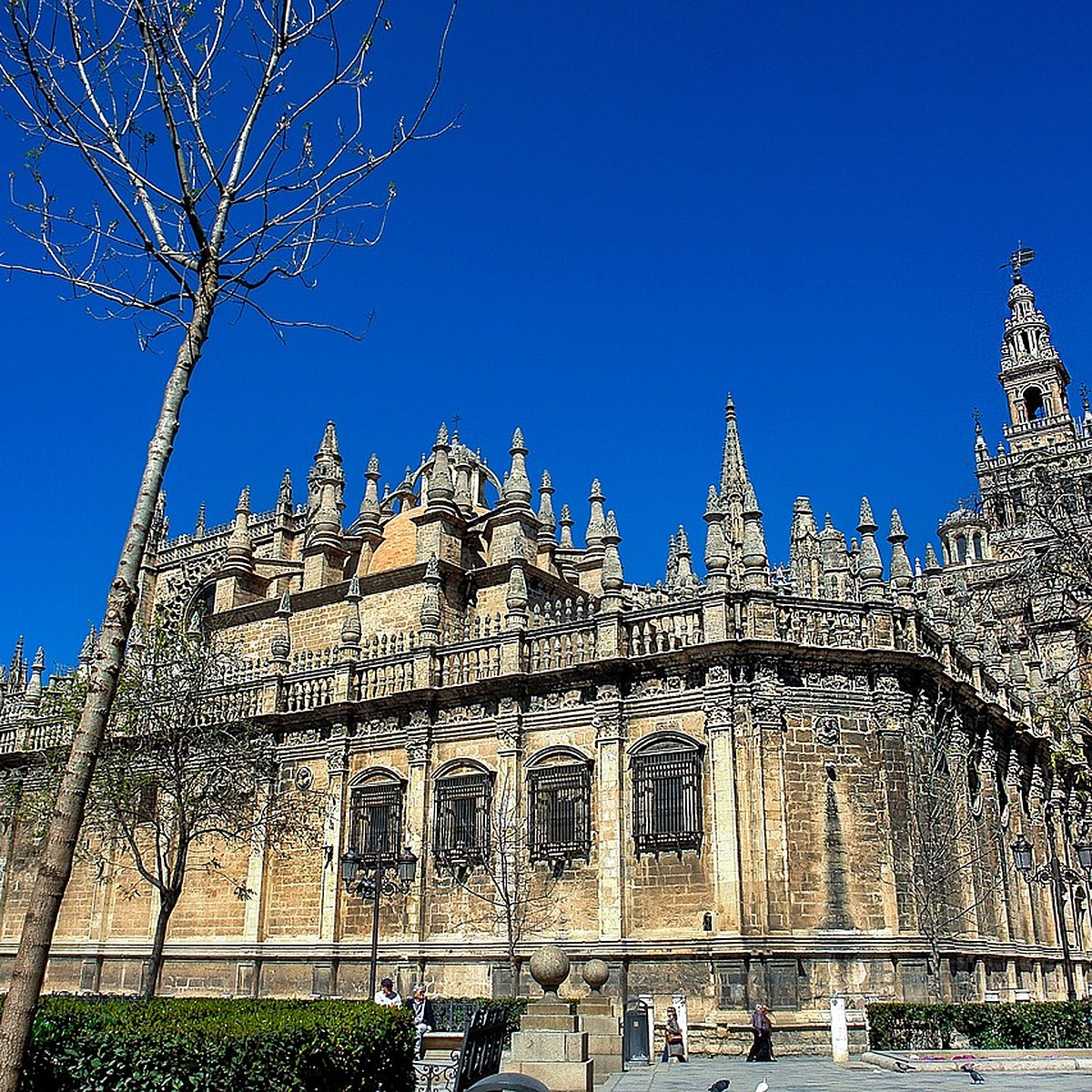
Seville Cathedral
One possible highlight of the route, Seville Cathedral stands on the site of the city’s former main mosque and was built after the Christian conquest, mainly between the 15th and 16th centuries. It is one of the largest Gothic cathedrals in Europe, and its scale reflects Seville’s growing importance as a commercial and religious centre during the late medieval and early modern periods.
The Giralda
If your route includes it, the Giralda began as the minaret of the Almohad mosque in the 12th century before becoming the cathedral’s bell tower. One of its most striking features is the internal ramp system instead of a tight staircase, a design that made ascent easier in the medieval period and still sets it apart from many church towers in Spain.
The Royal Alcazar
Another possible stop, the Alcázar remains an official royal residence, making it one of the oldest palaces in Europe still used for that purpose. Its best-known phase comes from the 14th century under Pedro I, when Mudéjar artisans created patios, carved plasterwork, wooden ceilings and tile decoration that combine Islamic artistic language with a Christian court setting.
María Luisa Park
María Luisa Park can form part of a customised route and marks a later chapter in Seville’s history. Its broad avenues, pavilions and landscaped spaces are closely linked to the Ibero-American Exposition of 1929 and show how the city presented itself in the early 20th century, in clear contrast with the tighter medieval street pattern of the old centre.
La Maestranza Bull Ring
La Maestranza is one of the possible landmarks on the walk. It is one of the best-known bullrings in Spain and is tied to the Real Maestranza de Caballería, an institution historically linked to horsemanship and elite military culture. Built over the 18th and 19th centuries, it remains a prominent landmark near the Guadalquivir riverfront.
Triana Bridge and Triana
If you choose a route that crosses the river, Puente de Isabel II, commonly called Triana Bridge, opened in the 19th century as Seville’s first permanent bridge linking the centre with Triana. Across the river, Triana developed a strong identity through ceramics, river trades, flamenco culture and working-class neighbourhood life, elements that still shape the area today.
Tips to Enjoy the Private Walking Tour of Seville
✔️ Use the flexible start point strategically. You can start where you choose, including your hotel or a central location, so it helps to begin near the area you most want to explore.
✔️ If María Luisa Park is part of your route, choose an early morning or late afternoon slot, especially from May to September. The park and the riverfront have much less shade than streets such as Calle Mateos Gago or the lanes around Santa Cruz.
✔️ Admission is not included, so treat the walk as orientation and book interiors separately if needed. The Cathedral and Royal Alcázar both use timed entry, and same-day tickets can be harder to secure in busy periods such as Semana Santa, Feria week and many spring weekends.
✔️ Ask the guide to build the route around one subject rather than trying to cover every major sight equally. Islamic Seville, the route from mosque to cathedral, Atlantic trade near the Archivo de Indias, or Triana ceramics are all stronger approaches for a 2 hour and 30 minute walk.
✔️ If you are staying in the centre, choose an end point that helps with your next visit. As the tour can end where you choose, you can finish near the area you want to explore afterwards.
✔️ If accessibility is important, mention it when booking. Most areas are accessible, accessible toilets are available, and an accompanying person is required and must be indicated in the reservation.
What Else to See in Seville
Archivo de Indias
Next to the cathedral, the Archivo de Indias occupies a late 16th century Renaissance building first intended for merchants. It later became the archive for documents relating to Spain’s administration in the Americas, making it a strong follow-up if your walk raises questions about Seville’s role in imperial trade and navigation.
Hospital de los Venerables
In the Santa Cruz quarter, the 17th century Hospital de los Venerables was founded as a residence for elderly priests. Today its courtyard, baroque interiors and art displays give useful context for Seville after its commercial peak, when religious patronage still shaped much of the city’s architecture.
Centro Cerámica Triana
Near Calle Antillano Campos in Triana, this museum occupies the site of former ceramic workshops and kilns. It explains how the district produced tiles and pottery used across Seville, so it is an especially relevant stop if your walking route includes Triana Bridge and the neighbourhood’s artisanal history.
The Best of Seville
Seville is at its most coherent when you follow the links between the Almohad city, the Christian conquest, the royal court and the trade routes of the early modern period. The Giralda, cathedral, Alcázar, Archivo de Indias and riverfront are all parts of that same story, which is why a well-planned walking tour works so well here.
Food also fits that historical thread. In central bars you may see espinacas con garbanzos, a classic Seville dish with deep Andalusi and Lenten associations, while in Triana and traditional taverns you are more likely to come across montadito de pringá, filled with slow-cooked meat from puchero. Both make more sense after a walk that explains how different parts of the city developed.
If the private walk leaves you wanting a broader view, continue with areas linked to the same narrative rather than jumping randomly between sights. The route from the cathedral to the Archivo de Indias, Torre del Oro and the river gives a clear sense of how religion, monarchy and trade shaped Seville together.
Frequently Asked Questions
How long does the Private Walking Tour of Seville last?
The walk lasts 2 hours and 30 minutes. That is enough time to cover several key areas of central Seville at a measured pace, especially if you focus the route on one or two districts.
Where does the Private Walking Tour of Seville start?
You can start the tour where you choose, including your hotel or a central location. You can also end the walk where you choose.
What language is the Private Walking Tour of Seville conducted in?
The tour is conducted in English, with an English-speaking guide specialised in the history of Seville.
Is admission included in the Private Walking Tour of Seville?
No. Entry to monuments and museums such as Seville Cathedral or the Royal Alcázar is not included, so any interior visit should be booked separately.
Do I need to book in advance?
Booking in advance is a good idea for a private tour, especially if you want to request a specific historical focus or a practical start and end point.
Is the Private Walking Tour of Seville accessible for people with reduced mobility?
Most areas are accessible and accessible toilets are available. An accompanying person is required and must be indicated in the reservation.
Is photography allowed during the Private Walking Tour of Seville?
This outdoor private walk passes through some of Seville’s most photogenic areas. If you later enter monuments separately, indoor photography rules may differ.
What is the best time of year to visit Seville?
For general trip planning, spring and autumn are usually the easiest seasons for walking in Seville. In summer, an early morning or evening start is often more comfortable because midday heat can be intense.
Popular Activities in Seville

Free Tour of Seville
Alcazar of Seville Tour

Seville Cathedral and Giralda Guided Tour
Segway Tour of Seville
