

Puebla sits in a high valley between volcanoes, and that geography still shapes the city: on clear mornings, Popocatépetl and Iztaccíhuatl appear beyond a grid of domes, tiled roofs, and old industrial chimneys. This was the first Mexican city laid out largely for Spanish settlers rather than on top of a major pre-Hispanic capital, and that helps explain why its streets feel unusually ordered for a colonial city.
If you want to get under the surface without spending much, Puebla gives you plenty to work with. Here are 10 free or low-cost plans that show different sides of the city, from baroque religion to wrestling masks and riverside urban renewal.
Walk Across the Zócalo
The Zócalo is Puebla’s civic core, and it has been the city’s public living room since the 16th century. What sets it apart is not just the arcades and cathedral backdrop, but the way the square still keeps an older rhythm of bandstands, shoe shiners, and families circling in the evening. One detail many visitors miss is that the iron kiosk in the center was installed in the Porfirian period, when French-style urban furniture was being imported into Mexican public squares to signal modernity.
Go early in the morning if you want to see the center before traffic and tour groups thicken, or come back at dusk when the portales fill with locals. Take time to look up at the upper floors around the square, where old commercial houses still show traces of 19th-century signage and decorative tilework. Keep small change with you if you want a coffee from a street vendor and a bench with a view of daily life.
Climb Up to the Barrio del Artista
The Barrio del Artista is a small courtyard complex where painters still work in open studios around a central patio. It took shape in the mid-20th century as an officially protected space for local artists, but the area around it had long been tied to workshops near the old course of the San Francisco River. That matters in Puebla, a city where artistic production has rarely been separate from ordinary neighborhood life.
Head there in the late morning or early afternoon, when more studios are open and artists are actually at work. Spend a while looking at the paintings, then step into the adjoining Plazuela del Torno, which gets its name from the old turning area once used by carriages and carts in this part of the city. Admission to the courtyard is free, but if you want to photograph people closely, ask first.
Browse the Biblioteca Palafoxiana
Admission is low-cost. The Biblioteca Palafoxiana is one of the oldest public libraries in the Americas, founded in 1646 when Bishop Juan de Palafox y Mendoza donated 5,000 volumes on the condition that they be available not only to clergy but to the wider learned public. Its cedar shelving, carved over two levels, is reason enough to go, but the deeper story is that this library represented an early idea of public access to knowledge in colonial New Spain.
Visit in the middle of the day, when the light entering the hall lets you see the woodwork and painted details more clearly. Pay attention to the retablo at the far end, dedicated to the Madonna of Trapani, and to the scientific instruments and globes that show the collection was never limited to theology. Since opening hours can shift, it is worth checking the current schedule before you make a point of going.
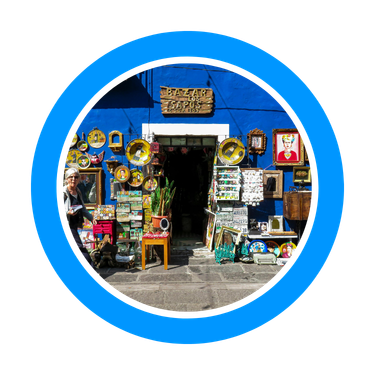
Study the Talavera Facades on Callejón de los Sapos
Callejón de los Sapos is a short colonial street known for antique shops, old houses, and facades lined with Talavera tile details. Its odd name comes from the time when this area lay beside the unruly San Francisco River and regularly flooded, leaving mud, frogs, and a reputation for being less respectable than the polished center uphill. That scruffier past is exactly why the street is interesting now: Puebla’s prettiest corners are often the result of cleanup and reinvention, not untouched elegance.
Come on a weekday morning if you want to see the architecture without the weekend market crowds. Look closely at balconies, doorframes, and house numbers, because some of the best ceramic details are easy to miss when the street gets busy. Sundays are better if you want antiques and atmosphere, but worse if your aim is to study the buildings themselves.
Enter the Capilla del Rosario
Admission is free. The Capilla del Rosario, inside the Templo de Santo Domingo, is one of the clearest statements of New Spanish baroque anywhere in Mexico. When it was completed in 1690, local chroniclers treated it as proof that Puebla could rival the artistic ambition of Mexico City, and the lavish gilded stucco was meant to teach doctrine through excess as much as beauty. This is not subtle architecture, and that is precisely the point.
Go in the late afternoon when the light softens and the chapel tends to feel less rushed than at peak midday. Stand still for a few minutes instead of trying to photograph everything, because the ceiling program only really makes sense when you let your eyes adjust. Dress respectfully and keep your voice low, since this is an active religious site rather than a museum room.
Follow the Murals in Barrio de Xanenetla
Xanenetla is an old neighborhood on the edge of the historic center that has been reworked through a long-running urban mural project. The painted walls are not random decoration: many pieces refer to local memory, family histories, trades, and the stigma the area carried for decades before residents and artists began reclaiming it publicly. Even the name points to older layers of the city, coming from Nahuatl and surviving in a place that the colonial grid never fully absorbed.
Walk the area in daylight, ideally in the morning or late afternoon when the colors photograph better and the streets are less harsh under the sun. Take your time with side streets rather than just the best-known murals, because some of the strongest works are integrated into stairways, garage doors, and domestic facades. Wear good shoes, since some stretches are sloped and uneven.
Cross Through the Pasaje Histórico 5 de Mayo
Admission is low-cost. This underground passage preserves part of Puebla’s 19th-century military infrastructure linked to the forts and defenses associated with the French Intervention. For years, locals repeated stories about vast tunnels beneath the whole city, and most of that was legend, but this site is a useful corrective because it shows something more interesting than myth: how supplies, troops, and messages could move under pressure in a city repeatedly forced to think about siege and invasion.
Visit during the hotter part of the day if you want a break from the sun, since the interior stays cooler than the street above. Read the interpretive panels rather than rushing through, because Puebla’s role in the 1862 battle is often flattened into a patriotic slogan when it was actually part of a longer and messier military campaign. The floor can be damp, so avoid slippery footwear.
Watch Lucha Libre at Arena Puebla
Tickets are low-cost. Arena Puebla is one of the classic lucha libre venues in the country, operating since the 1950s and carrying a rougher, more local atmosphere than the famous arenas in the capital. Puebla’s wrestling crowd has a reputation for being sharp and demanding, which means the audience is not background noise here but part of the performance itself.
Go on a match night and arrive a bit early so you can take in the crowd before the card starts. Sit where you can see both the ring and the audience, because half the point is hearing how people react to técnicos and rudos. Bring cash for snacks and check the schedule in advance, since events are not held every night.
Ride Along Parque Lineal
Access is free, and bike rental is sometimes available at low cost depending on the current scheme in operation. Parque Lineal makes most sense if you treat it as evidence of how far Puebla has stretched westward toward Angelópolis rather than as a great park in its own right. The useful contrast here is between the tiled, compressed historic center and the broad avenues, overpasses, and newer development that define a large part of contemporary Puebla.
Use it in the early morning or toward sunset, when the heat eases and local runners and cyclists are out. Focus on a short stretch near landmarks such as the area around the Estrella de Puebla and the Museo Internacional del Barroco side of the city, then look back mentally toward the old center. It is one of the clearest ways to grasp that Puebla is not just a UNESCO postcard. Sun protection matters here because there is less shade than in the historic center.
Join a Free Tour of Puebla
A free tour of Puebla ties the city together by walking through the Centro Histórico with a local guide in English, usually over roughly two to two and a half hours. The route commonly links the Zócalo, the Catedral de Puebla, the Biblioteca Palafoxiana area, Callejón de los Sapos, the Barrio del Artista, and sometimes the Templo de Santo Domingo and its Capilla del Rosario. That matters in Puebla because many of the city’s strongest stories are easy to miss from the sidewalk alone.
These tours work on a pay-what-you-want basis. At the end, visitors decide how much to pay according to what they thought the tour was worth.
Notice How Popocatépetl Still Frames Puebla’s Ordered Streets
What stays with many people here is the tension between order and volatility: the carefully planned colonial grid on one hand, and the presence of Popocatépetl on the other. Puebla still lives inside that contrast. You see it in the polished Talavera, in flood-prone streets turned picturesque, and in military passages under a city that likes to look serene from above.