

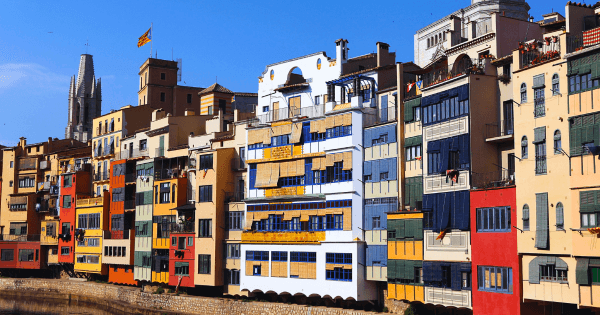
Girona sits where four rivers meet, but what gives the city its particular shape is the Onyar, with its row of painted facades facing the water and the old quarter rising behind them. This is also a city marked by layers that stayed visible: Roman foundations, a major medieval Jewish quarter, and walls that still explain why Girona mattered for centuries on the road between Barcelona and France.
If you want to get under the surface without spending much, there are plenty of ways to do it. Here are 10 free or low-cost plans that show Girona beyond the traditional angle.
1. Walk Along the Passeig de la Muralla
Admission is free. This elevated walkway follows large sections of Girona’s old Carolingian and medieval walls, giving you a clear sense of how the city defended itself over time. One detail many people miss is that parts of the wall trace an earlier Roman perimeter, so when you walk here you are not just getting views, you are following the long logic of Girona’s military geography.
Take your time between the watchtowers and stop at the wider sections where the old town, cathedral area, and newer districts open up in different directions. Early morning or late afternoon is best, especially in warm months, and the stone can get slippery after rain, so decent shoes help.

2. Admire the Girona Cathedral
The staircase leading to Girona Cathedral has become familiar to many through screen appearances, but the building matters for older reasons, including the fact that its Gothic nave is often cited as the widest of its kind in the world. More interesting than the filming trivia is the way the cathedral advertises episcopal power from above the city. Girona liked to present itself as smaller than Barcelona but harder to ignore.
Spend a few minutes on the staircase and the terrace below, where you can watch how the cathedral dominates the upper city. Come early or near dusk for fewer people on the steps, and if you decide to go inside later, check current ticket prices separately because the museum and interior are not free.

3. Cross the Eiffel Bridge Over the Onyar
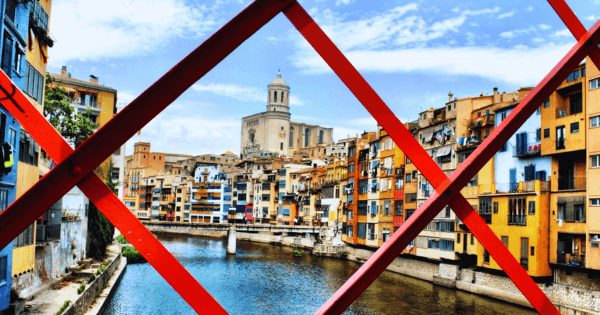
The Pont de les Peixateries Velles, known by many as the Eiffel Bridge, was designed by Gustave Eiffel’s company in 1877, years before the Paris tower made his name global. What makes it worth more than a quick photo is its practical industrial design: the red iron lattice was built to be assembled efficiently, a piece of 19th-century engineering dropped into a medieval city.
Stand in the middle and look south for the cleanest view of the Onyar facades lined up over the riverbanks. Go around sunset if you want softer light on the houses, and note that this is a pedestrian bridge, so you can stop without dodging traffic.
4. Visit the Arab Baths
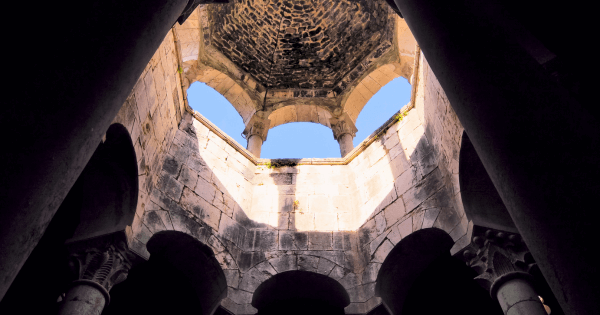
Admission to the interior is low-cost, and seeing the exterior area is free. Despite the name, the Banys Àrabs are actually a Romanesque Christian building from the 12th century, rebuilt after the 1285 French siege, in a style influenced by Islamic bath models that had circulated across the Iberian Peninsula. That misleading name has confused visitors for generations, and Girona is better understood when you resist easy labels.
Look closely at the stonework around the entrance and the compact setting beside the old quarter, then decide whether you want to pay to see the central pavilion inside. Earlier in the day is easier if you want to look around without crowds collecting at the cathedral end of town.
5. Discover the Jewish Quarter
El Call is one of the best-preserved medieval Jewish quarters in Europe, and its importance is tied not just to urban fabric but to intellectual history: Girona was home to Moses ben Nahman, known as Nahmanides, one of the major Jewish scholars of the 13th century. The narrow passages and worn steps here are not staged for visitors, they reflect the density of a community that was forced to live under specific legal restrictions before the expulsion of 1492.
Wander slowly through Carrer de la Força and the side alleys, looking at door lintels, interior courtyards glimpsed through gates, and the way the quarter folds into the slope. Late morning is a good moment because the stone catches the light, and if you want context, read the street plaques since several point to former communal sites that are easy to pass by.
6. Relax in the Devesa Park
Devesa Park is one of Girona’s easiest escapes when the old quarter starts to feel crowded. Its long avenues of plane trees give the park a formal, almost monumental rhythm, and the scale is surprising for a city of Girona’s size. This is not a dramatic attraction in the cathedral-and-walls sense, but it shows another side of local life: families walking, people reading in the shade, cyclists cutting through, and market activity nearby on certain days.
Go in the morning or late afternoon, especially in summer, when the shade makes a real difference. It works well as a low-cost pause between the old town and the newer parts of Girona, or as a picnic stop if you have picked up fruit, bread, or cheese from the market.

7. Browse the Local Markets
For a more everyday version of Girona, head to the Mercat del Lleó, the city’s main food market. It is not a sightseeing monument, and that is exactly the point. The stalls give you a better feel for how people in Girona actually shop, with produce from the surrounding region, cured meats, cheeses, fish, prepared foods, and seasonal Catalan ingredients that rarely appear in postcard versions of the city.
You do not need to buy much to make the stop worthwhile. Even a quick walk through the market helps connect Girona with the wider food culture of Catalonia. If you want a simple low-cost plan, pick up something for breakfast or a light picnic, then continue toward Devesa Park or back toward the old quarter.

8. Marvel at the Sant Feliu Church
Before Girona Cathedral became the city’s most photographed religious building, Sant Feliu was one of Girona’s great landmarks. Its tall bell tower still shapes the skyline, and its position near the old northern entrance to the city makes it feel like a gateway between the river, the old quarter, and the cathedral hill. From the outside alone, it is worth a stop because the building shows how Girona’s sacred geography was not centered on just one monument.
Look at the mix of Romanesque and Gothic elements, then step back toward the river or the square to see how the basilica sits against the old stone fabric of the city. If you choose to go inside, check the current visiting conditions first, but even from the exterior it adds an important layer to any walk through Girona.

9. Follow the Rambla de la Llibertat
This long arcaded street was laid out over part of the medieval river edge and became one of Girona’s main commercial spines, with a name that reflects 19th-century political change rather than medieval origins. The porticoes are not decorative filler. They tell you this was a working street for trade, credit, and daily negotiation, the sort of place where a city shows what it actually values.
Walk the full length under the arches, then notice how it links the old commercial center with the bridges over the Onyar. The side lanes toward Carrer de les Olles and Carrer de la Cort Reial feel very different from the polished riverfront image, which is exactly why they are worth the detour. Morning is best if you want Girona before it starts performing for visitors.

10. Join the Free Tour of Girona
A free tour of Girona is a smart way to connect the city’s scattered layers: the Roman past, the medieval walls, the Jewish quarter, the Onyar bridges, the cathedral steps, and the political importance of Girona between Barcelona and France. On your own, these places can feel like separate stops. With a good local guide, they start to form a single story.
The pay-what-you-want format makes it one of the most accessible introductions to the city, especially if you are visiting for the first time. It is also useful at the start of your stay, because the guide can help you decide what deserves more time later, from museums and churches to food stops, viewpoints, and quieter streets away from the busiest corners of the old town.
Girona rewards slow looking. The city is compact enough to explore on foot, but dense enough that every corner seems to carry another layer: Roman walls, medieval lanes, Jewish heritage, Gothic churches, riverside houses, local markets, shaded parks, and bridges that turn a short walk into a visual memory. You can spend money here, of course, but many of Girona’s best experiences come from walking carefully, reading the city’s stone, crossing the Onyar at different times of day, and letting the old quarter reveal itself gradually.
For travelers looking for free and low-cost things to do in Girona, the best approach is not to rush from monument to monument. Start with the walls, the cathedral area, the Jewish quarter, and the bridges, then balance the historic center with places like Devesa Park and Mercat del Lleó. Add a free tour if you want local context, and Girona becomes much more than a pretty day trip from Barcelona. It becomes one of Catalonia’s most rewarding small cities to understand on foot.
