


Benidorm is not just high-rise hotels facing the sea. It grew from a fishing town into one of the most vertical urban skylines in Europe, and that contrast still defines the place: old maritime habits below, apartment towers and package tourism above, all pressed between two broad bays and the Serra Gelada cliffs.
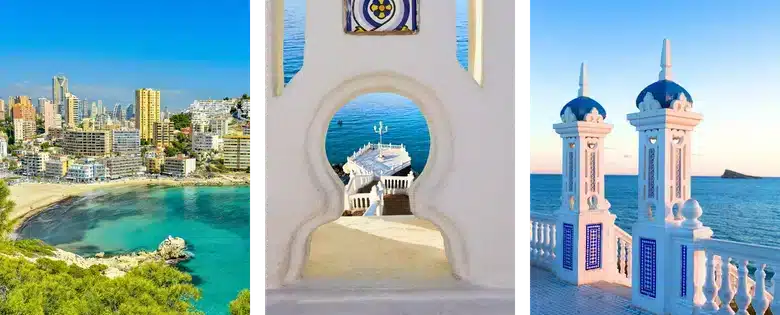
If you want to read the city beyond the sunbed version, there are plenty of ways to do it. These 10 free or low-cost plans show a Benidorm that is older, stranger, and more layered than many visitors expect.
1. Join a Free Tour of Benidorm
A free tour of Benidorm usually runs on a pay-what-you-want basis, so the price is not fixed and you decide the contribution at the end. The useful part is not the saving but the structure: a good route links Parque de Elche, the port, Calle Mayor, the Church of San Jaime y Santa Ana, the Balcón del Mediterráneo on Punta Canfali and parts of the old town that many people otherwise cross too quickly.
Benidorm is a city that can look obvious from a distance and become much harder to read at street level. A guided walk helps connect the fishing settlement, the defensive headland, the 20th-century tourist boom and the modern skyline without flattening them into a simple before-and-after story.
2. Walk El Casco Antiguo
Benidorm’s old town is free to explore, and it still preserves the street pattern of the settlement that existed before the hotel boom of the 1950s and 60s. This is the part of town that grew around the old fishing community, with narrow lanes, whitewashed facades and small squares that feel detached from the grid of the beachfront towers. One detail many people miss is that several streets here follow the line of the old defensive enclosure that once protected the headland from attacks by Barbary corsairs.
Take your time around Calle Mayor, Calle Alameda and the lanes above the port, where the shift between working town and resort is easiest to read. Early morning is the best time if you want to see local life before terrace seating takes over, and comfortable shoes help because some streets are steep and paved with worn stone.
3. Climb to the Balcón del Mediterráneo
Access to the Balcón del Mediterráneo is free. This white-railed viewpoint stands on the Punta Canfali promontory, where Benidorm’s castle and later fortress once stood before being demolished in the 19th century. What you see now is a civic terrace, but the site’s military past matters because this was the strategic point used to watch the coast for pirate raids and to control the two beaches on either side.
Go up for the divide it gives you between Levante and Poniente, and stay long enough to notice the different rhythms of each bay. Sunset draws a crowd, but late morning often gives clearer light for photos and a bit more room on the steps, and there are benches nearby if you want to sit with the sea rather than rush through it.
4. Visit the Church of San Jaime y Santa Ana
Entry is generally free, though visitors should be respectful if services are taking place. This parish church, with its blue tiled dome, is one of the clearest landmarks in the old town and dates from the 18th century, after the rebuilding that followed a period of depopulation and coastal insecurity. Its dedication matters locally: the Virgen del Sufragio, Benidorm’s patron saint, is tied to a story about a drifting ship and an image saved from it in the 18th century, a legend still central to town identity.
Inside, look beyond the compact scale and pay attention to the devotional objects linked to local seafaring life. If you are in Benidorm in November, the Fiestas Mayores Patronales make the church’s role much easier to grasp, because the image of the Virgin is not a decorative detail but the center of one of the town’s strongest surviving traditions. Midday can be quiet between worship times, and modest clothing is a sensible idea if you plan to step in during a religious event or festival period.
5. Follow the Paseo de Poniente
Walking the Paseo de Poniente is free. This long seafront promenade, redesigned by architect Carlos Ferrater and completed in the late 2000s, gave Benidorm one of the few public spaces in Spain that seriously challenged the lazy idea that the city has no architectural ambition beyond hotel blocks. Its layered curves and ramps were designed as urban infrastructure as much as scenery, solving circulation, beach access and flood management along a heavily used shore.
Come in the late afternoon when the sun softens and locals start using the route for their evening walk. The full stretch is longer than it first appears, and the western end near Parque de Elche feels very different from the quieter residential stretch toward La Cala side, so it is worth walking more than a token section. Water and a hat help in warmer months, and there are plenty of places to pause if you want to watch how Poniente works as a neighborhood beach rather than a postcard view.
6. Watch the Fishing Port at Work
Seeing the port area is free, though access to operational zones may be restricted depending on the time and activity. Benidorm’s marina and fishing port remind you that before mass tourism, tuna and other catches shaped the local economy, and that maritime labor has not disappeared entirely behind the pleasure boats. A less obvious detail is that families from Benidorm were linked to almadraba tuna fishing not only on this stretch of coast but also seasonally farther afield, which helps explain why seafaring knowledge here was broader than the resort image suggests.
Head there in the later afternoon if you want the best chance of seeing movement around the working side of the port rather than just the leisure craft. The port matters because it sits directly below the old town and exposes the city’s real structure in one glance: church and lanes above, boats below, towers behind. Keep out of marked service areas, and if you are interested in photography, the contrast between nets, hulls and high-rises is strongest when the light starts dropping behind Poniente.
7. Swim at Cala del Tío Ximo
Access to Cala del Tío Ximo is free. This small cove at the foot of the Serra Gelada side of town feels like a corrective to the standard Benidorm image, which is precisely why it is worth your time. Instead of wide managed sand, you get a tighter inlet of rock and clear water that shows what this coastline looked like before the city learned to package itself so efficiently for beach tourism.
The cove also sits close to an area where the slopes of Serra Gelada begin to dominate the urban edge, so the setting feels geologically sharper than the main beaches. Bring water shoes if you have them, because the shore is more stony than sandy in parts and getting in and out is easier that way. Morning is usually the calmer time for swimming before the cove fills up, and shade is limited, so you need to arrive prepared rather than count on beach rentals.
8. Hike in Serra Gelada Natural Park
Entry to Serra Gelada Natural Park is free. This protected coastal range rises directly beside Benidorm and contains some of the most abrupt sea cliffs in the Valencian Community, a geological fact that explains why the city’s skyline and hard mountain edge feel so tightly packed together. One thing often overlooked is that the park also protects marine areas, not only land routes, because the underwater environment off these cliffs is part of the same ecological system.
If you want a route that feels specifically tied to Benidorm rather than a generic nature walk, take the marked path from the Rincón de Loix side toward the Cruz de Benidorm, where the city keeps appearing behind you in increasingly unlikely proportions. Go early or late in the day to avoid the worst heat, especially outside winter. The terrain is dry and exposed, so proper shoes, sun protection and enough water matter more here than on a casual urban stroll.
9. Browse the Municipal Market
Entry to Mercat Municipal de Benidorm is free, and buying something is optional. The market is where the city drops the beach-resort mask for a while and returns to everyday food shopping, with stalls selling fish, cured meats, fruit and prepared items for local households. It also says something about Benidorm’s year-round population, which is easy to forget in a place so often treated as purely seasonal, despite the fact that many residents use this market as part of their normal weekly routine.
Walk through slowly and pay attention to what is actually being bought rather than just what is displayed for visitors. In a town stereotyped as all fry-ups and pints, the market is a useful reality check, especially around fish counters and produce stalls that reflect the wider Marina Baixa rather than the tourist strip. Mid-morning is the best moment to catch it with some energy but without the early rush, and carrying cash can still be useful at smaller counters even if many now take cards.
10. See the Cruz de Benidorm
Access to the Cruz de Benidorm area is free. The large cross above Levante is one of those places many people know for the view without knowing the story behind it: it was erected in 1961 by local Catholic youths as a symbolic response to Benidorm’s growing reputation for bikinis and moral permissiveness during the tourism boom. That tension between conservative Spain and the new beach economy is part of the city’s real history, and the cross is one of its clearest physical traces.
Go near sunset if you want the city laid out below with the bay catching the last light, but expect company because it is a popular hour. The route up is exposed and can feel longer than it looks, so take water and avoid the hottest part of the day in summer.
From the Waterline to the Skyline
Benidorm makes sense when you keep returning to Punta Canfali, the rocky point where surveillance, religion, trade and tourism have all taken turns occupying the same small piece of ground. From there, the city’s logic stops looking accidental. The old lookout position, the church above the port and the towers behind them form a sequence, not a contradiction.
That is why Benidorm is more interesting than its reputation. It is a place where a former defensive headland now frames selfies, where the moral panic of the bikini years survives in a hilltop cross, and where the fishing town was not erased so much as forced to coexist with one of Europe’s most vertical holiday skylines.