


Budapest’s bath culture was never just about leisure. Long before spa weekends and social media posts, thermal bathing here sat at the intersection of medicine, class and city planning, and Széchenyi was built as a statement that modern Budapest could turn geothermal water into public life on a grand scale. What looks today like a photogenic yellow palace in City Park began as part of a serious early 20th-century belief that bathing could improve the health of the urban population.
Seen that way, the place makes more sense. Széchenyi is not a quiet sanctuary removed from the city, but a social institution with steam rooms, medical pools, outdoor basins, chess games played in waist-deep water and a constant flow of Budapest residents and visitors passing through the same ornate halls.
Book Your Ticket Before Arrival
Book online before you go, because queues at Széchenyi run long on weekends, public holidays and summer afternoons. The bath sits in Városliget, at Állatkerti körút 9-11, a short walk from the Széchenyi fürdő stop on metro line M1, the oldest underground line in continental Europe. Morning entry is far easier than turning up at midday, weekday tickets cost less than weekend ones, and you choose between a basic locker ticket and a cabin ticket with a private changing cubicle.
Early arrival also fits how the building works. Opened in 1913 and expanded in 1927 with the outdoor pools, Széchenyi belongs to a period when Budapest invested heavily in public hygiene, medical infrastructure and civic display. Its scale was meant to move large numbers of city residents through therapeutic bathing, not just to present an elegant façade, which is why the monumental halls still process crowds efficiently when you arrive ahead of them.
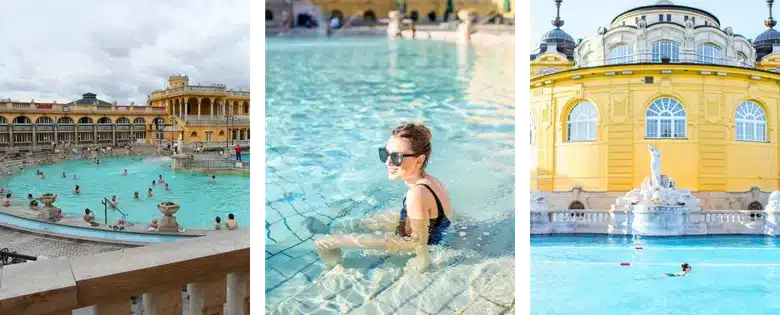
Pack Properly for the Pools
Bring a swimsuit, flip-flops and a towel, because renting basics on site adds cost and slows everything down. A swimming cap is required in the outdoor lap pool when lane swimming is running, and staff enforce it. A standard ticket comes with a locker, while a cabin gives you a private changing cubicle that most people find more comfortable in colder months.
That short list reflects how structured bath-going remains in Budapest. Even in one of the city’s biggest complexes, the routine still owes something to older urban bath culture, where changing, washing, swimming and soaking followed a clear order. Tourists fill the place, but it also runs on habits shaped by regular bathers who treat it less as a spectacle and more as part of everyday city life.
Understand Which Pool Does What
Not every pool at Széchenyi serves the same purpose. Outside, the three main pools are a lap pool for swimming, an adventure pool with a whirlpool current, and a thermal sitting pool held around 38°C. Inside, multiple thermal pools sit at different temperatures alongside saunas and steam rooms. Check the posted temperature boards before getting in, because some medicinal pools run hotter than first-time visitors expect, with a few reaching close to 40°C.
That split between swimming, soaking and treatment sits at the centre of Hungarian bath culture. Széchenyi draws thermal water from more than 1,200 metres below Budapest, but the point was never simply to sit in hot water as long as possible. Different pools were arranged to support exercise, recovery, supervised cures and sociability, which is why the complex feels closer to a civic health institution than to a modern spa built around one uniform experience.
Choose Your Timing Around the Crowds
Go early in the morning or later in the evening for more space, particularly in the outdoor thermal pool that fills up fastest with lingering bathers and photo-takers. Midday through late afternoon is the busiest window, and Saturdays get especially crowded. Winter ranks among the best times to visit, because hot outdoor water against cold air creates the atmosphere many people come for, though that keeps the outdoor pools popular even at low temperatures.
That winter scene reflects a local habit, not a staged travel image. Budapest residents have used thermal baths through the colder months as ordinary urban routine for generations, and Széchenyi’s steaming outdoor pools became especially iconic through the 20th century as the city’s bath culture moved into modern public life. The appeal is not only the visual contrast but the sense that bathing still belongs to the seasons of the city.
Treat It as a Working Bath, Not a Photo Set
Take your photos quickly and watch where you stand, because the people around you are there to bathe, swim and rest. Loud group behaviour, blocking pool edges for pictures and treating every corner as a backdrop wears thin fast in a place this busy. Even on crowded days, the atmosphere holds up better when visitors remember that Széchenyi still works as a thermal bath with local users, treatment areas and health-oriented facilities.
That tension between landmark and utility is one of the most revealing things about it. The Neo-Baroque architecture suggests grandeur, but the bath was built to be used repeatedly by ordinary people. In Budapest, baths like this turned access to thermal water into something public and civic, which is why basic courtesy matters more here than at an attraction designed only for sightseeing.
Read the City Park Setting, Not Just the Yellow Facade
Széchenyi makes more sense once you see it as one part of Városliget’s long role as a public landscape shaped by politics, leisure and display. The bath sits near Heroes’ Square, the zoo and Vajdahunyad Castle, all within a district reworked repeatedly to show what Budapest thought a modern capital should look like. That mix of health culture, national symbolism and weekend recreation still shows in the flow of people crossing the park.
One detail many visitors miss is how democratic the setting was meant to feel, even under grand architecture. City Park gave Budapest residents a place where classes mixed more easily than in much of urban life, and the bath continued that pattern by turning medicinal water into something public rather than exclusive.
From Medicinal Water to City Life in Városliget
After a few hours in Széchenyi, the rest of Budapest opens up differently, especially if you continue through the park and then walk the old town on a Budapest free walking tour. The city reads less as a list of monuments and more as a place where imperial architecture, public bathing and everyday routine still overlap.
That is the thread running back to the start: Széchenyi was built on the idea that urban life could be shaped through shared access to health, leisure and public space. Once you have moved through its corridors and pools, the yellow façade matters less than the civic ambition behind it, still visible in the daily rhythm of bathers crossing City Park.
Frequently Asked Questions
How long should I spend at Széchenyi Thermal Bath?
Most visitors stay two to three hours, which is enough to move between the outdoor thermal pools, a few of the indoor pools and a sauna or steam room without rushing. If you plan to swim laps as well as soak, or you visit on a quieter weekday, half a day is easy to fill.
Do I need to book Széchenyi tickets in advance?
Booking online is strongly recommended, especially on weekends, holidays and summer afternoons, when on-site queues are longest. Advance booking also lets you compare locker and cabin options before you arrive rather than deciding in line.
What should I bring to the baths?
Bring a swimsuit, flip-flops and a towel, plus a swimming cap if you plan to use the outdoor lap pool during lane swimming. Renting these on site is possible but adds cost, so packing your own saves both time and money.
Is Széchenyi worth visiting in winter?
Yes. The contrast between the hot outdoor water and the cold winter air is one of the main reasons people single out Széchenyi, and the outdoor pools stay open through the season. Expect the outdoor basins to remain busy even on cold days.
How do I get to Széchenyi Thermal Bath?
The bath is in City Park at Állatkerti körút 9-11, directly served by the Széchenyi fürdő stop on metro line M1. From the city centre the ride takes under fifteen minutes, and the entrance sits a short walk from Heroes’ Square.
