


The best free things to do in Copenhagen are walking a free tour through Indre By, crossing Queen Louise’s Bridge at sunset, visiting Assistens Cemetery, entering the Black Diamond, exploring Superkilen, and reading the harbor from Islands Brygge and Slotsholmen.
Copenhagen sits on the narrow strait between the North Sea and the Baltic, and that position shaped it into a port city where trade, naval power, and brick warehouses mattered more than anything else. You feel that history in the low skyline, the canals cut through old working districts, and the constant presence of bicycles moving faster than cars.
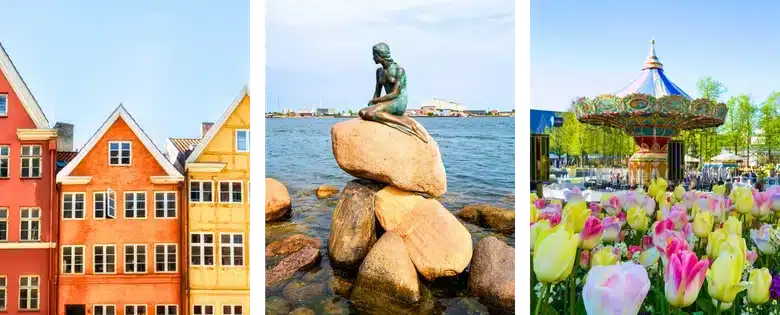
Most of these plans cost nothing, and a few are low-cost enough to fit into the same budget-friendly itinerary. Together, they’ll give you a way to read the city on its own terms.
1. Join a Free Tour of Copenhagen
Copenhagen’s street layout can be disorienting at first; the medieval core was rebuilt twice after major fires in the 18th century, and the result is a city centre that mixes Baroque planning with older canal logic. A free tour of Copenhagen pulls that together in two or three hours, connecting City Hall Square, Strøget, Christiansborg, Nyhavn, and Amalienborg into a route that makes sense of the sequence. Most tours run on a pay-what-you-want basis, so there is no fixed price upfront. A good guide will explain what each neighbourhood was originally built for, not just what it looks like now.
In Copenhagen, context matters more than spectacle, and a solid walk through Indre By, the royal quarter, and the old waterfront will make later visits to places like Christianshavn or Nørrebro feel much less random.
2. Walk Along Assistens Cemetery
Admission is free. Assistens Kirkegård in Nørrebro is both a burial ground and a public green space, which says a lot about Copenhagen’s practical relationship with urban life. Hans Christian Andersen is buried here, but the place also holds Niels Bohr and Søren Kierkegaard, turning a simple walk into a compact lesson in Danish literature, science, and philosophy. One detail many visitors miss is that local residents have used it for daily walks and quiet breaks for generations, despite periodic debates over how much leisure belongs in a cemetery.
Take the smaller paths rather than the main avenue if you want the older gravestones and more atmosphere. Early morning or late afternoon is best, and it is worth keeping your voice low and treating it first as a cemetery, second as a park.
3. See Copenhagen From the Round Tower
Admission is low-cost. The Round Tower, or Rundetaarn, was built in the 17th century as part of an astronomical complex commissioned by Christian IV, and its long spiral ramp was designed so horses could haul books and instruments up to the library and observatory above. It is one of the few places in central Copenhagen where you can still read the king’s scientific ambitions directly in the architecture. The observatory remained in scholarly use long after most royal prestige projects had become decorative backdrops.
Head up slowly and look at the changing curve of the walls, not just the final view over the rooftops. Go near opening time or just before closing for fewer people, and check whether the current observatory exhibition is open if you want more than the lookout.
4. Browse the Black Diamond Waterfront
Admission to the public areas is free. The Black Diamond is the modern extension of the Royal Danish Library, a polished slab of black granite and glass facing the harbor, but what matters is how it turned a national research library into a public urban space. Inside, the atrium catches light in a way that feels almost engineered for gray Copenhagen days, and the library often shows small cultural displays beyond the main reading functions. A less obvious fact is that the original Royal Library collection includes materials from Denmark’s colonial period, so this building also quietly connects the city to stories far beyond Scandinavia.
Walk the waterside first, then go inside to see the atrium and public areas before finding a seat with a harbor view. Late afternoon works well for the changing light on the facade, and free lockers are not a given, so travel light if you want to linger comfortably.
5. Cross Queen Louise’s Bridge
Admission is free. Dronning Louises Bro is not just a bridge but one of the clearest social crossroads in the city, linking the center with Nørrebro over the Sortedam Lake. It is famous for bike traffic, but the real story is how it became a stage for everyday Copenhagen after redesigns prioritized cyclists and pedestrians over cars. The bridge carries tens of thousands of cyclists on a busy day, which is why it feels less like infrastructure and more like a live demonstration of the city’s transport culture. On warm evenings, people line the edges with cans from nearby kiosks and treat the bridge as if it were an outdoor balcony over the lakes.
Come around sunset and stand still for a few minutes rather than treating it as a crossing. If you want the full effect, walk a stretch of the lakes on either side too, because the bridge only makes sense as part of the long urban water edge that locals actually use. The benches and parapets fill up fast in good weather, so arrive earlier than the after-work crowd.
6. Study the Ruins Under Christiansborg Palace
Admission is low-cost. Beneath Christiansborg Palace are the excavated ruins of earlier castles on the same site, including the medieval fortification associated with Bishop Absalon, the founder traditionally linked to Copenhagen’s origins. What makes this place worth the small fee is that it strips away the polished state-building above and shows how often power here has literally burned down and been rebuilt. The layers underground tell a more convincing story than the current palace alone, especially because Christiansborg is the only building in the world that houses a national parliament, the prime minister’s office, and the supreme court.
Give yourself time to read the plans and wall remains instead of rushing through as a palace add-on. Midday is usually quieter than the late morning rush, and the stone floors below can feel cool even in summer, so bring a light layer.
7. Watch the Harbor at Islands Brygge
Admission is free. Islands Brygge on Amager was once tied to industry, storage, and harbor labor, and that history matters more than the polished summer image it now sells. The harbor bath gets the attention, but the broader story is urban cleanup: these waters were once too polluted for swimming, and their recovery became a point of civic pride after years of investment in sewage infrastructure. If you want a sharper reading of Copenhagen than the usual design clichés, stand here and look at how former working waterfront became prime public space without pretending the industrial past never happened.
Come for a slow walk along the quay, watch swimmers cut through the harbor, and notice how the skyline lines up across the water toward Slotsholmen and the old center. Summer evenings are best, though the area is useful in any season if you want to see how Copenhagen treats its harbor as a public room rather than just a view. If you plan to swim, check local water quality updates when heavy rain changes conditions.
8. Enter the Church of Our Saviour
Entry to the church is free, while the tower requires a paid ticket. Most people know Vor Frelsers Kirke in Christianshavn for its external spiral staircase, but the interior deserves attention for the carved altar and the huge organ facade that anchors the space. One detail that often gets skipped is the church’s carillon, which has played across the neighborhood since the early 20th century and adds a sonic layer to Christianshavn that many visitors never identify. The church also sits in a district laid out under Christian IV as a fortified merchant area, so even stepping inside connects you to the city’s military and trading expansion.
Step inside first, then spend a few minutes outside judging whether the tower climb is worth the ticket and the head for heights. Morning is usually calmer inside, and modest behavior matters because this is still an active church, not just a monument.
9. Roam Through Superkilen
Admission is free. Superkilen in Nørrebro is an urban park with a sharper political edge than many visitors expect, built to reflect the district’s immigrant communities through objects, signs, and references from around the world. It is less about greenery than about who gets represented in public space in a capital that often markets itself as neat and consensual. The red square, black market, and green park sections were designed with deliberately different atmospheres, and several objects came from resident suggestions, not just from designers making symbolic choices from a distance.
Walk its full length and actually read the plaques on selected objects, because otherwise it can look like a stylish collage without the argument that makes it interesting. Go in the afternoon when the space is active, and combine it with surrounding Nørrebro streets if you want to understand why this project belongs here and not in some sanitized waterfront district.
10. Visit the Copenhagen City Hall Lobby
Admission to the lobby area is free, while some guided visits and the tower have a fee. Copenhagen City Hall is one of those civic buildings that tells you how seriously the city takes municipal identity, with its National Romantic style, heavy brickwork, and decorative interiors. A concrete detail worth knowing is that Jens Olsen’s World Clock, housed inside, took decades to complete and is still regarded as one of the most advanced mechanical clocks ever built. This is not just administrative space but a statement about science, craftsmanship, and public authority.
Go inside to see the main hall and check whether the clock area is accessible during your visit. Weekday daytime is the safest bet, and it is worth looking up from the floor patterns to the timber ceilings because much of the building’s character sits above eye level.
Through Slotsholmen and the Harbor
Copenhagen makes the most sense when you remember it was shaped by water, trade, and a habit of rebuilding rather than by grand scale alone. That is why the city reads best from places like Slotsholmen, Christianshavn, and the harbor edge, where power, shipping, and daily life still sit close together. The narrow strait from the introduction is not background scenery. It is the reason the warehouses existed, the reason the navy mattered, and the reason so much of the city still turns outward toward water instead of inward toward monuments.