
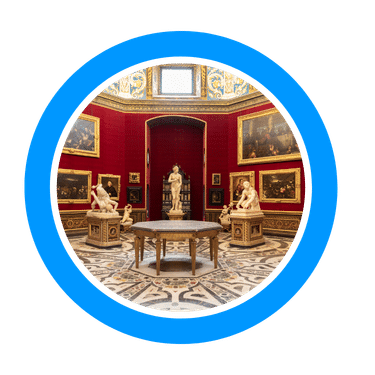

Reserve the Uffizi Gallery before the day you visit, especially between April and October, because timed entry can save you from losing the best morning window outside Piazzale degli Uffizi. Standard admission costs about €25, while a guided tour costs around €64 and makes sense if you want skip-the-line entry, a structured route and context for reading the Uffizi as a Medici power corridor, not just a room-by-room art museum.
With an English-speaking guide and a route lasting about 1.5 to 2 hours, the visit can connect Giotto, Cimabue, Botticelli, Leonardo da Vinci, Michelangelo, and the Medici collection to the building that frames them. The Botticellis are the headline, but the Uffizi itself is part of the story, from the long internal perspectives to the windows that keep pulling your eye back to the Arno, the Vasari Corridor and Palazzo Vecchio.
Built as government offices for Cosimo I de’ Medici, the Uffizi was never conceived as a neutral museum. What many people experience today as a sequence of masterpieces began as an architectural argument about who ran Florence and how they wanted to be seen.
1. Book a Timed Ticket
The Uffizi normally opens Tuesday to Sunday from 8:15 to 18:30, with the ticket office closing at 17:30, and it is closed on Mondays, 1 January, and 25 December. If you enter near opening time, you can use the first hour for the upper-floor route before the Botticelli rooms thicken with groups. From 10:30 onward, the visit often feels more like crowd management than slow looking.
That pressure on entry reflects a modern problem inside a building designed for control rather than comfort. The Uffizi channels people through a space first conceived for magistrates and officials, not mass tourism. Vasari’s long, disciplined axes were part of a political language, and seeing them without starting the day in a crowded holding pattern changes how clearly that language comes across.
2. Begin on the Upper Level Before the Crowds Thicken
Head up to the top floor as soon as you enter, since the main chronological route starts there. Rooms 10 to 14, where many visitors make a beeline for Botticelli, Leonardo, and Michelangelo, tend to become noticeably busier from late morning onward. Starting early gives you a quieter first hour and a better chance to see the sequence of rooms as a narrative rather than a series of stops for quick photos.
That upper route also helps explain what made Florentine painting so influential. In a relatively short walk, you can trace the shift from medieval panels with gold backgrounds to pictures built around depth, anatomy, and human presence. One of the most revealing details is how workshop practice shaped that change: masters, assistants, and apprentices often worked side by side, which is why some rooms are more useful when read as evidence of collaboration than as a parade of isolated geniuses.
3. Limit Your Route to Key Rooms Instead of Trying to Cover Everything
Pick a route you can actually sustain. For many visitors, that means the early Tuscan rooms, the Botticelli rooms, Leonardo and Michelangelo, then Caravaggio before leaving. The Uffizi is large enough that a full pass can easily take three hours or more, and fatigue often sets in just when people reach the works they most wanted to see.
This matters because the gallery’s strength is density, not just fame. Around Botticelli’s Primavera and Birth of Venus, for example, the surrounding panels help decode the court culture that shaped them, including marriage imagery, classical references, and the visual language of elite patronage in late fifteenth-century Florence. Looking at only the headline works without their neighbours can flatten the collection into a checklist.
4. Use the Windows to Reconnect the Paintings to the City Outside
Pause at the windows over the Arno and toward Palazzo Vecchio instead of treating them as dead space between rooms. From inside the galleries, you get framed views of the river, the historic centre, and the line of the Vasari Corridor crossing the Ponte Vecchio. When the rooms feel crowded, those pauses also help reset your eye before the next run of paintings.
The views are not incidental. Vasari built the Uffizi as part office block, part urban stage set, and those sightlines keep the city in play while you look at art. They also hint at a practical side of Medici rule that visitors often miss: visual command mattered in Florence, where trade, government, ceremony, and family prestige all occupied the same compact centre. Looking out from the gallery makes that overlap easier to grasp.
5. Finish in the Courtyard Instead of Walking Straight Back to the Street
Do not rush out the moment you leave the main galleries. Spend a few extra minutes in the ground-floor spaces and the courtyard, especially if you exit toward Piazza della Signoria. Even five or ten minutes here can reset the visit, because after hours of framed paintings you are back in a civic passage that still feels tied to the city’s political centre.
The courtyard was conceived as a working urban corridor, not as a decorative afterthought. Its role was to organize movement between institutions in the Medici core of Florence. Ending here underlines something easy to forget upstairs: the Uffizi was inserted into the machinery of government first, and only later became the kind of museum people travel across the world to see.
6. Read the Medici’s Politics in Stone and Paint
One of the least discussed aspects of the Uffizi is how tightly it was tied to surveillance and controlled access. The Medici did not simply commission art and collect it tastefully. They shaped movement through the city itself, and the Uffizi formed part of that system, especially once the elevated Vasari Corridor linked Palazzo Vecchio to Palazzo Pitti through and above the Ponte Vecchio. That private route allowed the ruling family to move unseen over workshops, streets, and river traffic, turning Florence into something close to a stage set for power.
Inside the gallery, that history lingers in the way the building channels you forward while constantly offering strategic views outward. It is one reason the Uffizi feels different from later museums built as public temples to art. The place still carries the habits of a court, where display, access, and authority were never separate things.
From the Arno Windows to Piazza della Signoria
After the Uffizi, walk straight into the civic heart of the city instead of mentally ticking the museum off and moving on. The route makes more sense once you have seen how art, government, and spectacle were bound together here, and a free tour of Florence helps place those buildings back into the life of the streets around them.
When you map out the rest of the day, leave room for traditional food in Florencia as well as the churches, markets, and squares usually grouped under the best of Florencia. The most useful plans combine a few major sights with time to wander, because many of the real things to do in Florencia happen in the transitions between one historic room and the next.
By the time you step back into the open air, the windows and corridors from the opening of the visit should make more sense. What first seemed like a museum layout starts to read as a system for directing sight, movement, and status. Seen from Piazza della Signoria, the Uffizi is still doing what it was built to do: turning Florence itself into part of the display.
