


Visit Amber Fort close to opening time, allow at least 2.5 to 3 hours, and read the palace as a sequence of gates, courtyards, water systems, and viewpoints rather than as a quick stop for Sheesh Mahal photos.
For nearly two centuries, before Jaipur was laid out on the plain in 1727, this was the political centre of the Kachwaha Rajputs, built to control the route north and to stage power in a landscape of ridges, lakes and defensive walls.
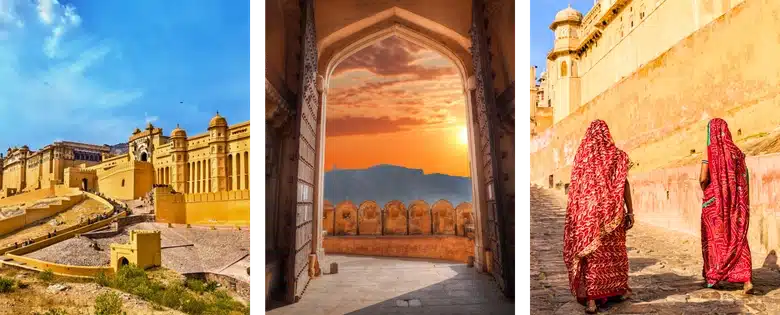
Seen from below, the fort looks like a single monument in honey-coloured stone. Inside, it is really a sequence of thresholds, each one narrowing who could go further. That is the useful way to visit Amber: not as a collection of photo spots, but as a carefully managed progression from outer gate to inner court.
If you want that sequence explained while you move through the fort, an Amber Fort guided tour with entry ticket is the cleanest way to visit without reducing the palace to disconnected photo stops. The visit usually lasts 1.5 to 2.5 hours and helps you follow the route through Jaleb Chowk, Diwan-i-Aam, Diwan-i-Khas, and Sheesh Mahal with context for the Rajput, Mughal, and Kachwaha layers behind the carvings, frescoes, gates, and courtyards.
1. Arrive Early for the Ramp and Main Courtyards
Reach Amber Fort close to opening time so you can move through Jaleb Chowk and the ascent beyond Suraj Pol before the site fills with tour groups. Morning light falls better across the sandstone façades and Maota Lake, and the climb from the parking area is far easier before late-morning heat builds. Buy your entry ticket at the official counter or online in advance if that option is available on your date, since queues usually build quickly after the first group arrivals.
Amber was designed to regulate access, so arriving early changes more than the light. Jaleb Chowk was the parade ground where returning armies displayed spoils and where royal processions assembled before moving inward. The open scale of that first court was deliberate. It staged power publicly before visitors encountered the tighter sequence of guarded gates, stairways and elevated palace rooms above.
2. Trace the Route From Diwan-i-Aam to Sheesh Mahal
Walk the fort in order instead of heading straight for the mirror palace. Start at the Diwan-i-Aam, continue through Ganesh Pol into the more private palace zone, then spend time in Jai Mandir and Sheesh Mahal. That sequence makes the site easier to read and saves you from doubling back through narrow passages that often clog when large groups stop for photos.
Ganesh Pol does more than decorate the route. It marks a real shift in court protocol, from spaces where petitioners and officials might gather to zones tied to the ruler’s household. The floral painting and refined surfaces here reflect more than taste. They show how the Kachwahas adapted techniques associated with Mughal luxury for a Rajput hill court, especially in rooms designed for controlled access, seasonal comfort and ritual display rather than open public use.
3. Choose the Walk or Jeep Instead of the Elephant Ride
Elephant rides up to Amber Fort remain part of its tourist image, but walking or taking a jeep is usually the more practical option. The uphill route is manageable for most visitors if taken steadily, and jeeps operate from the base area when heat, limited time or mobility concerns make the climb less appealing. Both options are typically quicker than waiting in a long queue on the slope.
Approaching Amber without the elephant ride also helps the site read more clearly. The fort was planned around defended ascent, controlled gates and a dramatic reveal from below. On foot or by road vehicle, you notice how the walls follow the ridge and how the entrance route exposes visitors before drawing them inward. That experience is closer to the logic of a fortified capital than the later tourist image that reduced the approach to spectacle.
4. Study the Water System, Not Just the Mirrors
Many visitors rush through the reflective interiors and miss the engineering outside. From the upper sections, pause to look toward Maota Lake and the slopes below the fort, where the relationship between water storage, garden design and hill-fort planning becomes easier to grasp. Carry your own water, especially in hotter months, because the exposed terraces can feel draining and shade becomes patchy once you move away from the main halls.
Water shaped Amber at every level. Maota Lake was part of a broader system of capture, storage and distribution that supported both court life and defence in a dry landscape. Even the formal garden below, often treated as a scenic foreground, helped express control over scarce resources. In a Rajput capital built on steep ground, reliable water was political capital as much as practical necessity.
5. Extend the Visit to the Ramparts Facing Jaigarh
Set aside another 30 to 45 minutes after the palace core to look toward the fortifications linking Amber with Jaigarh Fort above. From several points along the upper areas, you can trace the defensive logic across the ridge and see how the palace below and the military complex above worked together. Many visitors leave after the inner courtyards, but the wider landscape is what makes the site coherent.
That relationship with Jaigarh explains why Amber feels both ceremonial and defensive. Jaigarh protected arsenals, watch positions and the ridge itself, while Amber remained the seat of courtly life below. The pairing reveals a division of labour within Kachwaha rule that is easy to miss if you stay only with the decorated interiors. Power here depended on what could be seen from the palace, and what could be defended from the heights above it.
Read Amber Through the Kachwaha Court, Not Just the Facade
One detail guides a better visit: the Kachwaha rulers of Amber were deeply entangled with the Mughal court, and the fort reflects that political reality in ways many visitors overlook. The painted gateways, audience halls and garden planning are not simply Rajput survivals or Mughal borrowings. They show a ruling house that was negotiating status through architecture, presenting itself as both regionally rooted and fully conversant with imperial taste.
Jaipur later became famous for its planned streets, astronomy and painted facades, but Amber preserves the older courtly habit of rule by enclosure, access and vantage. Even the famous views are political. Looking down over Maota Lake or out across the hills was part of how authority was staged here, with the ruler literally elevated above approach roads, courtyards and petitioners.
From the Ridge Above Maota Lake to Jaipur’s Ordered Streets
After Amber, Jaipur reads differently, especially once you have seen how power was first organised on the ridge above Maota Lake and then recast in the open geometry of the later city. A free tour of Jaipur helps connect those two worlds, from the old hill capital to the planned avenues below. The shift is not just architectural. It changes how you understand the city, looking back at the fort.
That shift begins at Maota Lake. From the ridge above it, authority was staged through ascent, enclosure and controlled entry. In Jaipur, the same ruling house translated power into straight streets, planned visibility and urban order. Once you have walked Amber’s thresholds, the city below stops looking decorative and starts to read as a deliberate answer to the hill capital above.
