

Free walking tour
Free Tour of Guimaraes
8.8 Fabulous · 63 reviews (as of Nov 2026) Free cancellation
Choose your date
Civitatis displays availability and confirms bookings on its own site.
One of the stranger details in Guimarães survives in plain sight: the small Church of São Miguel preserves ten of the twelve consecration crosses used to dedicate a church. Local tradition also links it to the baptism of Afonso Henriques, the ruler who declared Portugal independent in 1139 and became its first king. That mix of documented history, civic ritual and persistent legend runs through the whole old town, where granite facades, arcades and medieval street lines still shape daily life.
This free walk takes in the places that give Guimarães its weight in Portuguese history, including the Castle of Guimarães, the Palace of the Dukes of Braganza, the Church of Nossa Senhora da Oliveira and the main squares around Largo da Oliveira and Largo do Toural. You will also see exterior views of churches that add detail rather than decoration, from São Miguel to São Francisco and the Basilica of São Pedro. Along the way, the medieval walls and the famous sign declaring that Portugal was born here place the city’s old claim front and centre.
The tour lasts 2 hours and is led in English by an English-speaking guide. You meet at Padrão do Salado and finish near the Church of Nossa Senhora da Consolação e Santos Passos. The English-speaking guide is included, and tipping the guide is up to you. The walk is not wheelchair accessible.
What You’ll See on the Free Tour of Guimaraes
Church of Nossa Senhora da Oliveira
You will see one of the key religious buildings in the historic centre, rebuilt by King João I after the Battle of Aljubarrota in fulfilment of a vow to the Virgin. That ties the church directly to one of late medieval Portugal’s defining victories, not just to local devotion. In the square around it, you can also notice how the old monastic core shaped the lower town, one of the two poles around which medieval Guimarães developed.
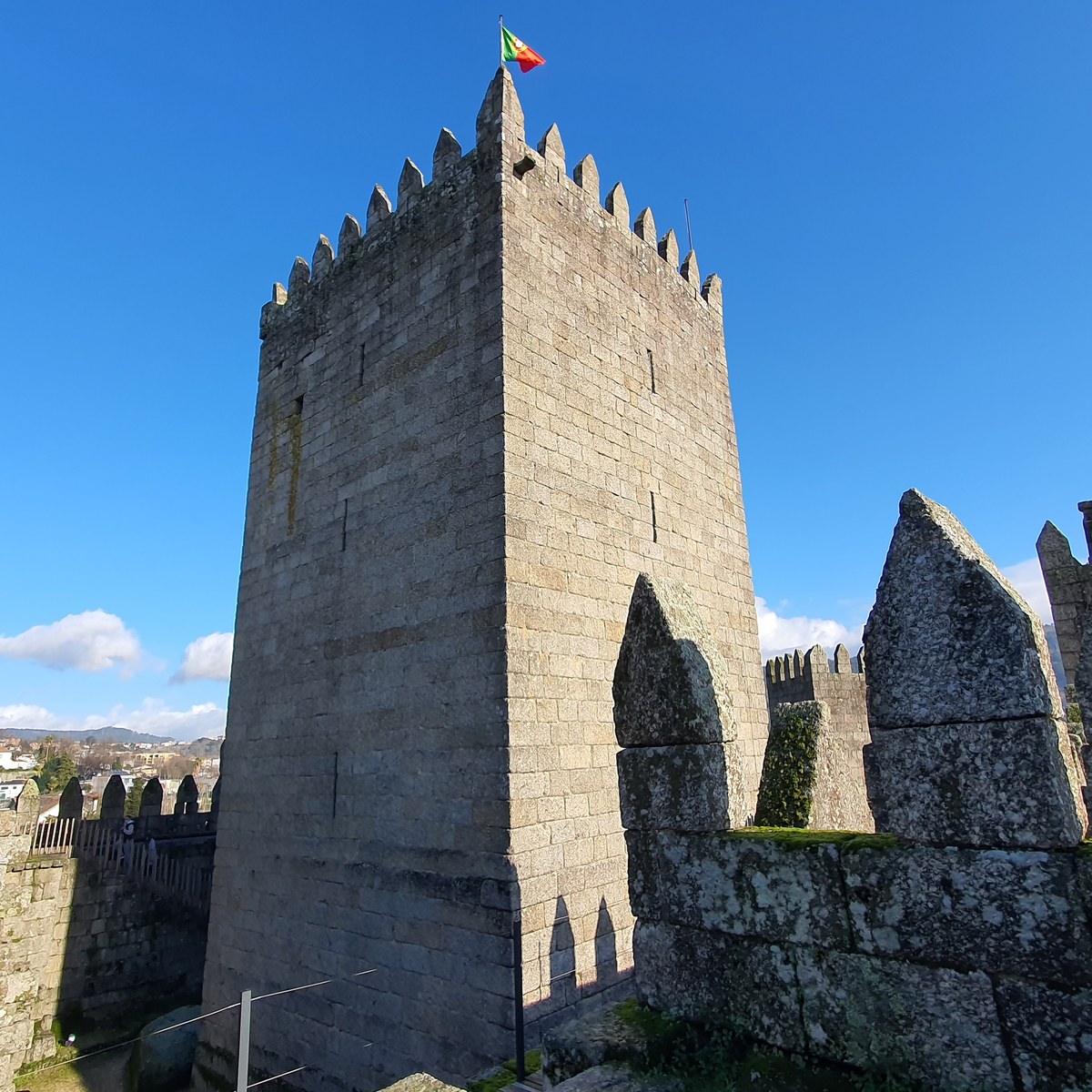
Castle of Guimarães
The castle began as a defensive foundation of Countess Mumadona Dias between about 950 and 957, built to protect the monastery she had established below and the people gathering around it. A document from 4 December 968 is the earliest known reference to the castle. Much of the fortress silhouette seen today comes from later work by King Dinis, who added the keep and the eight towers flanking the walls in the 13th and 14th centuries.
Palace of the Dukes of Braganza
You will see the great ducal palace that started in the 15th century as the residence of D. Afonso and D. Constança, Dukes of Braganza. Its history is less smooth than its stonework suggests: it was abandoned between the 16th and 18th centuries, used by the military in the 19th, and reopened in 1959 as a museum and the official presidential residence in northern Portugal. That long interruption helps explain why the building belongs as much to modern heritage policy as to medieval princely life.
Churches Seen Along the Route
The route also includes exterior views of several churches that help explain how dense the religious landscape of Guimarães once was. The Basilica of São Pedro began construction in 1737 and became the first church in the Archdiocese of Braga to receive the title of minor basilica in 1751. Only one of the two planned towers was built, and its bell still marks every quarter hour. The Church of São Francisco is a Baroque building noted for one of Guimarães’s most important Joanine gilded wood retables and for azulejo panels showing the life and miracles of Saint Anthony.
Church of São Miguel
From the outside, this small church looks modest, but it carries unusually dense symbolism. The earliest known reference to it dates from 1216, and tradition associates it with the baptism of Afonso Henriques. It also preserves ten consecration crosses, and in medieval times some municipal hearings were held under its porch, which means the building served civic business as well as worship.
Squares and Walls of the Historic Centre
The walk takes in Largo de Santiago, Largo da Misericórdia, Largo de São Damasco, Largo da Oliveira, Padrão do Salado and Largo do Toural, plus the medieval city walls with the sign saying that Portugal was born here. Largo de Santiago marks the site of a chapel dedicated to Saint James on the road to Santiago de Compostela. Largo da Misericórdia lies inside the UNESCO-listed historic centre, whose buildings show the town’s evolution from the Middle Ages to the 19th century. In the Alameda de São Dâmaso, you find a central garden with bandstand and sculptures, including the monument to Gil Vicente.
Largo da Oliveira and Padrão do Salado
This square is one of the clearest expressions of old Guimarães, where religious monuments, arcades and everyday urban space meet. Largo da Oliveira takes its name from an olive tree that, according to legend, withered and then revived in 1342 after a cross was placed beside it, an event locals treated as miraculous. At Padrão do Salado, your meeting point, the dense setting of granite buildings, balconies and porticoes shows why the historic centre is valued for preserving urban forms from the Middle Ages onwards.
Largo do Toural
You will also see the square that long functioned as one of the city’s main social spaces and was once used for cattle fairs. Largo do Toural was not just ceremonial: the old road to Porto ran out from here along Rua D. João I, linking local commerce with regional movement and trade. It is a useful place to read Guimarães as a working town, not only as a backdrop to royal origin stories.
History and Curiosities of Guimaraes
Mumadona Dias and the Two Birthplaces of the Town
Around 950, Countess Mumadona Dias founded the Monastery of Santa Maria in lower Guimarães and then, between about 950 and 957, established the castle on the hill above. Those two foundations, one religious and one defensive, shaped the town’s growth for centuries. The walled historic centre later developed around these two poles, and you can still read that arrangement in the way the upper fortress and lower church precinct relate to each other.
The 12th Century and the Idea of Portugal
Guimarães is closely tied to Portuguese state formation, not simply because a famous king is associated with it, but because its early history is linked to the establishment of Portuguese national identity and language. In 1139, Afonso Henriques declared Portugal independent from León and became Afonso I. The phrase that Portugal was born here is therefore not just a slogan for visitors, but a compressed version of a political story rooted in the 12th century.
The Olive Tree Legend of Largo da Oliveira
Legend says that the square’s olive tree had dried out and then revived in 1342 after a cross was set beside it. Whether or not you take the story literally, it reveals how medieval communities interpreted urban space through signs and miracles. The name of the square itself keeps that story alive, so a casual place-name turns out to carry a centuries-old local memory.
Odd Customs at São Miguel
The Church of São Miguel generated customs that now sound half devotional, half folkloric. One local tradition held that pregnant women walked three fast circuits around the church and threw pebbles through the chancel slit to ask Saint Margaret whether the child would be a boy or a girl. Add that to the church’s role in municipal hearings, and the building becomes more than a sacred monument: it was once entangled with justice, childbirth anxieties and public belief.
More Than a Royal Story
Although Guimarães is often reduced to kings and origins, the city’s heritage is broader. The historic centre is prized for granite buildings, iron verandas, balconies, porticoes and arches, and for a local construction technique that combines granite with timber framing. Beyond the classic monuments, the Couros district preserves tannery structures and workers’ housing, showing that the city’s past also includes labour, industry and everyday urban life.
Local Life, Traditions and Food in Guimaraes
Squares, Streets and Everyday Town Life
The historic centre is compact, and that matters because Guimarães works best at walking pace. Narrow medieval streets open into small squares where civic and religious buildings sit side by side, and details such as granite arcades, iron verandas and timber-framed upper storeys are part of ordinary urban fabric rather than isolated showpieces. After the tour, one of the best free things to do in Guimaraes is simply to keep exploring these connected squares on foot and notice how the town changes from fortress-focused spaces to more commercial ones around Toural.
Festas Nicolinas and the Procession of Santos Passos
Guimarães still keeps strong annual traditions. The Festas Nicolinas, student festivities in honour of Saint Nicholas of Myra, are documented from at least 1664 and include events such as the Pinheiro, Pregão, Maçazinhas, Danças de S. Nicolau and Baile Nicolino. During Lent, the Procession of Santos Passos departs from the Church of Nossa Senhora da Consolação e Santos Passos, the area near where this tour finishes, showing that these monuments remain active parts of civic and religious life.
Traditional Food of Guimaraes
If the walk leaves you ready for something sweet, the traditional food of Guimaraes includes several convent desserts with a strong local identity. Torta de Guimarães is made with eggs, almonds and gila jam, while toucinho-do-céu is known as a rich, moist cake with convent roots in the region. Both are linked locally to the Clarist nuns of the former Convent of Santa Clara. Other local sweets include pudim de ovos, leite creme queimado and brisas de Guimarães, while Christmas tables often feature aletria, mexidos, rabanadas and sopas secas. Many visitors pair local dishes with Vinho Verde, the regional wine commonly associated with Minho cooking based on local and seasonal ingredients.
Tips for the Free Walking Tour of Guimaraes
- Wear comfortable shoes with grip, because the historic centre has stone paving, small level changes and stretches around old walls and monuments that can feel slippery after rain.
- Morning and late afternoon light are usually the best times to read the granite architecture and photograph the squares, while summer can feel hotter than the compact centre first suggests.
- Bring a little cash if you may want to leave a tip at the end, since Tipping the guide at the end is up to you.
- This walk is not wheelchair accessible, pets are not allowed, and you can book up to 1 hour before the start if places remain. If you cannot attend, cancel your reservation so the guide is not left waiting for you.
- Leave a little time after the tour for Largo do Toural or a nearby café, because that part of town has long been one of Guimarães’s main meeting places and gives useful context beyond the monuments.
Frequently Asked Questions
Where do I meet the guide for the free tour of Guimaraes?
You meet the guide at Padrão do Salado. Check the exact spot in your booking confirmation as well, because meeting points can occasionally shift due to seasonal changes, demonstrations, concerts or works.
Which places does the free tour of Guimaraes visit?
The walk includes the Church of Nossa Senhora da Oliveira, exterior views of the Basilica of São Pedro, the Church of São Francisco and the Church of São Miguel, plus the Castle of Guimarães and the Palace of the Dukes of Braganza. It also takes in Largo de Santiago, Largo da Misericórdia, Largo de São Damasco, Largo da Oliveira, Padrão do Salado, Largo do Toural and the medieval city walls with the sign saying that Portugal was born here.
How much time should I set aside for the free tour of Guimaraes?
Set aside 2 hours for the tour itself.
What language is the free tour of Guimaraes in?
The tour is in English. It is led by an English-speaking guide.
Where does the free tour of Guimaraes finish?
The walk ends near the Church of Nossa Senhora da Consolação e Santos Passos.
What is Guimarães known for?
It is known above all for its role in the formation of Portugal and for its 12th-century links to Portuguese national identity. It is also known for its UNESCO-listed historic centre, where medieval street patterns, granite buildings and later urban layers are still clearly visible.
Is Guimarães worth visiting?
Yes, especially if you want a compact historic centre where major monuments, small squares and medieval streets can be explored on foot. It suits travellers who prefer concentrated history over a larger city spread across many neighbourhoods.
Is Guimarães only about medieval kings?
No. The royal and early national story is central, but the city also has strong religious traditions, living public squares and a later industrial side visible in the Couros area, where tannery remains and workers’ housing survive. That broader picture makes Guimarães more than a single-origin story in stone.
Popular Activities in Portugal
Free Tour of Lisbon

Free Tour of Porto

Free Tour of Agueda
