

This 3-hour knife-making workshop in Kyoto lets you forge a real Japanese-style knife under the guidance of experienced instructors, with instruction available in English and Japanese. You heat the metal until red-hot, shape it repeatedly with a hammer, refine the blade, sharpen it with stones and grinders, polish the final surface and take the finished knife home. The completed knife measures approximately 13 to 15 centimetres, with slight variations because each one is made by hand.
This is much more hands-on than a workshop built around decorating, sharpening or attaching a handle to a blade that was already finished. The central part of the experience is forging itself. You work at the furnace and anvil while the instructors teach you how hammer angle, rhythm and placement gradually transform the heated metal into a usable knife.
Everything required for the workshop is supplied, including traditional blacksmith clothing, a towel, water, tools, knife-making materials, a box and a carrying bag for the finished piece. Beginners are welcome, and the class begins with instruction on tools and safety before anyone starts working with the forge.
The default meeting location is in Kyoto’s Sakyo Ward at 168-1 Yase-no-secho, close to the Eizan Electric Railway. However, the workshop operates from two forging studios, Studio NIN Yase and Studio NIN Kendo. Check the message sent before your session and travel to the studio specifically assigned to your booking.
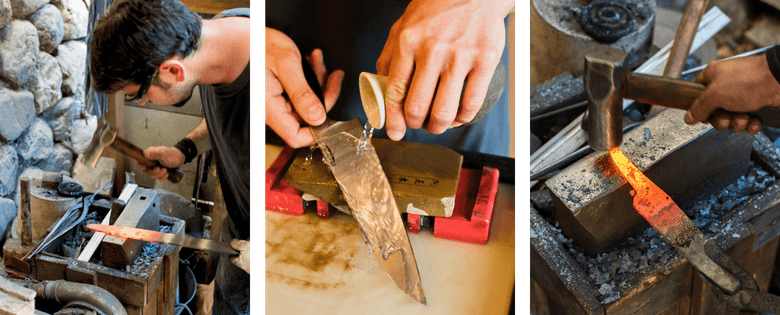
How the Kyoto Knife-Making Workshop Works
The complete booked experience lasts 3 hours. Once you arrive, the instructors welcome you to the forge and provide the traditional craftsman’s clothing used during the session.
Before working with hot metal, you receive an introduction to the equipment. Hammers, tongs, grinders and sharpening tools all form part of the workshop, so the instructor explains how they are handled and where your hands and body should be positioned while working.
The next step introduces the basic forging process used during the class. You learn how heating changes the metal and why shaping needs to happen while the material is hot enough to respond to repeated hammer blows.
The metal is then placed in the furnace until it glows red-hot. Once it reaches the required working condition, you move to the anvil and begin hammering under close supervision.
After forging, the blade is cooled and checked. Rough edges are refined and the shape is prepared for sharpening. You then work with sharpening stones and grinders before polishing the knife for its final finish.
The workshop concludes with the completed handmade knife, approximately 13 to 15 centimetres long. A box and bag are included so the finished piece can be packed after the activity.
Forging the Blade from Red-Hot Metal
Forging is the central skill in this experience. The metal is heated in the furnace until it becomes visibly red, giving you a clear sense of the temperature required before it can be reshaped efficiently.
Timing matters because the material begins cooling as soon as it leaves the heat. You therefore work in repeated cycles, heating when necessary and then returning to the anvil while the metal remains workable.
Learning the Hammering Technique
The instructor teaches you how to hold the hammer and how changes in angle, rhythm and strike position affect the developing knife. Hitting harder is not automatically better. Controlled blows allow you to move the metal while maintaining a useful shape.
This is one reason the experience works even for beginners. You are allowed to perform the actual forging, but the instructor remains close enough to correct your movement before repeated strikes push the blade too far in the wrong direction.
Shaping a Handmade Knife
Each participant’s result varies slightly. The finished knife is expected to measure roughly 13 to 15 centimetres, but handmade forging means its exact proportions and surface will reflect the work completed during your particular session.
The workshop deliberately uses a relatively compact knife so participants can experience the full process within a few hours. Larger kitchen knives require considerably more time to forge, refine and finish.
The goal is therefore not to reproduce an industrially uniform product. You leave with a practical knife that visibly records some of the hammering and shaping involved in making it.
Sharpening, Polishing and Your Finished Knife
Forging creates the basic form, but a shaped piece of metal is not yet a finished kitchen knife. Once the blade has cooled and its rough geometry has been refined, the class moves into sharpening.
Sharpening the Edge
Under the instructor’s guidance, you use sharpening stones and grinders to develop the cutting edge. This stage requires a different kind of control from hammering because small changes in angle can affect the final geometry of the blade.
The instructors help beginners through the process rather than expecting previous sharpening experience. The aim is to finish with a functional knife rather than simply a forged metal souvenir.
Polishing and Final Finish
After sharpening, the blade is polished and checked. The final finishing stage cleans up the surface and brings together the work completed at the furnace, anvil and sharpening station.
Photos and videos are welcome throughout the workshop, so you can record the different stages while the knife develops from heated metal into the finished object.
Taking Your Knife Home
The knife you make belongs to you and is ready to take home after the class. A box and carrying bag are provided as part of the experience.
If you are flying after the workshop, plan how you will transport the knife before arriving at the airport. Sharp knives should normally travel in checked baggage rather than cabin luggage, and airline, transit-country and destination rules can differ.
Studio Location, Safety and Frequently Asked Questions
The default meeting address is 168-1 Yase-no-secho in Sakyo Ward, close to the Eizan Electric Railway. The location is described as approximately one minute from the nearest station exit, and arriving by train is recommended.
There are two forging studios in Sakyo Ward, Studio NIN Yase and Studio NIN Kendo. Both offer the same workshop, but reservation levels can determine which location is used. Check the final studio message before leaving rather than relying only on the default address.
Bring socks. The workshop supplies the costume, towel, water, tools, materials and packaging. Alcohol and drugs are prohibited because the activity involves a furnace, hot metal, hammers, grinders and sharp tools.
The experience involves sustained standing, repeated hammering and work around high temperatures. It is not wheelchair accessible and requires a reasonable level of physical fitness. It is also not recommended for pregnant travelers or people with significant spinal or cardiovascular conditions.
How Long Does the Kyoto Knife-Making Workshop Last?
The booked activity lasts 3 hours, including the introduction, forging, refining, sharpening, polishing and final questions.
Do I Really Forge the Knife Myself?
Yes. Participants heat the metal and perform the hammering themselves under close instruction. You also take part in refining, sharpening and polishing the finished knife.
How Big Is the Finished Knife?
The completed handmade knife measures approximately 13 to 15 centimetres, although the exact size varies because each piece is forged individually.
Can I Take the Knife Home?
Yes. The finished knife is yours to keep, and a box and carrying bag are included. If you are flying, check current airline and baggage rules for transporting knives before your departure.
Which Studio Should I Go To?
The workshop uses Studio NIN Yase and Studio NIN Kendo in Sakyo Ward. The default meeting information points to the Yase location, but the final message sent before your session confirms the studio assigned to your reservation.
What Languages Are Available?
Instruction is available in English and Japanese.
Can Children Join the Workshop?
The current participation information is inconsistent for guests under 15. The structured booking conditions classify the workshop as unsuitable for children under 15, so age 15 should be treated as the practical minimum unless younger participation is confirmed before booking.
Is the Workshop Wheelchair Accessible?
No. Current accessibility information for this workshop lists it as not wheelchair accessible and recommends a moderate level of physical fitness.
Can I Take Photos and Videos?
Yes. Personal photos and videos are welcome throughout the knife-making process.
Popular Activities in Kyoto

Candlelit Zen Meditation

Kendo and Samurai Experience with Gear

Chopstick Making Workshop in Kyoto
