

Free walking tour
Free Tour of Palermo
9.3 Exceptional · 17,008 reviews (as of Nov 2026) Free cancellation
Choose your date
Civitatis displays availability and confirms bookings on its own site.
At Quattro Canti, four palace corners were cut back between 1609 and 1620 to create a compact Baroque crossroads that divided Palermo’s old city into four historic districts. Each facade is layered with civic symbolism: a fountain for one of the city’s old rivers, an allegory of a season, a Spanish king and a patron saint. It is also known as the Teatro del Sole because at least one side is lit by the sun throughout the day, a clue to how deliberately Palermo staged its urban centre.
This free tour introduces central Palermo through places that reveal how many different periods and cultures meet in a short walk. You start at the entrance to Sant’Ignazio all’Olivella Church, continue towards Piazza Verdi and the facade of Teatro Massimo, pass through the 20th-century Galleria delle Vittorie, then reach Quattro Canti, Piazza Bellini, the exterior of La Martorana, Corso Vittorio Emanuele and the exterior of Palermo Cathedral. The route follows the two historic axes that still organise everyday movement through the old city.
You meet at the Church of Sant’Ignazio all’Olivella and the walk lasts 2 hours. The tour is conducted in English with an English-speaking guide. Most areas are accessible, but anyone who needs assistance must be accompanied.
What You’ll See on the Free Tour of Palermo
Sant’Ignazio all’Olivella Church
The tour begins at the entrance to Sant’Ignazio all’Olivella Church, built between 1598 and 1622 for the Oratorian Fathers, who had settled in Palermo in 1594. The design is linked to Antonio Muttone, while the facade was completed between 1655 and 1690 and marked by twin bell towers. It is a fitting starting point for a route where late Renaissance, Baroque, Norman and modern Palermo all sit within a short distance of each other.
Teatro Massimo and Piazza Verdi
In Piazza Verdi you will see the facade of Teatro Massimo, described by the City of Palermo as the largest opera house building in Italy. Construction was interrupted in 1878, resumed in 1890, and after the death of architect Giovan Battista Filippo Basile in 1891, the building was completed by his son Ernesto Basile. On the portico, look for the inscription about art renewing peoples and revealing their life, a line that captures how Palermo presented itself in the late 19th century.
Galleria delle Vittorie
The Galleria delle Vittorie on Via Maqueda opens a less familiar chapter of Palermo’s history. This commercial gallery was inaugurated on 2 October 1935 during the Fascist period. It has a quadrangular plan, five storeys, four named entrances and a central glass-and-metal-covered space. It rose in the destroyed Conceria quarter and originally opened with wall paintings by the Palermo artist Alfonso Amorelli, now almost entirely lost, so the building speaks as much about disappearance and urban change as about architecture.
Quattro Canti
At the crossing of Via Maqueda and Corso Vittorio Emanuele, Quattro Canti condenses a surprising amount of civic theatre into a small space. Created between 1609 and 1620 by chamfering the corners of four palaces, it formalised the Baroque centre of Palermo and the division of the old city into four districts. Each facade follows the same four-level scheme, turning a crossroads into a stone diagram of the city.
Piazza Bellini and La Martorana
Piazza Bellini has long been part of Palermo’s civic as well as religious core. The area was once the planum Sancti Cataldi, and in 1463 the municipal judicial seat, the Pretorium, was enlarged here on the initiative of Pretore Pietro Speciale. On this part of the route you will also see the exterior of Santa Maria dell’Ammiraglio, known as La Martorana, built in 1143 by George of Antioch, admiral to Roger II. It is one of the clearest reminders that Norman Palermo was shaped by Greek, Arab and Latin traditions at the same time.
Corso Vittorio Emanuele
You will continue along Corso Vittorio Emanuele, the Cassaro, one of the two historic axes that still structure movement through the old city. It links monuments, civic buildings and daily routes across central Palermo, so it works both as a ceremonial street and as a practical one. During the Feast of Saint Rosalia on 14 July, this same route becomes part of one of Palermo’s major urban rituals.
Palermo Cathedral
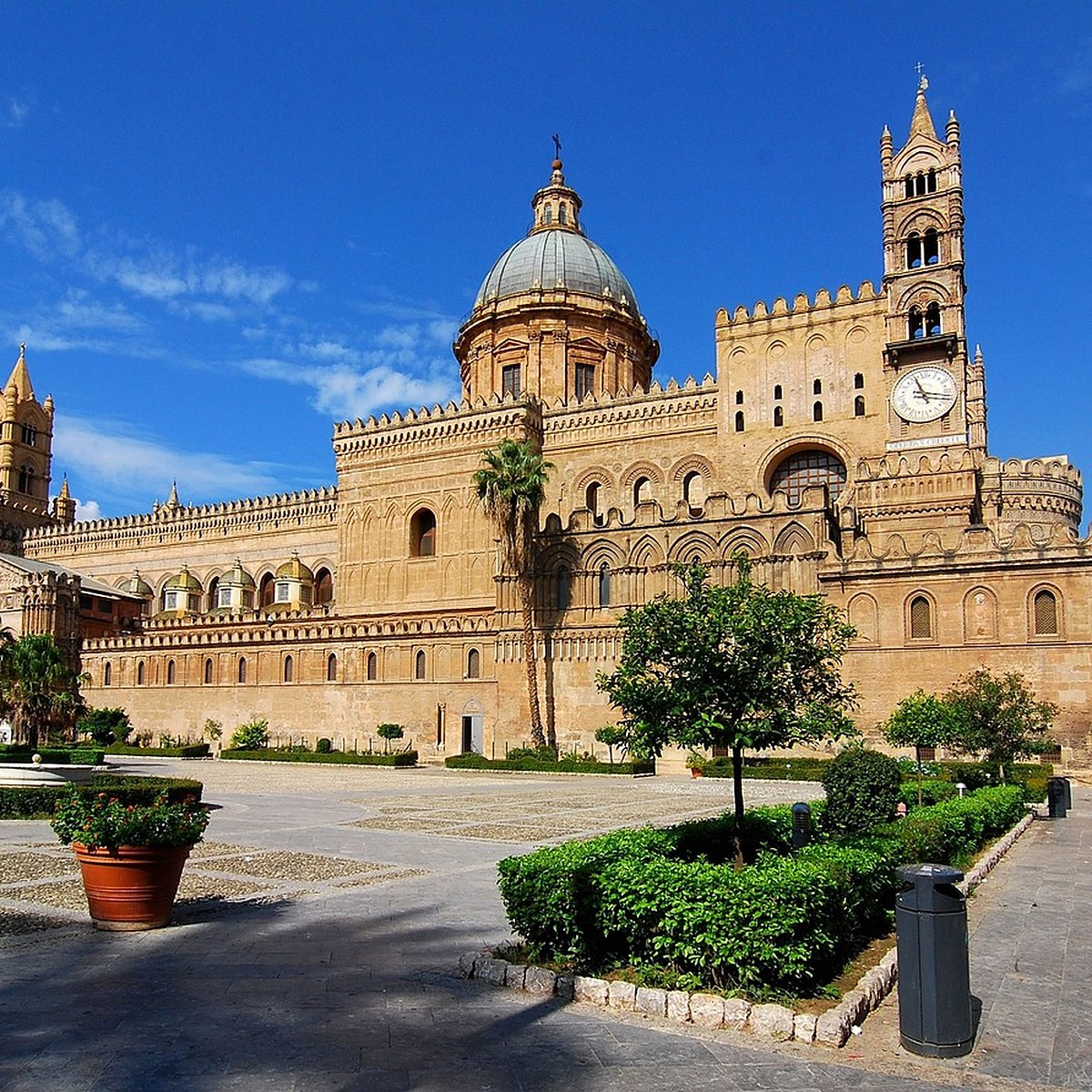
The exterior of Palermo Cathedral gathers together centuries of religious and political change. The cathedral was founded around 1185 by Archbishop Gualtiero Offamilio, but the site had already passed from Christian church to mosque and back to Christian worship, which helps explain the building’s layered identity. Inside are the royal tombs of Frederick II, Henry VI and Constance of Altavilla, and the chapel of Santa Rosalia makes the cathedral an important devotional destination as well as a dynastic one.
History and Curiosities of Palermo
The Arab-Norman City
Palermo’s most distinctive historical signature is Arab-Norman, but the term only makes sense if you treat it as a deliberate mixture rather than a single style. The UNESCO monuments of the Norman Kingdom of Sicily, from 1130 to 1194, show how Muslim, Byzantine, Latin, Jewish, Lombard and French communities shaped a shared urban culture. On this route, La Martorana and the cathedral are the strongest examples. One is directly tied to the mixed Greek-Arab-Latin court culture of Roger II, while the other stands on a site whose religious role changed more than once.
Quattro Canti as City Theatre
Quattro Canti was not only designed as a monumental crossroads. It was also used for public festivities and, at times, capital executions, which is why it was known as the City Theater. That contrast matters because it shows how early modern public space could be decorative and disciplinary at the same time. The nickname Teatro del Sole adds another layer, turning the square into a stage set animated by light as well as ceremony.
The Civic Centre Around Piazza Bellini
Piazza Bellini matters because it shows Palermo as a working civic centre, not only a collection of monuments. In 1463 the municipal seat around the Pretorium was enlarged here, and nearby Palazzo delle Aquile, today the town hall, was built in 1470 by architect Giacomo Bonfante for Pretore Pietro Speciale. It was later transformed several times, including a major remodelling between 1874 and 1891 by Giuseppe Damiani Almeyda. This area shows a civic heart repeatedly rewritten rather than frozen in one period.
The Unfinished Afterlife of Galleria delle Vittorie
The Galleria delle Vittorie tells a more awkward 20th-century story than many first-time visitors expect in central Palermo. Opened in 1935, it fell into abandonment from the 1970s and only partially reopened in 2014. Some of Alfonso Amorelli’s murals survive on the entrances, although they are now almost entirely lost. What remains is a place where decay, reuse and historical discomfort are still visible.
Local Life, Traditions and Food in Palermo
Santa Rosalia and the Ritual City
The most important annual celebration in Palermo is the Feast of Saint Rosalia, tied to the miracle traditionally believed to have freed the city from plague in 1624. On 14 July, the Festino procession follows the Cassaro through the historic centre in a mixture of music, dance, performance and devotion. Quattro Canti is one of its key ritual stages, where the collective cry of “Viva Palermo e Santa Rosalia” is raised. In mid-July, streets on this route function not just as heritage but as active ceremonial space.
How the Historic Centre Works Today
Central Palermo is easy to understand on foot because Corso Vittorio Emanuele and Via Maqueda still organise everyday movement much as they once organised ceremonial movement. Their crossing at Quattro Canti remains the city’s main urban reference point. Piazza Bellini sits within a pedestrian area, and nearby lanes were historically associated with crafts such as boilermakers and candlemakers. Teatro Massimo also lies within walking distance of the Capo market, the harbour and the station, showing how closely monuments and ordinary city life overlap.
The Traditional Food of Palermo
Palermo’s food culture is direct, filling and closely tied to street eating. Panelle are chickpea-flour fritters, often served in bread, and they are commonly paired with crocchè, the potato croquettes also known as cazzilli. You will also come across sfincione palermitano, a soft thick pizza topped with tomato sauce, onion, Sicilian caciocavallo, breadcrumbs, oregano and anchovies, as well as pani c’a meusa, a bread roll filled with spleen. Add arancine, frittola, quarumi and musso, and the pattern is clear: Palermo has a long taste for market food and nose-to-tail cooking.
Tips for the Free Walking Tour of Palermo
- Wear comfortable shoes with good grip, because the route follows long historic streets and paved squares in the centre.
- Spring and autumn are usually the easiest seasons for walking Palermo, while July is the key month if you want the Santa Rosalia celebrations, especially 14 and 15 July.
- Bring water in hot weather, as much of the walk takes place outdoors in open squares and along major streets.
- After the tour, use Quattro Canti, Via Maqueda and Corso Vittorio Emanuele as your bearings for getting around the old city on foot.
- The tour includes an English-speaking guide. It does not include tips, food and drinks, or access inside the monuments visited during the tour. Groups of more than 4 people are not allowed on the standard booking and should book a private tour. Pets are not permitted. Most areas are accessible, but an accompanying person is required if you need assistance. You can book up to the tour start time, subject to availability. If you are unable to attend, cancel your reservation.
Frequently Asked Questions
What Is the Meeting Point for the Free Tour of Palermo?
The meeting point is the Church of Sant’Ignazio all’Olivella. Check your booking confirmation before you go, as the exact meeting arrangements can occasionally change because of seasonal conditions, demonstrations, concerts or works.
What Does the Free Tour of Palermo Cover?
The walk covers central Palermo in 2 hours with an English-speaking guide. Highlights include the entrance to Sant’Ignazio all’Olivella Church, Piazza Verdi, the facade of Teatro Massimo, Galleria delle Vittorie, Quattro Canti, Piazza Bellini, the exterior of La Martorana, Corso Vittorio Emanuele and the exterior of Palermo Cathedral.
How Long Is the Free Tour of Palermo?
The tour lasts 2 hours.
What Language Is the Free Tour of Palermo in?
The tour is conducted in English with an English-speaking guide.
What Does the Free Tour of Palermo Not Include?
It does not include tips, food and drinks, or access inside the monuments visited during the tour.
What Is Palermo Known for?
Palermo is known for its Arab-Norman monuments, layered religious and civic history, historic markets and street-food culture centred on foods such as panelle, arancine and sfincione.
Is Palermo Worth Visiting?
Yes, especially if you are interested in places where different cultures left visible marks in the same streetscape. Palermo shows medieval, Baroque, neoclassical and 20th-century layers within one compact historic centre.
How Many Days Should I Stay in Palermo?
At least 2 to 3 days is a sensible minimum. That gives you time for the historic centre, major Arab-Norman sites, markets and a slower look beyond the main route.
Popular Activities in Italy

Free Tour of Rome

Free Tour of Florence
Venice Historic Center Walking Tour
