

This free walking tour of Rome runs two hours and thirty minutes with an English-speaking guide, starting under the maritime pines beside Trajan’s Column and finishing near the Colosseum after tracing the heart of the ancient city.
Rome does not ease you in gently. Within the first few minutes of the walk, you are standing in front of two thousand years of continuous urban history with no buffer between you and it. The route moves through Piazza Venezia, the Victor Emmanuel II Monument, Capitoline Hill, Michelangelo’s Piazza del Campidoglio, the Roman Forum seen from above, the Imperial Fora, and Palatine Hill, before ending at the exterior of the Colosseum.
What a guide changes is the scale. Rome’s centre reads clearly on a map but disorients in person: the Forum sits below street level, the hills are shorter than expected, and centuries of construction sit stacked on top of each other with no signage to explain any of it. A guide who knows which detail to point to turns a walk that could feel like a list of facades into something with an actual argument running through it.
The tour runs on a tips-only basis: booking secures a spot, and you decide what to pay the guide at the end. The Colosseum sits on the route but is not entered on this walk. Travelers planning to go inside afterward should check ticket types in advance, since entry queues and access tiers vary through the day.
What You’ll See on the Free Tour of Rome
Trajan’s Column and the Imperial Fora
The walk begins right at the base of Trajan’s Column, a 30-metre marble shaft wrapped in a spiral relief carving that runs the length of the column, depicting Trajan’s military campaigns in Dacia. It once stood at the center of Trajan’s Forum, the last and largest of the Imperial Fora built to give Rome’s emperors a stage separate from the older Republican Forum. Standing at ground level next to it gives a sense of scale no photograph captures.
Piazza Venezia and the Victor Emmanuel II Monument
The tour passes through Piazza Venezia, the traffic hub where several of Rome’s main streets converge, dominated by the white marble bulk of the Victor Emmanuel II Monument. Built to commemorate Italy’s first king after unification in the late 19th century, it’s often mocked by Romans for clashing with the older brick and stone around it, which is itself part of the story your guide tells about a city built in layers rather than in one style.
Capitoline Hill and Michelangelo’s Piazza del Campidoglio
From Piazza Venezia, the route climbs Capitoline Hill, the smallest of Rome’s seven hills but historically the most important, home to the ancient Temple of Jupiter. At the top sits Piazza del Campidoglio, designed by Michelangelo in the 16th century, its geometric star pattern in the pavement visible clearly only from above.
The Roman Forum from Above
Just behind the Campidoglio, a terrace opens onto a view down into the Roman Forum, the political and religious center of ancient Rome for nearly a thousand years. From here you can pick out the Temple of Saturn’s columns, the Arch of Septimius Severus, and the outline of the Via Sacra, the road ancient triumphal processions marched along.
Palatine Hill
The route continues past Palatine Hill, the hill where, according to Roman tradition, Romulus founded the city, and later where emperors built their private palaces overlooking the Forum and the Circus Maximus. The ruins visible from the path hint at just how much of the hillside was once covered in imperial residences.
The Colosseum (Exterior)
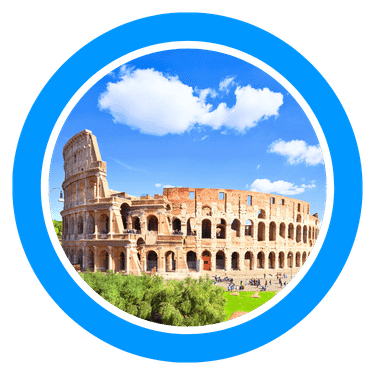
The walk ends facing the Colosseum, completed around 80 AD to host gladiatorial contests and public spectacles for tens of thousands of spectators at a time. The tour does not go inside, but seeing its full exterior arcade up close, after walking through the Forum that once sat in its shadow, puts the building in context rather than treating it as an isolated photo stop.
Tips to Enjoy the Free Walking Tour of Rome
- Wear real walking shoes. Much of central Rome is paved in sampietrini, the small uneven cobblestones that make flat sandals and stiff soles uncomfortable over two and a half hours.
- Bring a refillable bottle. Rome’s streets are dotted with nasoni, the small cast-iron drinking fountains that run constantly with free, drinkable water, so there’s no need to buy bottled water along the route.
- Arrive at Trajan’s Column a few minutes early. The meeting point sits among maritime pines and can be easy to walk past if you’re rushing, so give yourself a buffer before the start time.
- Dress for the season. Rome summers run hot with little shade along the Forum overlook, while spring and autumn are milder but can still bring sudden rain, so check the forecast the night before.
- Keep your electronic voucher on your phone. The tour is booked digitally, so having the confirmation ready to show avoids delays at the meeting point.
- Carry small cash for the tip. The tour runs on a pay-what-you-think-it’s-worth basis at the end, and cash is the simplest way to handle that on the street.
- Travel light. The route includes the climb up Capitoline Hill and uneven ground near the Forum overlook, so a heavy bag or awkward luggage will slow you down.
Interesting Facts About Rome
Rome is built on seven hills, but the walk only touches two of them directly, the Capitoline and the Palatine, which is enough to feel the difference in elevation that shaped how the ancient city was laid out. The Forum’s position in the low valley between these hills is exactly why it flooded regularly in antiquity before drainage systems like the Cloaca Maxima were built to control the Tiber’s overflow.
The Imperial Fora, including the one built around Trajan’s Column, were constructed because the original Roman Forum ran out of space for new monuments as the city and its administration grew. Each emperor who built one was, in part, making a statement: Trajan’s Forum was funded largely by the spoils of his Dacian campaigns, which is what the column’s spiral carving actually documents in sequence from base to top.
The Colosseum’s original name was the Flavian Amphitheatre, after the Flavian dynasty of emperors who built it. The nickname “Colosseum” likely comes not from its own size but from a colossal bronze statue of Nero that once stood nearby, long after Nero himself had fallen out of favor and the statue had been reworked to represent the sun god instead.
Frequently Asked Questions
Where do I meet my guide for the Rome free tour?
Under the maritime pines next to Trajan’s Column, at the edge of the Imperial Fora area.
How long does the free walking tour of Rome last?
Two hours and thirty minutes, covering the route from Trajan’s Column to the exterior of the Colosseum.
What language is the tour conducted in?
English. The guide leads the entire walk in English, with no other language option on this particular tour.
Do I pay anything before the tour, or how does the tip work?
Booking secures your spot at no upfront cost. At the end of the walk, you decide how much to tip the guide based on what you thought the tour was worth.
Is the tour accessible for people with reduced mobility?
No. The route includes uneven cobblestones, a hill climb, and standing viewpoints that are not adapted for wheelchairs or limited mobility.
Can I bring my pet on the tour?
No, pets are not allowed on this tour.
How many people join each group?
Group sizes vary by date and season. Booking early tends to mean a smaller, quieter group.
Where does the tour end?
The walk finishes at the exterior of the Colosseum. The tour does not include entry, so plan separately if you want to go inside.
Popular Activities in Rome
More Tours in Rome
St. Peter’s Basilica

Castel Sant’Angelo
Colosseum
