

This Ancient Rome tour lasts between 2 hours 30 minutes and 3 hours, runs in English, begins at the Via dei Fori Imperiali exit of Colosseo metro station and finishes on Via dei Fori Imperiali after visiting the Colosseum, Palatine Hill and Roman Forum. Admission to all three archaeological sites is included, allowing you to follow the development of Rome from its legendary beginnings to the public spectacles and political institutions of the imperial city.
The experience begins with entry to the Colosseum, where the guide explains the amphitheatre’s construction, seating system and role in Roman public life. The route then continues to Palatine Hill, traditionally associated with the foundation of Rome and later occupied by the residences of emperors. From its elevated sections, you can observe how the hill relates geographically to the Roman Forum and Circus Maximus.
The final part of the tour crosses the Roman Forum along the Via Sacra. Among the remains identified during this section are the Temple of Saturn, the Arch of Titus, the House of the Vestals and other structures connected with religion, government and civic ceremonies. The order of the three sites may change according to the entry time assigned by the Colosseum, but the activity retains admission to each of them.
This product includes standard admission rather than access to the arena floor, underground chambers or other restricted sectors. Tickets are personal and non-transferable, so every participant’s full name must match the passport or official identification presented at the entrance. Due to the monument’s capacity controls, the starting time can be moved by as much as three hours. Keeping the surrounding part of the day flexible is therefore essential when planning this visit.
Ancient Rome Tour Itinerary
Meeting at Colosseo Metro Station
The meeting point is at the Via dei Fori Imperiali exit of Colosseo metro station. This detail matters because the station has more than one possible exit and the surrounding area can become crowded. Arriving at least 15 minutes early provides enough time to find the guide, confirm the booking and complete any preliminary checks.
Before leaving for the tour, verify the final starting time in your most recent confirmation. The Colosseum controls access through a timed ticketing system, and the activity provider may move the original departure by up to three hours. If a change affects your reservation, you will be contacted using the details entered during booking.
Guided Visit Inside the Colosseum
The Colosseum is normally the first major site, although the itinerary can be rearranged for organisational reasons. Once inside, the guide introduces the amphitheatre’s dimensions, the arrangement of its stands and the ways in which spectators were separated according to status.
Construction began under Emperor Vespasian and the amphitheatre was inaugurated under Titus in AD 80. It hosted gladiatorial combats, animal hunts, executions and other forms of organised spectacle. These events combined entertainment with political communication, allowing emperors to address large crowds through carefully staged public displays.
From the standard visitor areas, you can see the arena and the exposed structures of the hypogeum below it. The hypogeum contained corridors, holding spaces and mechanisms used to move participants, animals and scenery. This tour explains those areas from the accessible visitor route but does not include entry to the underground chambers or arena floor.
Palatine Hill and Imperial Residences
The tour continues to Palatine Hill, the central member of Rome’s traditional seven hills. Archaeological evidence shows that people lived here long before the imperial period, while Roman tradition identified it as the setting where Romulus founded the city.
During the Republic, the hill became a prestigious residential area. Under the emperors, increasingly large palace complexes occupied its slopes and summit. The word “palace” itself ultimately derives from the Latin name of the hill, reflecting the close association between this location and imperial authority.
From the accessible viewpoints, the landscape helps clarify the relationship between the emperors’ residences, the Roman Forum and Circus Maximus. The precise buildings and viewpoints covered can depend on the route used that day, site closures and the order assigned to the group.
Roman Forum and the Via Sacra
The Roman Forum was not designed as one unified monument. It developed over centuries as temples, basilicas, commemorative arches and political buildings accumulated around an important public space. This gradual development explains why structures from different periods now stand close together.
The guided route follows sections of the Via Sacra, the ceremonial road used for religious events and triumphal processions. The guide identifies important remains and explains how political assemblies, judicial activity, worship and public commemoration shared the same urban setting.
The tour finishes after approximately 2 hours 30 minutes to 3 hours on Via dei Fori Imperiali. From there, it is possible to continue walking towards Piazza Venezia, the Capitoline Hill or the Monti district without returning to the original metro entrance.
What You Will See in the Archaeological Area
The Colosseum
The Flavian Amphitheatre could accommodate tens of thousands of spectators and used a complex system of numbered entrances, passageways and seating sectors to control movement. Its architecture reveals how Roman engineering was applied to public entertainment on an unprecedented scale.
The surviving stands and internal corridors allow the guide to explain what different spectators would have seen and how access reflected Roman social hierarchy. Although much of the original decoration disappeared over time, the structure still communicates the scale and organisation of imperial spectacles.
The Temple of Saturn
The remaining columns of the Temple of Saturn form one of the most recognisable silhouettes in the Forum. The building had religious importance but was also connected with the public treasury, showing how finance, government and worship overlapped in Roman civic life.
The Arch of Titus
This triumphal arch commemorates the Flavian victory in Jerusalem. Reliefs inside the passage show spoils being carried in procession, including a seven-branched menorah. The monument provides a concrete example of how military campaigns were transformed into public images of imperial legitimacy.
The House of the Vestals
The remains of the House of the Vestals stand beside the Temple of Vesta. The Vestal Virgins maintained the sacred fire associated with Rome’s continuity and occupied an exceptional religious position. Their residence, courtyard and surviving statues help explain the institutional role of priesthoods within the Roman state.
Views of the Roman Forum and Circus Maximus
The higher parts of Palatine Hill provide a broader reading of the archaeological landscape. The views show how imperial residences stood between the Forum, the political and ceremonial center, and Circus Maximus, the vast venue used for chariot racing and public events.
Access to individual viewpoints can change because the archaeological park is an active conservation site. The tour guarantees the three principal attractions rather than every minor structure or terrace within them.
What Is Included and Which Areas Are Excluded
Admission to Three Archaeological Sites
The reservation includes admission to the Colosseum, Roman Forum and Palatine Hill. These three sites form a connected archaeological itinerary, although security controls and the sequence assigned to the group can affect how the visit progresses.
English-Speaking Guide
An English-speaking guide accompanies the group through the monuments and explains their historical relationship. The guided format is particularly useful in the Forum, where isolated foundations and columns can be difficult to interpret without a reconstruction of the original buildings and their functions.
Standard Colosseum Access
This activity does not include the arena floor, the underground level or other restricted sectors of the Colosseum. Travellers specifically seeking gladiator-gate entry or underground access should not assume that those areas form part of the standard ticket.
Personal and Non-Transferable Tickets
Each ticket is issued for a named participant. The first and last names entered in the reservation must match the identification carried on the day. Incorrect spelling, missing surnames or the use of a nickname can result in refused admission.
Names cannot be changed after the tickets have been issued, and another person cannot use the reservation. Every participant should therefore check the booking details carefully before completing payment.
Practical Advice for Visiting Ancient Rome
- Carry valid identification: bring the passport or official ID matching the full name entered in the reservation. A discrepancy may prevent admission.
- Keep the day flexible: the assigned departure can move by up to three hours due to the Colosseum’s capacity limits and ticketing system.
- Arrive early: be at the Via dei Fori Imperiali exit of Colosseo station at least 15 minutes before the confirmed starting time.
- Wear supportive shoes: the Forum and Palatine Hill contain slopes, worn stone and uneven archaeological surfaces.
- Bring water and sun protection: substantial portions of the route are outdoors and have limited shade, particularly on Palatine Hill.
- Avoid bulky luggage: all visitors pass through security controls, and large items can complicate or prevent access.
- Travel light: the route covers three large archaeological areas and involves prolonged walking, steps and changes in elevation.
- Check the weather: use a light waterproof layer when rain is forecast, but avoid large umbrellas that are difficult to manage in crowded areas.
- Review the cancellation deadline: cancellation is free until five days before the activity. Later cancellations and no-shows are not refunded.
The complete route is not suitable for people with reduced mobility or for pushchairs and strollers. Pets are also not permitted. Children under 18 may participate when accompanied by an adult, but reservations cannot include more than 10 minors for each accompanying adult.
During periods of extreme heat, the itinerary may be adjusted for safety. Any operational change communicated by the provider should take precedence over the general route described here.
Frequently Asked Questions
How Long Does the Ancient Rome Tour Last?
The guided visit lasts between approximately 2 hours 30 minutes and 3 hours. The precise duration can depend on security checks, crowd movement and the itinerary order assigned that day.
Where Does the Tour Start and Finish?
The group meets at the Via dei Fori Imperiali exit of Colosseo metro station. The activity finishes on Via dei Fori Imperiali.
Does the Tour Include Admission Tickets?
Yes. Admission to the Colosseum, Roman Forum and Palatine Hill is included together with the guided service in English.
Does It Include the Arena or Underground Chambers?
No. This version includes standard Colosseum admission. It does not provide access to the arena floor, hypogeum or other restricted sectors.
Can the Starting Time Change?
Yes. The starting time can be moved by up to three hours because of the official capacity limits and ticket allocation system. Affected travellers are contacted before the activity.
Do I Need to Bring Identification?
Yes. Each participant must present a passport or official ID showing the same first and last names entered during booking. The tickets are nominative and non-transferable.
Is the Tour Accessible?
No. The complete itinerary is not suitable for people with reduced mobility or for pushchairs and strollers because it includes uneven surfaces, slopes and steps.
Can Children Participate?
Yes. Children under 18 must remain accompanied by an adult. Each adult can be responsible for no more than 10 children within the same reservation.
Are Pets Allowed?
No. Pets are not permitted during this activity.
What Is the Cancellation Policy?
Cancellation is free until five days before the activity. Cancellations made after that deadline and failure to attend are not refunded.
More Tours in Rome

Castel Sant’Angelo

Rome
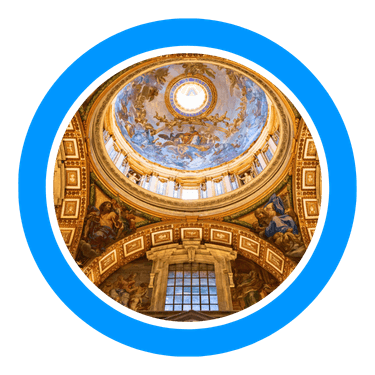
St. Peter’s Basilica
