


More than 40 kilograms of gold were used in the decoration of the Hungarian Parliament, yet the building was finished just as the political world that commissioned it was beginning to crack. Opened in 1902 after the great boom years of the Austro-Hungarian period, it was designed to project confidence on the Danube at a moment when Hungary wanted to present itself as equal to Vienna, not subordinate to it.
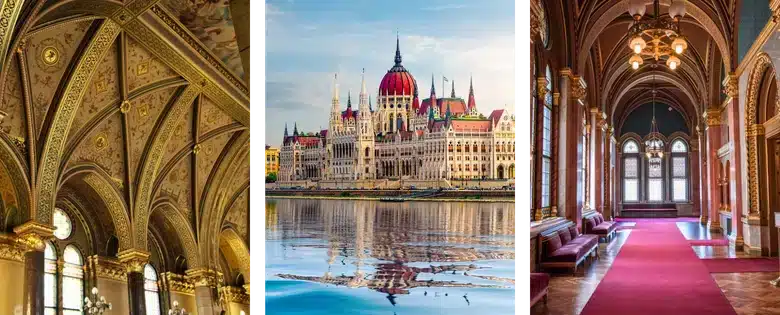
Seen from across the river, the Parliament looks like a fantasy in stone. Up close, it is more interesting than that. The building is part royal theatre, part national shrine, part working legislature, and visiting it makes more sense when you understand that all three roles still shape how people move through it today.
1. Book Your Ticket in Advance
Timed-entry tickets regularly sell out, especially from late spring to early autumn and around Christmas. The standard route is a guided visit of around 45 minutes, and entry is organised in language slots rather than as a free-flow visit.
Buy ahead through the official booking system if you know your date, because turning up on Kossuth Lajos tér and hoping for a same-day place often ends in a long wait or no entry at all. If you also want wider city context before stepping inside, a Budapest Guided Tour + Parliament can be a practical option, since it combines the building with the surrounding political and historic landmarks instead of treating the visit as an isolated interior stop.
Budapest Guided Tour + Parliament
Guided Tour in English · Local Guide · Free Cancellation
⭐ 8.0/10 · 2,849 reviews
That controlled system is not only about crowd management. Parliament is still a functioning seat of government, so public access has always been negotiated around state business, protocol and security. Visitors are entering a symbolic political space, not a museum that happens to occupy an old palace.
2. Allow Time for Security Checks
Give yourself at least 20 to 30 minutes before your slot, particularly in peak season. Security screening is airport-style, with bag checks and metal detectors, and queues can build quickly on the square outside. Bring photo ID as well, because staff may ask to see it alongside your ticket.
Standing in line here is part of the odd modern reality of the place. The Neo-Gothic façade suggests a 19th-century monument, but the building also carries the routines of a present-day parliament under tight protection. That contrast between ceremonial architecture and practical state security is part of what makes the visit feel different from a standard heritage site.
3. Follow the Crown Route Closely
The highlight for most visitors is the dome hall, where the Hungarian Holy Crown is displayed under guard. Tours move briskly, so pay attention when you enter this section and keep your phone away if photography restrictions are in force. You will not have much time to linger, and the route through the grand staircase, main hall and cupola is designed to funnel you towards the crown as the symbolic centre of the visit.
For Hungarians, the crown is not just old regalia. Under the doctrine of the Holy Crown, it came to represent the continuity of the Hungarian state itself rather than merely the authority of a ruler, which helps explain why it sits in Parliament and not in a palace treasury. That is also why the mood shifts in the dome hall, becoming quieter and more formal than in the decorative corridors leading up to it.
4. View the Building From Across the Danube
Before or after your visit, cross to the Buda side and look back from Batthyány tér or the embankment nearby. Morning light usually works best for the façade facing Pest, and from that distance you can read the full symmetry of the building in a way that is impossible from the square directly in front. The river view also helps you understand how Parliament was meant to dominate the city skyline.
Architect Imre Steindl was already losing his eyesight while the building was being completed, a detail that gives the finished riverside composition an oddly poignant edge. The long frontage, the central dome and the dense line of spires were planned as a national statement at a time when Budapest was trying to prove itself as more than the junior partner to Vienna. It is easier to grasp that ambition once you stop looking at carvings and start looking at scale.
5. Continue Into Kossuth Lajos Tér
Do not rush off as soon as the tour ends. Kossuth Lajos tér, the square in front of Parliament, has been carefully reconstructed and is worth walking properly, including the memorials and the view towards the Ministry of Agriculture and the Museum of Ethnography. The nearby Shoes on the Danube Bank memorial is only a short walk south along the river and changes the tone of the area completely.
That surrounding landscape tells a harder story than the polished interiors. The square is tied to one of the most contested episodes of the 1956 uprising, when gunfire and panic turned the parliamentary forecourt into a site of national trauma. Seeing the square and riverbank in the same visit makes the building feel less isolated and far more honest.
Read the Red Star Scars on Kossuth Lajos Tér
One of the least obvious things about the Parliament area is how often it has been physically rewritten. Under state socialism, the square in front of the building was used for mass ceremonies that tried to fold a pre-1914 national monument into a communist capital. After 1989, and especially in the 2010s, the space was reshaped again to resemble more closely its appearance before the Second World War, part urban planning, part argument about memory.
Locals still read the area through dates that casual visitors miss. The 1956 uprising is one of them, because shootings on and around Kossuth Lajos tér left the square etched into national memory as more than a ceremonial forecourt. That is why the district can feel unusually tense and formal even on a calm afternoon. It is not just monumental architecture by the river. It is a place where Hungary keeps revisiting its own version of legitimacy.
Walk On From the Dome to the Riverbank
After Parliament, the best next step is to stay in District V and keep walking, because this part of Pest reveals itself in layers rather than headline sights. Joining a free tour of Budapest works well here, especially if you want the route from Kossuth Lajos tér to the Danube memorials, St Stephen’s Basilica and the older streets behind Szabadság tér to make historical sense.
Once you have seen the building as a stage for power rather than a postcard, the city around it starts to look different too. That helps when choosing between traditional food in Budapest, sorting through the best of Budapest, or narrowing down the many things to do in Budapest, because the grandest places are often the ones carrying the heaviest arguments. From across the Danube, Parliament still reads as a perfect statement in stone. After walking its halls and then returning to the river, it looks more like what it always was: confidence built at the edge of uncertainty.
