


Quito makes more sense when you stop looking only at monuments and start noticing gradients. At 2,850 meters, streets tilt, clouds move fast, and whole neighborhoods seem arranged by the logic of a long narrow basin rather than by tidy urban planning. The city’s historic center was inscribed on UNESCO’s first World Heritage list in 1978, but what stays with you is not just preservation. It is how a capital still negotiates altitude, politics, religion, migration, and daily trade in the same few square kilometers.
If you want to understand Quito without spending much, these are the free or low-cost places that do real work. They show how the capital thinks, not just how it poses.
1. Join a Free Tour of Quito
A free tour of Quito usually works on a pay-what-you-want basis, so the cost is up to you at the end. It is one of the simplest ways to connect the historic center’s pieces without flattening them into trivia. Good routes commonly pass through Plaza Grande, the area around the Palacio de Carondelet and Catedral Metropolitana, San Francisco, La Compañía, Calle García Moreno, and La Ronda, with context on colonial power, religious orders, independence, and how present-day politics still shape the center.
Take the tour after you have already walked at least one or two of these places on your own. Quito rewards a little prior confusion. The guide can then help order what you have seen instead of replacing your first impressions with a script.
2. Walk Plaza Grande
This is Quito’s political and symbolic center, framed by the Palacio de Carondelet, the Catedral Metropolitana, the Palacio Arzobispal, and the Municipio. What makes it more than a postcard stop is how much state ceremony still happens here, from changing-of-the-guard events to public demonstrations that use the square as a pressure valve. In the middle stands the Monumento a la Independencia, inaugurated in 1906, and many people miss that the condor at the top is tearing apart a lion, a blunt allegory of Spanish rule.
Go slowly around the edges instead of cutting straight across. Early morning is best if you want cleaner light, fewer crowds, and a better look at the carved balconies and republican facades, while midday gives you more of the actual square, shoe-shiners, office workers, police presence, political conversations, and the low-key theater of a capital at work.
3. Climb El Panecillo
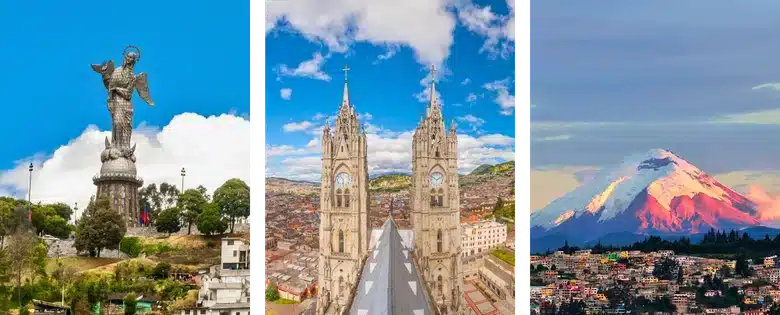
Admission to the hill itself is free, though entering the Virgen de Quito monument is paid. El Panecillo is the rounded hill between the historic center and the south of the city, and from up here Quito’s geography finally stops being abstract. The aluminum statue at the summit is based on Bernardo de Legarda’s 1734 sculpture of the Virgin of the Apocalypse, a distinctly Quiteño image from the Escuela Quiteña, and its wings are not a decorative flourish. They are part of the original iconography that made this Virgin unusually dynamic by colonial standards.
Head up for late afternoon, when the light stretches over the old center and the northern districts. This is one of the few places where you can read the city as a long compressed strip between mountains instead of a checklist of attractions. Bring a layer because the wind can turn sharp fast.
4. Explore La Ronda
This narrow street, officially Calle Juan de Dios Morales, is one of the rare places in central Quito where restoration did not fully erase the memory of ordinary urban life. Long before it became a standard evening stop, it was associated with artisans, guitar makers, small taverns, and writers. The area also sits near the old quebrada routes that once cut through Quito, which helps explain why this part of the center developed differently from the more ceremonial streets around Plaza Grande. The name La Ronda comes from the night patrol that used to pass through here.
Come in late afternoon if you want to see balconies and doorways properly, then stay into the evening when the lane starts to fill. The street can feel a little polished for visitors, but it is still worth reading past the souvenir layer and looking for workshops, inner courtyards, and traces of the older neighborhood structure that survived the 20th century unevenly.
5. Circle the Basílica del Voto Nacional
Walking around the outside is free, while tower and interior access is paid. This is one of Quito’s strangest buildings, and better from the street than many people admit. Its neo-Gothic design borrows European forms, but the stone fauna is Ecuadorian, with gargoyle substitutes such as armadillos, marine iguanas, tortoises, and frigatebirds. The project was tied to Ecuador’s consecration to the Sacred Heart in the late 19th century, and the persistent local saying that the republic will end when the basilica is finished tells you something about how Quito mixes piety with political superstition.
Circle it instead of just photographing the facade. From the steeper surrounding streets, especially toward the San Juan side, the buttresses and vertical scale make more sense. This is one of those places where paying to go up is optional. The exterior already does the argumentative work of showing how Quito tried to turn religion into nation-building.
6. Browse Mercado Central
Entry is free, and this is one of the clearest windows into everyday Quito. Mercado Central is where office workers, families, and longtime residents come for herbs, soups, juices, and low-cost lunches. What matters here is not only the food but the medicinal and ritual economy running beside it. In the herb section, vendors sell plants used for limpias, cleansing rites that combine Catholic invocations with Andean healing practice, a blend that says more about Quito than any polished museum label.
Arrive in the morning when the produce is at its best and the food counters are already in rhythm. Order a juice or a caldo if you want to participate rather than hover with a camera. Quito can sometimes feel staged for outsiders in its prettiest corners. The market corrects that fast.
7. Step into Casa de las Artes La Ronda
Admission is usually free, though temporary events can vary. Inside the La Ronda area, this cultural space is worth your time precisely because it resists the idea that the street should function only as a restored colonial backdrop. Programming often includes exhibitions, workshops, music, and community events, and that matters in a part of Quito where heritage can easily slide into theater.
Check the schedule the day you go because activity varies. Mid-afternoon is a good time to stop in before the street outside gets louder. If La Ronda feels too curated at first glance, this is one of the places that gives it back some substance.
8. Look Out from Parque Itchimbía
Entry to the park is free. Itchimbía gives you one of the broadest views over Quito, but the hill is not only about the panorama. It was once known for archaeological finds linked to pre-Hispanic occupation, and its current identity layers that older ground with the iron-and-glass structure often called the Palacio de Cristal. The building itself has had a wandering history in Quito and reflects the city’s late 19th- and early 20th-century fascination with imported industrial materials and exhibition architecture.
Come near sunset if the weather is clear. From here, the city’s length becomes obvious, as does the imbalance between the compact historic center and the sprawl pushing north and south. It is one of the best places to grasp that Quito is less a neat capital than a settlement continually negotiating steep terrain.
9. Enter Museo Camilo Egas
Admission is free. Set in a colonial house in the historic center, this small museum focuses on Camilo Egas, one of Ecuador’s key 20th-century painters. His career moved from indigenismo to social realism and then toward more experimental work in the United States, and that arc matters because it exposes a tension Ecuador has never fully resolved: whether Indigenous life is treated as a living political reality or as material for national aesthetics. The museum handles that debate better than many larger institutions.
Give yourself time to read the wall texts because the context is the point. Late morning is usually calm, and the courtyard is worth a pause for its own sake. If you only have energy for one small museum in the center, make it this one rather than a more decorative stop.
10. Trace Street Art in La Floresta
Walking the neighborhood is free. La Floresta has been one of Quito’s cultural districts for years, but what sets it apart is that the murals and posters here are embedded in a lived-in neighborhood of older houses, schools, bars, and independent venues, not isolated in a sanitized art corridor. Look around streets such as Valladolid, Guipúzcoa, and the area near Cine Ocho y Medio, where public walls often register political moods, feminist demands, environmental messaging, and neighborhood identity faster than formal institutions do.
Start in the afternoon when the sidewalks are active and the light still works for photos. Pay attention to side streets and temporary paste-ups, not only the biggest commissioned walls. In Quito, the smaller and more perishable pieces often tell you more than the mural everyone already knows.
Read Quito from the Slopes Below Pichincha
From street level, Quito can feel fragmented, a ceremonial square here, a market there, an artisan lane a few blocks away, all compressed by altitude and traffic. But that long basin, with Pichincha pressing from the west and hills like El Panecillo and Itchimbía interrupting the grid, explains nearly everything. The city never had the luxury of spreading evenly.
That is why the best free experiences here are not the ones that simply save money. They are the ones that teach you how Quito holds together under pressure, with politics in Plaza Grande, ritual in Mercado Central, restoration in La Ronda, and lookout points that keep reminding you the terrain is still in charge.