

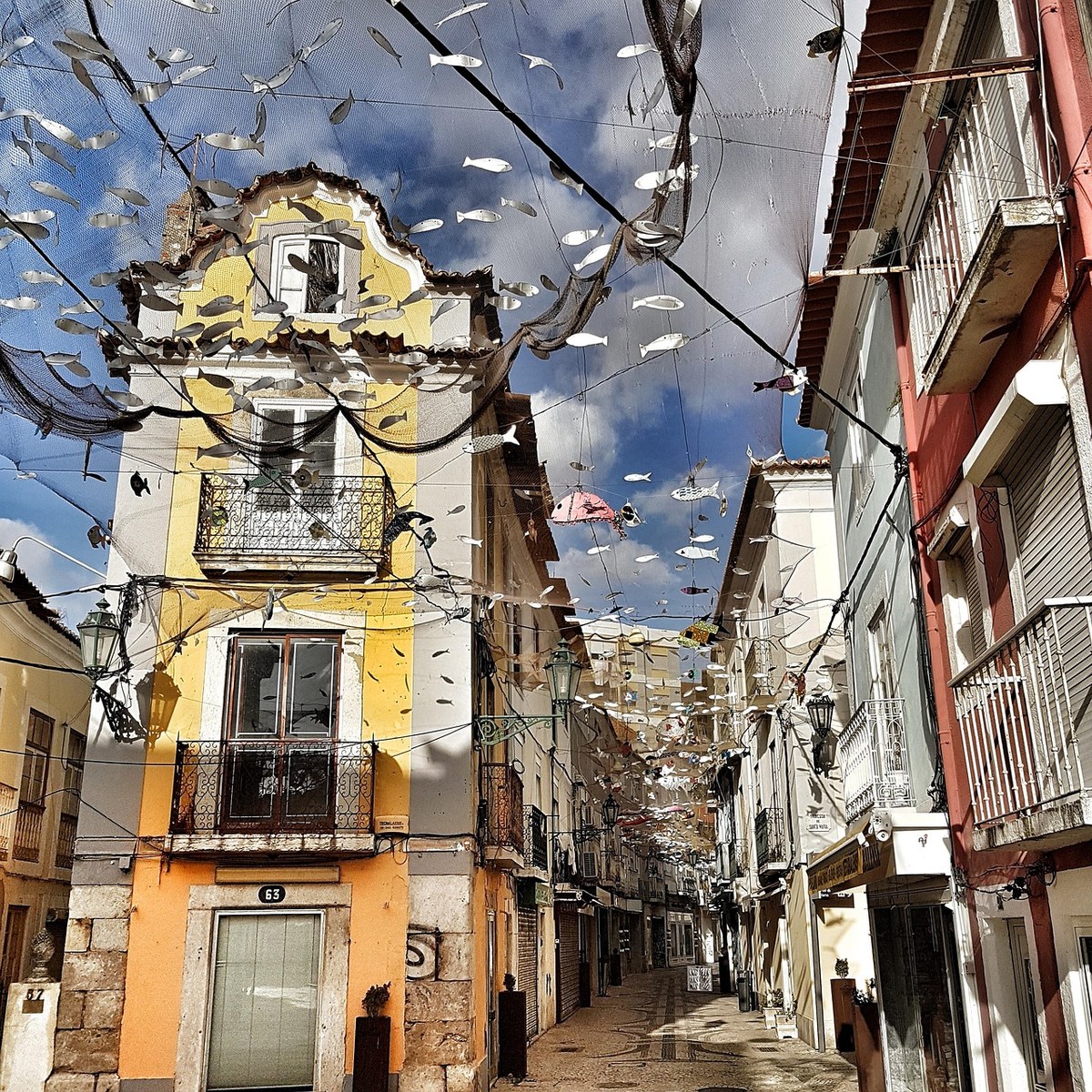
Free walking tour
Free Tour of Setúbal
Choose your date
Free to book, tip the guide at the end. GuruWalk confirms availability and the booking on its website.
Long before package tourism reached the Sado estuary, this coast was already organised around fish, salt and river traffic. In Roman times, Cetóbriga developed here as an urban and industrial centre linked to fish salting, and by 1339 Setúbal was producing more salt than it needed locally. That commercial past still explains much of the city today: a port-facing town whose old centre, market life and civic spaces grew out of work on the river.
This free walk focuses on the parts of Setúbal that best reveal that story. Highlights include the São Domingos viewpoint above the old centre, the Historic Portal of Setúbal in the medieval wall, the Cathedral of Santa Maria da Graça, Bocage Square and Jesus Square with the Church of the Convent of Jesus. You will also pass through downtown streets, see Mercado do Livramento, finish by the Busto de Luisa Todi and hear about places that are easy to overlook without local context.
The tour lasts 1 hour 30 minutes and is led in English by a local guide. You meet at Miradouro de São Sebastião and finish at the Busto de Luisa Todi. It includes a guided walking tour. Entry tickets and additional expenses are not included.
What You’ll See on the Free Tour of Setúbal
São Domingos Viewpoint
From the viewpoint near Setúbal’s historic centre, you get a quick read on the geography that shaped the city. The outlook covers the centre, the port and the Sado River, with views extending towards Arrábida. It is the right place to notice how closely urban life, maritime work and the surrounding landscape still sit together.
Historic Portal of Setúbal
The Historic Portal of Setúbal is Porta do Sol, also known as Porta da Moura Encantada. It is one of the surviving gates from the 14th-century medieval wall and still preserves a Gothic profile. This makes it one of the clearest physical traces of the fortified town and one of the best places to picture how access to medieval Setúbal was once controlled.
Cathedral of Santa Maria da Graça
The Church of Santa Maria da Graça began in the 13th century in Romanesque-Gothic style and was rebuilt in the 16th century to a design by the royal architect António Rodrigues. It became Setúbal Cathedral in 1975, when the Diocese of Setúbal was created. If you later visit independently, look for the 17th- and 18th-century gilded retables and the 18th-century frescoes on the Tuscan columns of the nave.
Misericórdia Square and the Old Centre
Largo da Misericórdia helps explain how the old town developed around overlapping civic, religious and defensive spaces. Its stairway area is protected together with Setúbal’s historic walls and bastions, so this is not just another square but part of the former fortification zone. Around it, the downtown streets show the layered character that local tourism associates with the city, from early settlement through to the modern townscape. The Portuguese cobblestone paving is part of that heritage in its own right.
Bocage Square
Bocage Square is the civic heart of Setúbal and one of the city’s everyday meeting points. The space was formerly called Praça do Sapal, was remodelled on the order of King João II, and the monument to the poet Bocage was inaugurated there on 21 December 1871. City Hall is also here, so the square brings together administration, memory and daily urban life.
Jesus Square and the Church of the Convent of Jesus
The Convent and Church of Jesus matter well beyond Setúbal because they are treated as landmarks in Portuguese architectural history. They mark the beginning of the Manueline style, one of Portugal’s defining late Gothic forms. This stop helps place Setúbal within a national story of art and architecture rather than only a local one.
Mercado do Livramento and Luísa Todi
Mercado do Livramento is more than a working fish market. The building is notable for its Art Deco design and for the large historic azulejo panels inside, which means everyday trade unfolds in one of the city’s most distinctive interiors. The route ends at the Busto de Luisa Todi, linking the market area back to Setúbal’s civic memory. Along the way, the guide also points out lesser-known places that many visitors would miss on their own.
History and Curiosities of Setúbal
From Prehistory to a Salt and Fish Town
Human occupation in the Setúbal area goes back to prehistory, with traces from the Neolithic onward. In Roman times, Cetóbriga developed on the Sado as an urban and industrial centre linked to fish salting, extending across both banks of the river towards Tróia. A first documented reference to Setúbal itself dates to 1235, when it was described as a small fishing village on the Sado. By 1339, salt had become important enough for its revenues to be disputed by the Crown and the Order of Santiago.
The Port and the Age of Expansion
Setúbal played a direct part in Portugal’s expansion period. In 1458, King Afonso V sailed from its port for the conquest of Alcácer Ceguer, showing that this was a strategically useful harbour as well as a local fishing town. Another major change came in 1525, when a new economic and social cycle began with large-scale salt production and trade. That growth helps explain the prominence of religious, civic and defensive spaces in and around the old centre.
Legends, Earthquakes and Seafarers at Santa Maria da Graça
Some of Setúbal’s most revealing details are attached to familiar monuments. Porta do Sol’s alternative name, Porta da Moura Encantada, preserves a legendary echo beside its military function. At Santa Maria da Graça, one side chapel is dedicated to Saint Peter Gonçalves, known as Santelmo, patron of Setúbal’s oldest confraternity of seafarers, founded in 1340. The 1755 earthquake spared most of the church, damaging mainly the tops of the towers and an outer wall of the tribune, both rebuilt later in the same century.
Bocage and the City’s Civic Memory
Bocage is not just a statue in a square but a figure built into Setúbal’s public identity. The current monument was paid for by public subscriptions raised in both Brazil and Setúbal, which says a great deal about the poet’s reach. Before the square took his name, it was also known as Praça das Couves because a vegetable market was held there. Today, 15 September, Bocage’s birthday, is a municipal holiday marked with music, exhibitions, theatre and community activities.
Local Life, Traditions and Food in Setúbal
A City Shaped by the Sado
Setúbal’s character still comes from centuries of fishing, salt production, trade and port activity. Local records describe fishermen and seafarers as an affluent class in the medieval town, and the river shaped work patterns that included naval carpentry as well as commerce. Later, the canning boom, whose story you can follow on a sardine and market walking tour, changed everyday life again by attracting workers from other parts of Portugal, especially Aveiro and the Algarve. That history helps explain why the historic centre still functions as the city’s practical social core and why Bocage Square remains such an active meeting place.
Manueline Heritage and Civic Traditions
The Convent of Jesus is a key site for understanding Manueline architecture, and that alone gives Setúbal a firm place in the wider story of Portuguese art. The cathedral adds another layer, with its gilded retables and frescoes showing how later centuries marked older structures. Civic traditions matter just as much here: Bocage remains central to local identity, and the September commemorations around his birthday connect literature, municipal history and community life.
What to Eat and Drink After the Tour
The traditional food of Setúbal starts with choco frito, the city’s signature dish. It is made from strips of cuttlefish coated in flour and egg, then fried in olive oil or peanut oil, usually served with fries, lettuce, lemon and often bean rice on the side; our guide to the traditional food of Setúbal covers it and the rest of the local table. Grilled fish is another local reference point, which makes sense in a city whose food culture is rooted in the Sado and in the long importance of fishing and salt. If you drink wine, Moscatel de Setúbal and Moscatel Roxo de Setúbal are the names to know, both protected under the D.O. Setúbal denomination. Oysters are another recognised product of Setúbal Bay.
Tips for the Free Walking Tour of Setúbal
- Wear comfortable shoes with good grip, because the historic centre has Portuguese cobblestones and some uneven surfaces, especially around older squares and stair areas.
- If possible, pair the walk with market time and lunch, since Mercado do Livramento and the city’s fish-based food culture make most sense when daily trade is active.
- Bring a camera or free space on your phone before you start, because the upper viewpoint helps you understand the city layout and gives context for the rest of the route.
- After the tour, start with the local basics: choco frito if you want the best-known dish, and Moscatel de Setúbal if you want the city’s classic wine style.
- The guided walking tour lasts 1 hour 30 minutes, starts at Miradouro de São Sebastião, ends at the Busto de Luisa Todi, is conducted in English by a local guide, is suitable for people with reduced mobility, allows pets, does not accept large group bookings, and can be cancelled free of charge if you cannot attend.
Frequently Asked Questions
What Is the Meeting Point for the Free Tour of Setúbal?
You meet at Miradouro de São Sebastião in Setúbal.
What Route Does the Free Tour of Setúbal Follow?
The walk includes the São Domingos viewpoint, the Historic Portal of Setúbal, the Church of Santa Maria da Graça, Misericórdia Square, downtown streets, Bocage Square, Jesus Square and the Church of the Convent of Jesus, Mercado do Livramento, the Busto de Luisa Todi and lesser-known places.
How Much Time Should I Set Aside for the Free Tour of Setúbal?
Set aside 1 hour 30 minutes for the tour itself.
Is the Free Tour of Setúbal in English?
Yes. The tour is conducted in English and led by a local guide.
Where Does the Free Tour of Setúbal Finish?
The tour finishes at the Busto de Luisa Todi.
What Is Setúbal Known For?
It is known for its fishing and salt history, the Sado estuary, the Convent of Jesus, Moscatel de Setúbal and the local dish choco frito.
Is Setúbal Worth Visiting?
Yes if you want a compact historic centre, working market life, strong food traditions and access to the Sado estuary and Arrábida landscapes in one place.
How Long Should I Stay in Setúbal?
A day covers the historic centre and market, but an overnight stay makes more sense if you also want time for the bay, beaches or Arrábida surroundings.
Popular Activities in Portugal
Setúbal Sardine Tour

Free Tour of Lisbon

Free Tour of Belem
