
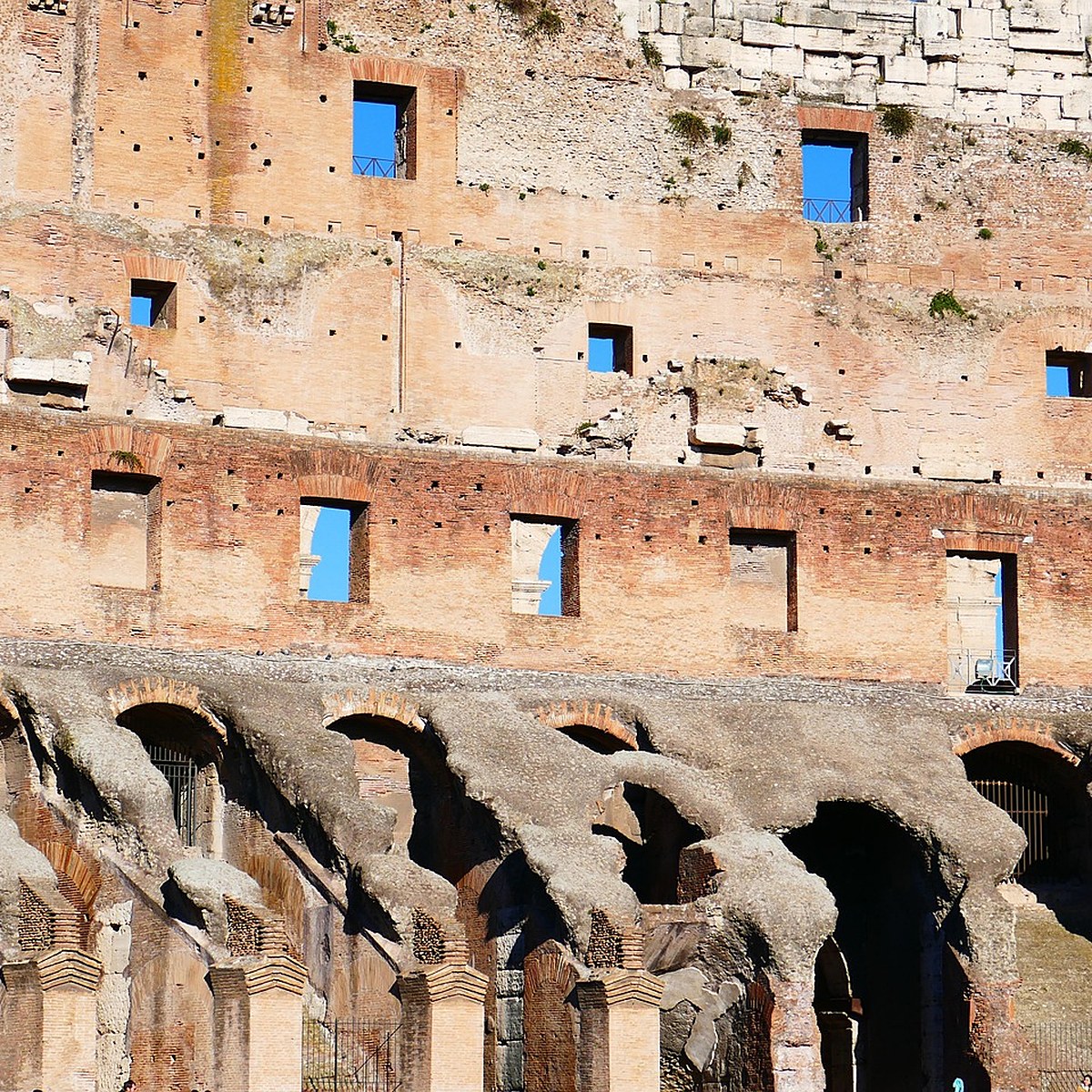

The Colosseum has holes all over its walls mainly because metal clamps were pried out of the stone after antiquity, leaving scars across the travertine. What looks at first like erosion or battle damage is mostly the result of deliberate stripping. The pitted surface belongs to the monument’s long afterlife as much as to its Roman past. Visitors interested in exploring this history up close can join a Colosseum Tour plus Gladiator’s Gate to discover the amphitheatre’s architecture and the stories behind its surviving structure.
When the amphitheatre was built under the Flavian emperors in the 1st century AD, its outer structure used huge blocks of travertine brought from the Tivoli area. About 100,000 tons of this stone were used, and the building was completed in AD 80 before being enlarged by Domitian. Those blocks were fitted with precision and joined without mortar. Instead, iron clamps, often secured with lead, tied the masonry together. The small cavities visible today mark the places where those metal fixings once sat inside the stone.
Later, after the Colosseum stopped functioning as an arena, earthquakes damaged the structure and helped turn it into a ruin and then a quarry. From the Middle Ages onward, people cut into the travertine to remove valuable metal and also carried off entire blocks for reuse elsewhere in Rome. If you see the monument as part of the wider ancient city rather than as an isolated ruin, the story becomes clearer, especially if you first take in the setting on a guided walk through central Rome.
How The Original Structure Worked
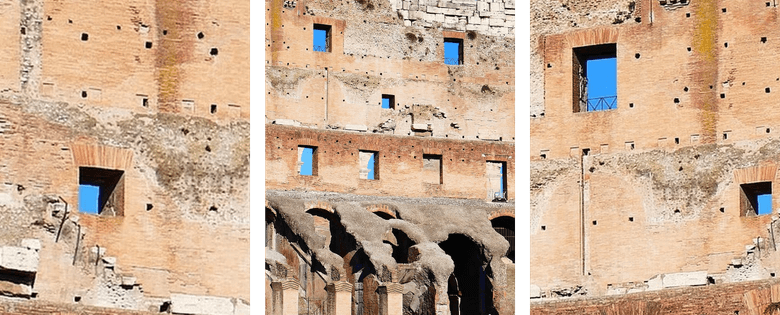
The holes make sense once you understand how the Colosseum was assembled. Its outer shell was built from large travertine blocks set tightly together without mortar. The strength of the wall did not depend on a paste binding the stones. It depended on precise cutting and on metal clamps inserted to fasten block to block.
Those clamps were usually iron, and lead could also be used around them. In practical terms, the metal acted as a hidden connector inside the masonry. When later generations wanted the metal, they had to cut into the surrounding stone to extract it. That process left repeated cavities across the surface, producing the pockmarked look you notice today.
This is why the holes are not signs of poor Roman construction. They are evidence of sophisticated engineering followed by later dismantling. If you are comparing the amphitheatre with the nearby ruins, the difference between the arena and its surroundings is easier to place after reading about how the Colosseum and Forum served different roles.
From Amphitheatre To Quarry
The Colosseum began as a state project of the Flavian dynasty, but its meaning changed drastically after antiquity. Once it was no longer used as an arena, the building entered a new phase shaped by neglect, collapse, salvage, and reuse. This is the period that produced much of the wall surface you see now.
Earthquakes played an important part in that change. They damaged the structure over time, and the great earthquake of 1349 is commonly treated as a major turning point. Collapses, especially on the south side, made the monument more vulnerable and more useful as a source of material. A damaged amphitheatre in the middle of Rome became a convenient place to quarry both stone and metal.
Workers did not just pick up loose fragments. They cut into hard travertine specifically to reach the clamps embedded in the joints. Lead associated with the fixings was also worth taking. Separate from this, entire travertine blocks were removed and reused in later buildings and palaces. The result is a monument that preserves Roman construction methods and the marks of centuries of extraction at the same time.
Myths And Reality
Several popular explanations miss the real cause of the holes. They were not made mainly by cannon fire, and they are not traces left by gladiators. Weathering has affected the monument, but it does not explain the pattern of small, repeated cavities spread across the surviving travertine blocks.
Another common simplification is to blame earthquakes alone. Seismic damage did cause major structural failures, but it did not create the dense field of little scars visible across the walls. The missing metal fixings explain that pattern much better. The pitted look comes from many acts of human extraction rather than from one natural disaster.
If you plan to examine the walls closely, it helps to avoid the usual planning errors that rush your visit. A quick look at common Colosseum visiting mistakes can make the details easier to notice once you are there.
Where You Can See The Scars Today
You can see these clamp scars at the Colosseum itself in Piazza del Colosseo, inside the Parco archeologico del Colosseo in central Rome. The monument stands within an archaeological park of more than 40 hectares that also includes the Roman Forum and Palatine area. The holes are therefore part of a much larger historic landscape, not an isolated curiosity on one famous façade.
On the surviving outer wall, the travertine still shows the cavities left by the removed fixings. On the southern side, two rings of the perimeter are missing. There, the presentation of the site marks the footprint of the lost ambulatories with travertine paving, helping you read the scale of what collapsed and what was later stripped away.
The Colosseum also forms part of the Historic Centre of Rome, included in the UNESCO World Heritage property first inscribed in 1980 and extended in 1990. If you want to focus on the amphitheatre and its immediate surroundings, a visit that combines the arena with the Forum and Palatine gives you the clearest view of how the building fits into ancient Rome.
Frequently Asked Questions
Are The Holes In The Colosseum Original?
They are original only in the sense that they mark the places where the original metal clamps once held the stonework together, but the visible cavities were created later when those clamps were removed.
Did Earthquakes Make All The Holes?
No. Earthquakes damaged the structure and caused collapses, but the small repeated holes in the travertine mostly come from people extracting metal fixings.
Were The Walls Built With Mortar?
No. The outer structure used precisely cut travertine blocks joined without mortar and fastened with metal clamps.
Did People Reuse Materials From The Colosseum?
Yes. Metal was taken from the joints, and whole travertine blocks were also removed for reuse in later buildings.
Is The South Side Missing Because Of The Same Process?
The major loss on the south side is linked to collapse after earthquake damage, while the pitted surface across surviving blocks comes mainly from clamp removal.
Where Exactly Can You See These Holes?
You can see them on the surviving travertine of the Colosseum at Piazza del Colosseo, within the Parco archeologico del Colosseo in central Rome.
